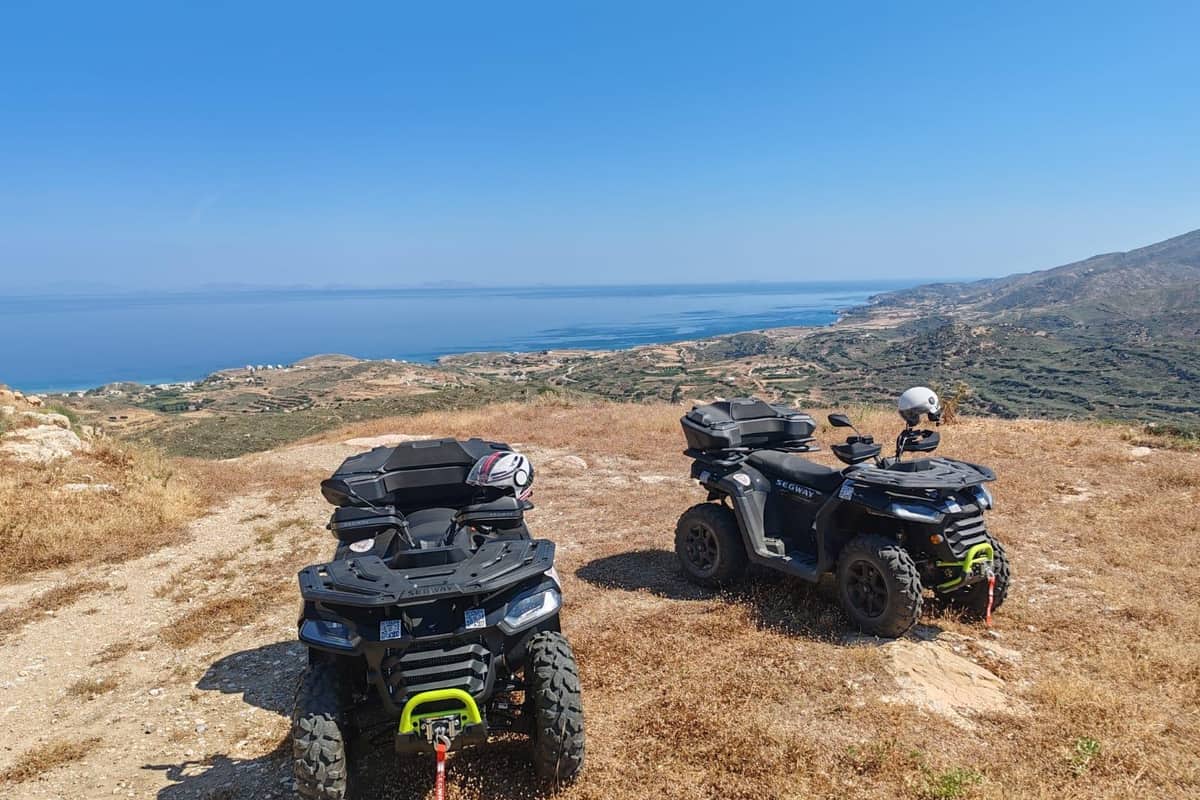
A Naxos ATV tour takes riders on quads across Naxos, in the Cyclades. Routes climb from the coast to marble villages and mountain roads. Rides follow a leader in a small group. It is one of the quad safaris in Greece on Greece VIP.
This post covers what a Naxos ATV tour includes, where tours ride and the villages on the way. It also covers the beaches, the mountain roads and the ancient sites. Licence rules, safety and what to wear follow. Nature, the best season and common questions come last.
Each section ends with a Naxos ATV tour or a nearby island tour that can be booked online.
What does a Naxos ATV tour include?
A Naxos ATV tour centres on a quad bike and the roads of the island. The machines run on simple engines and easy gearboxes. Riders learn safe distances and hand signals. Greek road signs also help them stay safe.
An ATV is an all-terrain vehicle for rough ground. A single-cylinder engine, nicknamed a “thumper”, is a common choice for it. Strict emissions rules have pushed two-stroke engines out of cars and motorcycles in certain regions.
A semi-automatic gearbox makes a quad easy to learn on a Naxos ATV tour. The clutch works by itself, but the rider still changes gears by hand or foot. Such machines lack a clutch lever on the handlebar.
Such gearboxes use a centrifugal clutch, which works by spinning force. At low engine speed it stays disengaged, so the quad does not creep forward. As speed rises, weighted arms swing out and engage it.
Safe distance matters on all island tours of Naxos. The two-second rule keeps a rider at least two seconds behind the vehicle ahead. A rider counts “zero… one… two” from a fixed road sign.
- Left turn: Riders in any country hold the left arm straight out.
- Greek signs: Danger signs are red-bordered triangles, and order signs are almost all circles.
- Slopes: Downhill roads and bad weather need more than two seconds.
A quad on a Naxos ATV tour counts as a road vehicle in the EU. So road rules apply to every rider.


Where do Naxos ATV tours ride on the island?
A Naxos ATV tour rides on main roads, rural roads and dirt tracks. The routes link Chora with mountain villages and quiet coasts. Chalki sits at the centre of the road network. Cliffs and valleys line the way.
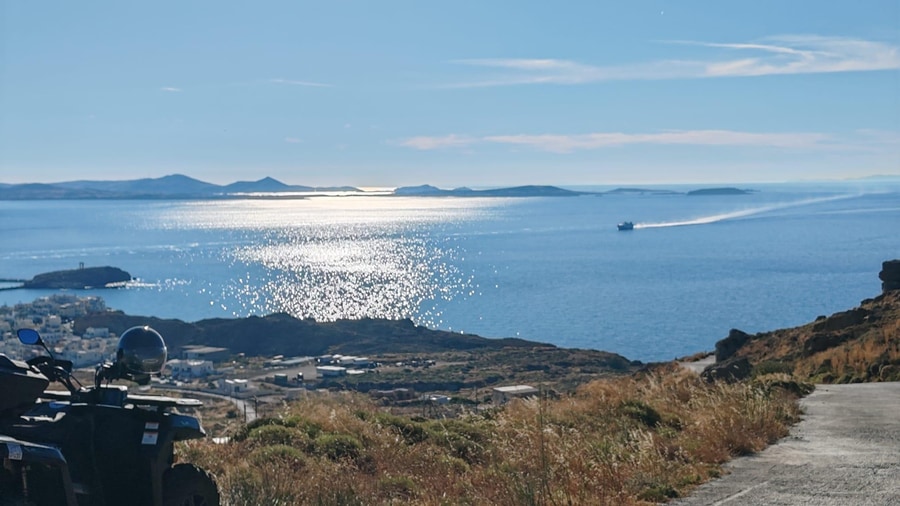
Its central spot made Chalki a trading hub. It served the Naxos uplands, the high inland area, until recent decades. From the Stavros Keramotis junction, rural roads run to Apiranthos, Koronos, Kynidaros and Moni.
Two main roads reach Apollonas. The western road leaves Chora and passes Eggares, 6 km out, and Komiaki. The central road runs to Stavros Keramotis instead. The north-east coast near Apollonas has steep cliffs, small bays and vineyards.
A Naxos ATV tour can follow a rural road from Chalki through Tsikalario to Potamia. It crosses dry, rocky, shaly land below the ruins of Apano Kastro. Potamia lies about 9 km from Chora, via Galanado.
In the south, an 8 km downhill starts at the Bazeos Tower. It drops from the Sagri valley toward the bay of Agiassos. A dirt road links Pyrgaki to Alyko beach.
- Melanes: It lies about 8 km south-east of Chora on the road to Kynidaros.
- Cape Kouroupia: The ruins of a huge hotel complex stand there.
- Galini: It lies 6 km from Chora on the main road to Apollonas, near Ammitis beach.
Galanado and Vivlos both look out over the west coast and over Paros. Vivlos also faces the fertile plain south of Chora. Galanado sits on the main road back to Chora.
Which villages does a Naxos ATV tour pass?
A Naxos ATV tour passes inland mountain villages full of history. Chalki, Filoti, Apiranthos and Koronos sit in the hills. Moni, Damarionas, Kynidaros and Melanes add old legends. Each village tells its own story of trade, mining or pirates.
Tradition says Chalki is named after bronze smiths placed there by the Venetian rulers. Chalkos is the Greek word for bronze. Its Tragea valley holds an olive grove with about 30 important Byzantine churches.
About 60,000 sheep are reared around Filoti. Beside its Barozzi Tower stands a marble tap with a marble wall inscription. The inscription dates from the reign of King Othon, 1832-62.
Apiranthos holds the Nikos N. Glezos library, the largest in the Cyclades. Emery mining lifted Koronos to about 3,000 residents before the Second World War. The mines closed under German occupation, and 414 people starved.
Moni takes its name from Panagia Drosiani, a former Byzantine monastery, now a church. Vineyards around it grow about 20 wine grape varieties. Cars cannot enter the village alleys.
- Damarionas: Fear of pirates moved its people inland from the Agiassos coast around 1400.
- Kynidaros: It sits on a rocky hillside at 400 m, about 15 km east of Chora.
- Melanes: One legend links its name, which means black, to the dark soil of the valley.
A 15th-century pirate raid also shaped Kynidaros. The last survivors of Kioura, in the Chalandra valley, moved to its present site. A Naxos ATV tour brings these old stories to life on the road.
Which beaches can a Naxos ATV tour reach?
A Naxos ATV tour can reach long sandy beaches on the south-west coast. Seaside roads in the east lead to quiet coves. Bays in the north add more choice. Each beach has its own sand and views.
Plaka beach is easy for riders, since parking is possible along its entire length. Just south, Orkos beach is a series of small inlets. Coarse sand covers these inlets between Plaka and Mikri Vigla.
A Naxos ATV tour can use the asphalt road from Kastraki beach to Mikri Vigla and Glyfada. Kastraki has fine white sand and calm water. Small boats can anchor there.
Glyfada is an enormous sandy beach with dunes and shady juniper trees. It never gets overwhelmingly crowded, even in August. Pyrgaki, another huge beach, looks out to Iraklia and Ios.
From Pyrgaki, a dirt road of about 3km leads to Agiassos beach. This rough track suits a Naxos ATV tour well. Agiassos also has a 12km asphalt road from Sagri.
- Moutsouna: The cove has two fine-sand beaches, Ai Giannis and Tigani.
- Panermos: The seaside road from Moutsouna ends at this harbour with very clean water.
- Psili Ammos: This south-east beach lies in front of a juniper tree forest.
In the north-west, Abram is a quiet beach next to Kampos. It suits windsurfing during the meltemia, the yearly summer winds. Apollonas beach in the north-east is sandy and sheltered from southerly winds.
What mountain roads does a Naxos ATV tour climb?
A Naxos ATV tour climbs mountain roads through old mining villages and high ridges. The roads pass emery mines and wind generators. Long slopes run around Mount Zas. Each climb shows a different side of the island.
A long but not steep track climbs from Apollonas to Koronos. Koronos is the old village of emery miners. Emery is a hard rock used for polishing. The village lies 28km from Chora.
A Naxos ATV tour can ride the 8km asphalt road from Koronos to Lionas. Emery gallery entrances show along the whole road. Hundreds of small mines dot the slopes of Mount Amomaxis.
Pylons of the old cable railway stand on both sides of this road. About halfway, the Sarantara mine is named after 40 workers. These workers were also its shareholders.
A short climb from Koronos to the wind generators opens a view of the east coast. South of Apiranthos, a long downhill follows the slope of Mount Zas toward Filoti.
- Komiaki: The northernmost village of Naxos sits on a ridge above the Icarian Sea.
- Stavros Keramotis: This is the largest crossroads of rural roads on Naxos.
- Danakos: This village lies deep in a gorge below Mount Zas.
Filoti is almost ringed by summits. Long ago, local worshippers climbed Mount Zas in hot summer months. They wore heavy winter fleece and asked the god for a cool breeze.
What ancient sites does a Naxos ATV tour pass?
A Naxos ATV tour passes ancient temples, marble quarries and old stone towers. Riders also see Byzantine churches with painted walls. Each site sits close to a road or track. The stops span ancient and Venetian times.
South of Sangri, open-air worship of nature gods began on the Gyroulas mound. This started in the 8th century BC. Workshops around the temple later made olive oil, wine and pottery.
The chapel of Agios Ioannis Theologos stood under an arch of the ruined basilica. A basilica is an old church hall. The chapel was moved in 1977 to allow the temple’s restoration.
A Naxos ATV tour can stop at the Flerio quarry. Wedge slots and rows of small chisel holes still show. Workers there turned to Otus and Ephialtes, giant twins worshipped at nearby springs.
The Kouros of Apollonas lies on an unpaved road above the village. A kouros is a large statue of a young man. On Grammata hill, an inscription reads “Holy Mountain of Apollo.”
- Chimarros Tower: This round tower from the late 4th century BC stands on a hilltop near Filoti.
- Zevgoli Tower: This two-storey tower rose at the Apiranthos entrance in the 17th century.
- Oskelos Tower: This tower near Kastraki is one of the rare Naxos towers by the sea.
Naxos has over 200 Byzantine churches, and 120 keep their original frescoes, or wall paintings. Christ Photodotis, a fortified monastery first built in the 6th century, is the oldest monastery on Naxos.
What licence and rules apply to a Naxos ATV tour?
A Naxos ATV tour follows Greek road law and EU licence rules. Riders carry a valid licence, since phone licences do not work outside their issuing country. Insurance is compulsory. Greek law punishes helmet, alcohol and drug offences hard.
The single EU driving licence model took effect on 19 January 2013. It replaced 110 licence models across the EU and EEA. All European licences issued before that date will become invalid by 2033.
Certain quads hold European Community Whole Vehicle Type Approval for public roads. Passenger quads with this approval can lack a locking differential, which locks the wheels together. They do not suit sloping off-road ground on a Naxos ATV tour.
Motor insurance has been compulsory in the EU since 24 April 1972. Directive (EU) 2021/2118 sets injury cover of €1,300,000 per injured party or €6,450,000 per claim. Property damage cover starts at €1,300,000 per accident.
Greece has belonged to the Green Card system since 1949. This scheme makes sure people hurt by a visiting motorist get compensated. The same insurance rules cover ATV tours on Paros.
- Health card: EU, EEA and Swiss residents get state healthcare in Greece like locals.
- Travel insurance: The card covers only state care, so extras need travel insurance.
- Helmet offences: A second offence within 5 years brings a 180-day licence withdrawal.
On a Naxos ATV tour, the alcohol limit matters. Riders caught from 0.2 mg/ml of blood alcohol get 7 penalty points. They also lose their licence for 30 days. Driving on drugs is banned, including medicines that affect driving. A first offence brings at least 2 months in prison.
How safe is a Naxos ATV tour?
A Naxos ATV tour stays safer when riders understand how a quad grips and tips. Rollovers start in turns, at kerbs and on soft ground. Good habits help: correct tyre pressure, balanced loads, smooth braking and calm body position.
A tripped rollover starts with an outside object, such as a kerb. An untripped one comes from steering, speed and ground friction. Soft ground can trip a sliding quad too.
In a turn, tyre grip pushes inward at ground level. Inertia, the pull to keep going straight, pushes outward through the centre of mass. The quad turns over once these forces beat gravity.
The static stability factor rates rollover resistance. It equals width divided by twice the height of the centre of gravity. On a Naxos ATV tour, weight fixed high over the rear rack cuts stability.
A quad without a differential turns when the rider shifts weight to the outside footrest. The inside wheels then skid slightly. Braking loads the front tyres, and each tyre has one limit of grip.
- Tyre pressure: Quad tyres run at about 2-7 psi, so 1 psi off can cause control problems.
- Rack loads: Loads stay strapped down and balanced between front and rear.
- Parking: Riders park across a slope, unless the slope is too steep.
A spotter, a helper on foot, directs the rider past unseen ground on a Naxos ATV tour. The UK Health and Safety Executive does not recommend roll-over bars on sit-astride quads.
What do riders wear on a Naxos ATV tour?
A Naxos ATV tour calls for a well-fitted helmet, sturdy boots and gloves. Riders also bring eye cover, a neck gaiter and water. Item labels show the safety standard. Correct fit matters as much as the label.
Under ECE 22.06, J marks an open-face helmet. P marks a protective chin bar. P/J marks a modular helmet approved both open and closed. The high-speed test runs at 8.2 m/s.
A smooth outer shell helps a rider slide along the ground. A shell that grips and rotates can injure the neck and brain. Long UV exposure degrades certain shell materials unseen.
Sizing starts with a tape above the ears and across the forehead. The chin strap sits tight but lets the mouth open. A fastened helmet that rolls off from the back can fall off in a crash.
Visors that let through less than 50% of visible light do not fully comply with any helmet standard. On a Naxos ATV tour, a long neck gaiter covers the lower face against dust.
- Boots: Motocross boots stand nearly knee-high, with 3 to 4 straps and a shin plate.
- Boot marks: IPA means ankle protection, IPS shin protection and WR water resistance.
- Gloves: Motorcycle gloves have reinforced palms.
A helmet lasts around five years, or three with regular use. It is never stored on its crown or near heat. For a Naxos ATV tour, a hydration pack can hold 1-3 litres.
What nature and geology does a Naxos ATV tour pass?
A Naxos ATV tour passes old emery mines, marble rock, olive groves and green ravines. Western Naxos is mainly granite, and its beaches formed from that rock. A waterfall and coastal junipers add variety. Every stop looks different.
Smyrida is the Greek word for emery, which names the mining villages, the Smyridochoria. About 50 emery mines have worked in recent years. Their maze-like galleries reach depths of up to 600 metres.
Mine names stand out on a Naxos ATV tour. A group of mines carry war names, such as Korea and Vietnam. Others carry foreign country names, such as Americana and Abyssinia.
Routsouna waterfall drops 20 metres near Keramoti. Two streams from the Koronos and Fanari mountains feed it. Its stream flows even in summer and reaches the sea at Ammitis beach.
A Naxos ATV tour also crosses marble country. Naxian marble formed under strong heat and pressure. Clear calcite crystals give it a blue-grey shimmer that shifts with the light.
- Olive groves: Over 270,000 olive trees grow on Naxos, mainly in the Tragaia valley.
- Woods: Kermes oaks and Cretan maples fill the broad-leaved woods.
- Ravines: Seasonal stream beds hold plane trees, wickers and oleanders.
The large-fruited juniper grows on coastal dunes up to 75 metres above the sea. Its cones ripen orange-red over 18 months. Birds spread the seeds. A Naxos ATV tour links all these landscapes.
When is the best season for a Naxos ATV tour?
A Naxos ATV tour suits late spring and early autumn best. Late spring and September bring mild highs in the hills. Midsummer gets hot, November turns wet, and winter brings the strongest winds. Dust and wind also shape the choice.
In the fifth month, highs average 21.9 °C in Apeiranthos, a mountain village at 600 m. Lows average 15 °C, with 4.7 mm of rain. The coldest reading for that month in Naxos town is 7.1 °C.
Early heat is possible on a Naxos ATV tour. That same month has reached a record 33.6 °C in Naxos town. June in Apeiranthos averages highs of 25.1 °C and lows of 18.6 °C.
July in Apeiranthos averages highs of 27.9 °C, with nights near 21.1 °C. September averages 24.9 °C, with 24.2 mm of rain. November there brings 91.1 mm of rain.
Wind matters on a Naxos ATV tour. The etesian winds, called meltemia, can blow from the fifth month to October. Mean wind reaches 15.5 knots in January and 14.9 knots in December.
- Sirocco dust: Sirocco dust can wear down moving parts in machines.
- Spring dust: Saharan dust reaches the central Mediterranean in two to four days.
- Rain: Rain settles Saharan dust quickly over the Mediterranean.
March has a mean wind of 14.7 knots, close to winter strength. November averages 13.2 knots. Records reach 28.6 °C in March and 28.8 °C in November, so both months swing widely.
What do travelers ask about a Naxos ATV tour?
A Naxos ATV tour raises common questions about safety, emergency calls, road signs, fuel and sand. Clear answers help riders feel calm on the road. Greek signs follow European models. Basic knowledge makes each ride safer for every rider.
Which emergency number works on a Naxos ATV tour?
The number 112 is free to dial from mobile phones. It reaches an ambulance, the fire service or the police. GSM phones can dial 112 even with a locked keypad. Advanced Mobile Location technology then shows emergency services the exact caller location.
Are there other Greek emergency numbers for a Naxos ATV tour?
Greece keeps separate numbers too. The police answer on 100, and the coastguard on 108. An ambulance comes through 166. The fire service answers on 199. Riders near coastal tracks can save the coastguard number before they set off.
What road signs matter on a Naxos ATV tour?
Greek warning triangles have a yellow background with black symbols. Sign K-18 warns that domestic animals can be on the road. Roadworks use a normal sign on an orange background. Small signs, with round signs 450 mm across, appear mainly on village and rural roads.
Where can riders park during a Naxos ATV tour?
Sign Ρ-40 bans both parking and stopping. Sign Ρ-41 bans parking on odd months, and Ρ-42 on even months. Sign Π-94 means no stopping or parking, with towing. Parking in a bus lane brings 5 penalty points and a 40-day licence withdrawal.
How does tyre pressure work on sand during a Naxos ATV tour?
On sand dunes, drivers lower tyre pressure on purpose. The tyre footprint grows wider and grips without sinking. The idea works like snowshoes on soft snow. Riders follow the instructor’s rules on pressure, because each machine and each sand patch differs.
What do fuel and child safety facts say about a Naxos ATV tour?
Under the EU petrol standard EN 228, petrol can contain 5 percent ethanol, a type of alcohol. Summer petrol evaporates less in the heat.