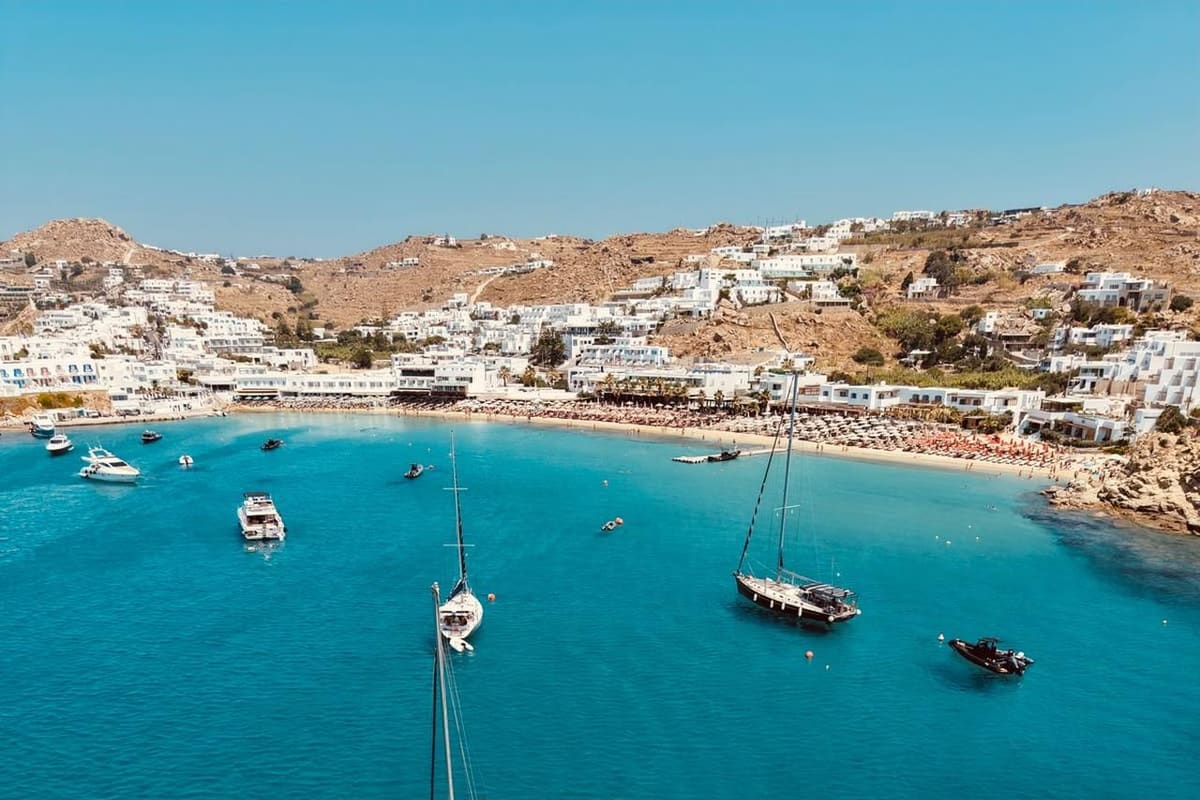
A Mykonos boat trip takes passengers along the coast of Mykonos by speedboat, caique or sea taxi. Trips link the ports, the south beaches and the islets offshore. It is one of the boat excursions in Greece on Greece VIP.
This post covers what a Mykonos boat trip includes, the boat types and the sea taxis. It also covers the two ports, the lighthouses and the islets. Sea caves, seabirds and the seabed follow, then safety, what to bring and fishing traditions. Families, the best season and common questions come last.
Each section ends with a Mykonos boat trip or a nearby sea tour that can be booked online.
What does a Mykonos boat trip include?
A Mykonos boat trip covers a small island with deep bays. Stops include beaches on the south and west coasts of the island. Delos lies close by across a narrow channel. Swimming, watersports and diving all fit into the day.
Mykonos measures about 14 kilometres at its longest and 10 kilometres at its widest. A Mykonos boat trip can circle a large part of this small coast. Bays cut deep into the shore. The main ones are the bays of Chora, Panormos and Ornos.
Boats to Delos leave daily from the small port opposite the church of Agios Nikolaos. This port sits on the beach in Mykonos Town. Tickets are sold at a ticket office outside the boats.
The municipality tells visitors to check the weather and schedules with the Port Authority before the crossing. On Delos, the Agora of the Competaliasts sits beside the Sacred Harbour. An agora is a market square. Its stone paving still shows the postholes for market awnings.
Agios Ioannis beach looks straight across at Delos, Cape Aleomandra and the channel between the two islands. Kapari has fine sand and the best view of Delos, above all at sunset.
Agios Stefanos, on the west coast, has a clear view of Delos and Rineia. A Mykonos boat trip along this side passes these viewpoints from the water. Other boat tours around Mykonos follow the same coastline.
- Watersports: Agrari beach is ideal for watersports.
- Families: At Kalo Livadi, families enjoy the calmest waters, among tavernas and beach bars.
- Diving: A diving centre at Agia Anna, by Kalafatis, runs lessons and underwater trips for all levels.
A Mykonos boat trip links the town harbour, the deep bays and the old market on Delos. Ornos bay is an ideal anchorage for pleasure boats. Each stop shows a different side of a small island. The sea between them is the real road.


Which boat types run a Mykonos boat trip?
A Mykonos boat trip runs on different boat types. RIBs, or rigid inflatable boats, are fast, light boats with air-filled tubes. Inboard boats, sterndrives and jetboats move in other ways. Each type handles waves, shallow water and speed differently.
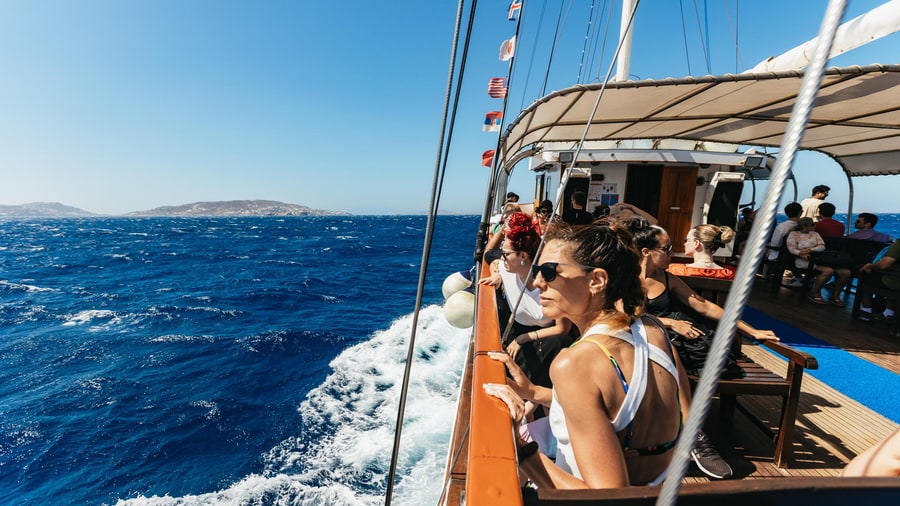
RIBs are commonly four to nine metres long, though they range from 2.5 to 18 metres. They run on one or more outboard motors. Others use an inboard engine that turns a water jet or a stern drive.
RIBs have planing hulls. Planing means the boat rises and skims on top of the water. A 6-metre RIB carries six passengers with 110 hp engines. It reaches around 30 knots in a force 2 breeze.
Hull shape changes the ride on a Mykonos boat trip. Deep-V hulls cut through waves easily but need more engine power to start planing. Shallow-V hulls plane at a lower speed, but the ride is more uncomfortable.
The low weight of a RIB lets it outpace other boats of similar size and power. Inboard engines are almost always diesel, while outboard motors are cheaper and lighter.
A sterndrive puts the engine just inside the transom, the flat back of the boat. The drive leg sits outside the hull, and the boat steers by pivoting it. Jetboats have no external rotating parts, so they are safer for swimmers and marine life.
- Engine power: RIB engines range from 5 to 300 horsepower.
- Tubes: Tubes of Hypalon and neoprene can last up to twice as long as PVC tubes.
- Safety valves: Pressure release valves let out air that expands in heat, so the tubes do not burst.
A Mykonos boat trip can use any of these designs. New Zealand engineer Bill Hamilton built the modern jetboat in the mid-1950s. He made it for rivers too shallow for propellers.
How do the sea taxis of a Mykonos boat trip work?
A Mykonos boat trip by sea taxi uses small beach boats. Caiques and launches, small passenger boats, carry people between beaches. The main line to the southern beaches starts at Platys Gialos. The municipality calls these beach boats reliable and safe.
From Platis Gialos beach, caiques leave for short trips to neighbouring beaches. Stops include Paraga, Paradise, Super Paradise, Agrari and Elia. A Mykonos boat trip of this kind works like a bus on water.
Getting to the start of a Mykonos boat trip by sea taxi is simple. The bulk of the island’s KTEL bus routes lead to Platys Gialos. KTEL is the public bus service. Launches also leave from Ornos beach for the other well-known southern beaches.
Paradise lies 5.5 kilometres from Chora. Both a bus and a caique from Platys Gialos serve it. Its Greek name is Kalamopodi, while visitors use the English name. A Mykonos boat trip there saves a road journey.
Land transport links the town with the sea. The new port of Mykonos lies north of Chora, in Tourlos bay. Road taxis wait in front of the OTE building in Mykonos Town and at Fabrika.
The term sea taxi has a loose meaning. A boat that only shuttles between two points is normally called a ferry. It is not called a water bus or a water taxi. In North American usage, the terms water taxi and water bus mean roughly the same thing.
- Elia: Elia is the second-to-last stop of the launch line from Platys Gialos.
- Kalo Livadi: Kalo Livadi is also a stop on the launch line.
- Psarou: Psarou is reached by bus, by car, or by small boat from Ornos and Platys Gialos.
A Mykonos boat trip by caique turns the south coast into one easy route. Beach hopping needs no car or bus. Short hops by boat link one beach to the next.
What does a Mykonos boat trip see at the old and new ports?
A Mykonos boat trip sees two harbours with long stories. The old port in Chora appears on maps from centuries ago. The new port at Tourlos opened in 1999. Today both ports handle busy ferries, yachts and cruise ships each season.
The old port has a long record on paper. A Frenchman completed its first plan in 1686. Tournefort drew the old port in 1717. Th. Hope drew it again in 1790.
In 1822, 22 ships were listed at the old port. Between 1860 and 1870, reports counted 60 ships there. In 1901 the seafront was widened, and the pier was extended.
A Mykonos boat trip leaving Chora passes later changes too. The old port got a new pier in 1970. All its improvements were finished in 1980. Today it takes only motor yachts over 25 metres. Sailing yachts of any size are banned there.
Tourist traffic kept growing. So in 1992 the Greek government planned a new port for tourists and passengers. The plan included an inland marina, a sheltered basin for boats. Building work began in 1995.
A second stage, from 2000 to 2002, added warehouses, toilets and electric lighting. It also finished the surface of the port’s islet in the Schengen area. A third stage, from 2006 to 2010, built the passenger and commercial part east of the bridge.
- Cruise ships: In 2023, cruise ships called 749 times and brought 1,192,295 passengers.
- Ferries: In 2023, ferries made 4,589 calls and carried 1,522,570 passengers and 191,398 vehicles, including trips to Delos.
- Tourlos marina: The marina takes only motor yachts, sailing yachts and RIBs under 25 metres long.
- New stage: The new port is now in its 4th stage, with cruise and commercial terminal buildings.
From the water, the Town Hall stands out on Akti Kampani at Gialos. It is the Voinovich building, a two-storey house of 1780 with a tiled roof. It was once the seat of the Russian Consul General of the Archipelago.
Which lighthouses does a Mykonos boat trip pass?
A Mykonos boat trip passes the old Armenistis lighthouse and smaller lights on rocky islets. Armenistis shines from 184 metres above sea level. Other lights stand on the Prasonisia and Chtapodia islets. Coloured harbour lights mark both port entrances at night.
Armenistis is an octagonal tower, which means it has eight sides. It joins a keeper’s dwelling. The site was called Varvoulakas before it took the name Armenistis.
Its first lamp mechanism was made by Sauter Lemonier. That machine won an award at the International Exhibition of Paris. It worked at the top of the tower until 1983. The light gives one white flash every 10 seconds: a 1-second flash, then 9 seconds of darkness.
The Hellenic Navy praises the lighting machine of Armenistis. The lighthouse is also on the Navy’s list of preserved monuments. This comes from Government Gazette 230/AAP dated 19-6-12.
A village called Faros Armenistis took its name from the lighthouse. It lies at 136 metres altitude. It sits about 7 km north of Chora.
A Mykonos boat trip also passes smaller lights. The Prasonisia light flashes white every 3 seconds from 25 metres above the sea. It reaches 6 nautical miles. The Chtapodia light gives two white flashes every 10 seconds from 130 metres up. Sailors see it 10 nautical miles away.
- Prasonisia frame: The light sits on a metal frame with a white round hut.
- Chtapodia tower: The light stands on a white pyramid-shaped structure with a gallery.
- Tourlos quays: The north-west quay head flashes green, the south-east red, every 3 seconds, 8 metres up.
- Old harbour: The north mole head shows red, the south breakwater head green, on white six-sided huts.
The harbour colours follow a clear rule. Europe lies in IALA Region A, a zone with shared sea marks. There, red lights mark the left side of the channel. This applies to a boat coming in from the sea.
Which islets lie off a Mykonos boat trip?
A Mykonos boat trip passes small, rocky islets all around the island. Tragonisi lies to the east. Ktapodia lies to the south-east. Baos and Kavouras sit opposite Chora, and the Prasonisia lie to the south-west. Each islet carries its own story.
Tragonisi, also called Dragonisi, is a small uninhabited islet. It lies 3 miles from the bay of Kalafatis. Cape Evry, the eastern cape of Mykonos, faces it. Tragonisi is well known for its caves.
Mediterranean monk seals have their dens on Tragonisi. This is one reason it is protected under Natura 2000, a nature protection scheme. Its church of Panagia also honours Saints Barnabas and Bartholomew.
A Mykonos boat trip toward the south-east reaches Ktapodia, also called Stapodia. It is a group of three rocky islets. They lie 5 nautical miles from Mykonos and 20 from Ikaria. The largest is Stapodi or Kalamapodi. The islets have no drinking water at all.
Baos, also called Agios Georgios, is a rock islet opposite Chora. It covers 0.12 square kilometres and rises 16 metres. Its name comes from the Mykonian pirate Georgios Baos. He raided Ottoman ships from it during the Orlov revolt. Its other name comes from its chapel of Agios Georgios.
Local legend says a vampire lived on Baos. The islet served as a place to bury and burn people thought to be vampires. One case dates from the early 18th century.
- Kavouras: Mega Kavouronisi and Mikro Kavouronisi lie beside Baos as flat bare rocks with no plants.
- Prasonisia: Krommydi, Praso and Sfontili are three rocky uninhabited islets east of Delos.
- Lazaronisi: This bare rock at the entrance of Ornos bay takes its name from the Lazaros peninsula opposite.
Marmaronisi is named after its rock, which is good for making lime. Caiques, small wooden boats, once carried that stone to lime kilns. The Ktapodia islets are identified with the Melantian rocks of the ancient Greeks.
What sea caves does a Mykonos boat trip reach?
A Mykonos boat trip reaches a granite coast shaped by faults, salt and waves. Sea caves here form along cracks and weak zones in the rock. Hollows called tafoni dot the cliffs. Each cave tells a long story of rising magma and slow erosion.
Geologists call Mykonos a Miocene metamorphic core complex. That term means deep rocks pushed up to the surface along big faults. Here the system joins detachment faults, a body of magma and a sedimentary basin. A sedimentary basin is a hollow filled with old sediment.
The granite of Mykonos is a laccolith, a mass of magma that cooled underground. A laccolith has a dome-shaped top and a level base. It forms when rising magma spreads sideways and lifts the rock layers above. On a Mykonos boat trip, this hard granite frames the coast.
Two low-angle faults cross the island, the Livada and Mykonos detachments. Both belong to the North Cycladic Detachment System. Sea caves cut along a fault tend to have very straight passages. These passages look like narrow canyons in the rock.
Granite expands and cracks into sheets when erosion strips away the rock above it. These cracks are called exfoliation joints. In jointed granite, onion-skin weathering peels the rock away in shells. It leaves rounded boulders called corestones.
Tafoni are cavities in granular rock such as granite. They range from less than 1 cm to more than 1 m across. They form best in salt-rich places like coasts and deserts. Yacht cruises off Mykonos pass salty granite coasts.
- Honeycomb weathering: Rows of tightly packed hollows under 2 cm wide form in granite on salty coasts.
- Cave shape: The typical sea cave is a single passage or a single chamber.
- Extra entrances: Sea caves with more than one entrance take more wave action and grow faster.
A Mykonos boat trip passes rock that holds clues from deep time. Barite and iron-mineral veins formed in the granite as it cooled. Caves also matter for wildlife. Sea storms that strike coastal caves are a major cause of death for newborn monk seal pups.
Which seabirds does a Mykonos boat trip see?
A Mykonos boat trip enters waters rich in seabirds. Shearwaters glide low over the open waves. Gulls, falcons and shags round out the list of birds to watch. The nearby small islets hold a protected area for seabirds.
Rineia, Chtapodia and Tragonisi form a confirmed Key Biodiversity Area. It covers 169.34963 square kilometres of sea and land. Protected areas cover 99.91 per cent of it. A Mykonos boat trip near these islets crosses this protected zone.
The yelkouan shearwater is the bird that qualifies the islets as a Key Biodiversity Area. It is listed as Vulnerable. It measures 30 to 35 cm long, with a wingspan of 70 to 84 cm.
Large numbers of yelkouans can be seen from boats, above all in autumn. Low over the sea, the bird looks like a flying cross. It flashes from dark brown to white as it tilts. A Mykonos boat trip in autumn suits this sight.
Scopoli’s shearwater is also recorded at the site. It leaves the Mediterranean through the Strait of Gibraltar at the end of October. It returns to the Mediterranean at the end of February.
Audouin’s gull is recorded at the islets too. It feeds at night, far out at sea. When near beaches it dangles its legs to slow down. Its wingtips show a white “string of pearls.”
- Eleonora’s falcon: This falcon reaches 36 to 42 cm long, with a wingspan of 87 to 104 cm.
- Colony life: Eleonora’s falcon breeds in colonies, an unusual habit among falcons, and lays up to four eggs.
- European shag: This seabird is 68 to 78 cm long, with a yellow throat patch.
Shags nest on rocky ledges, in crevices or in small caves. They build nests of rotting seaweed or twigs, stuck together with droppings. A Mykonos boat trip along rocky shores passes this kind of nesting ground.
Which underwater sights lie near a Mykonos boat trip?
A Mykonos boat trip sails near the sunken port of Delos. Ancient walls and shipwrecks rest on the seabed there. Meadows of a sea plant called Posidonia grow across the Mediterranean floor. Divers and scientists still study these sights.
A breakwater is a sea wall against waves. One about 520 feet long and 130 feet wide guarded the central port of Delos. Unshaped rocks formed its base under the water. Large granite blocks rose above it against strong northwestern winds.
Divers of the Ephorate of Underwater Antiquities found a fallen colonnade, a row of columns, near it. They also found three shipwrecks. One Hellenistic ship carried oil and wine from Italy.
A survey mapped remains off the north-eastern side of Delos, in the Stadium quarter. It confirmed a commercial harbour there. It also located seven shipwrecks. A Mykonos boat trip to Delos passes near this historic water.
The Key Biodiversity Area near Mykonos is 100% Marine Neritic, meaning shallow sea near the coast. Posidonia oceanica, a seagrass, forms the climax community of the Mediterranean. That means the stable final stage of its plant life.
Posidonia fruits ripen after six months and float away. Each releases a seed that sinks to the bottom to grow. Deep meadows flower about two months later than shallow ones.
- Pollen: Posidonia pollen turns thread-like once released, and water carries it to other flowers.
- Old colony: A Posidonia colony between Ibiza and Formentera, 8 km across, is estimated at 100,000 years old.
- Leaf records: Dead leaf bases on the stems change thickness each year, so scientists read past conditions.
Since 2003 the Ephorate has had authority over all ship and aircraft wrecks over fifty years old. It calls the Greek seabed the biggest underwater museum in the world. A Mykonos boat trip sails over part of it.
How safe is a Mykonos boat trip?
A Mykonos boat trip is safe when everyone follows simple rules. Passengers hold on, stay off the edges and keep clear of the propeller. Crews check the water before they start the engine. Good habits against heat and sun matter too.
The propeller is the main danger near any boat. A typical three-blade propeller at 3,200 rpm, or turns per minute, can strike 160 times in one second. It can move from head to toe on an average person in under one tenth of a second.
For this reason, passengers never climb on or off from the water while the engine runs or idles. The propeller can keep spinning even when the boat seems still. On a Mykonos boat trip, one passenger keeps watch near the propeller while others swim.
People in the water are not always visible from the helm, the steering spot. So the skipper walks around the boat and looks into the water before starting the engine. A boat also never goes into reverse to pick up a swimmer. It circles around again instead.
Milder heat illness includes heat cramps, fainting, swollen hands and feet, and heat rash. Early signs of heat stroke include behaviour changes, agitation, slurred speech, nausea and vomiting. Enough fluids, electrolytes (body salts) and slow adjustment to heat help prevent heat illness.
Boat engines can also release carbon monoxide. This gas has no colour and no smell. Poisoning feels like flu, with headache, dizziness and weakness.
- Bow and rails: Passengers never ride on the front, side edges, back wall or seatbacks. A fall overboard is easy there.
- Handholds: All passengers use the handholds while the boat moves.
- Hats: Vents on a hat cool the head, and so do sweatbands wetted with cool water.
The Knights of Malta are said to be the first to carry cork lifebuoys. They tied them by a rope to the stern, the back of the ship. Today, simple habits keep a Mykonos boat trip calm and safe.
What do passengers bring on a Mykonos boat trip?
A Mykonos boat trip calls for a short, smart packing list. Passengers bring a light towel, swim goggles or a mask, and a drinks flask. A strap for the phone helps too. Coins in euros cover small costs ashore.
A beach towel is larger and thinner than a bath towel. Its main job is to give a surface to lie on. A peshtemal, a flat Turkish towel, soaks up water and dries faster than thick towels. Its name comes from the Persian for “back towel”.
Peshtemals began as flat woven cotton or linen, now commonly 90 x 170 cm. The modern terry towel is linked with Bursa in Turkey in the 17th century. Microfiber towels use threads finer than one denier, a measure of thread weight.
On a Mykonos boat trip, a lanyard keeps a phone safe. Phones made for one have a small hole in a corner. The loop ties on with a cow hitch, a simple knot.
Swim goggles help near the surface only. Deeper down, water pressure presses them against the face, so a diving mask works better. Matthew Webb wore unsealed goggles, called “barnacles”, on his first Channel swim in 1875.
A vacuum flask keeps water cold through a hot day. It is two vessels joined at the neck with a partial vacuum between them. This gap slows heat transfer. Scottish scientist James Dewar invented it in 1892.
- Fins: Owen Churchill renamed the French “propulseurs” as “swimfins” to sell them in the United States.
- Early fins: Benjamin Franklin made hand fins as a boy in Boston from two thin pieces of wood.
- Coins: Greek euro coins show their value in Greek letters on the national side.
A light bag holds all of these items. Each one has a clear job on deck or in the water. Together, they make a Mykonos boat trip simpler and more comfortable.
Which fishing traditions does a Mykonos boat trip show?
A Mykonos boat trip shows fishing traditions that go back thousands of years. Bright floats bob above nets in the bays. Old saints and old recipes still link the island to the sea. Fishing boats remain a common sight.
A seine net hangs straight down in the water. Weights pull its bottom edge down, and floats hold its top edge up. The word seine comes from the Greek sagene, a drag-net, through Latin sagena.
Seine nets appear in Egyptian tomb paintings from 3000 BCE. A purse seine has rings along its bottom. A line through them closes the net so fish cannot dive out. It suits sardines, mackerel and anchovies near the surface.
Passengers on a Mykonos boat trip spot bright net floats on the water. Floats were once cork and are now mostly plastic foam. A trammel net has three layers, with a slack small-mesh net between two taut wide-mesh nets.
In Greek folklore, Saint Nicholas is “The Lord of the Sea”. Sailors and fishermen love him as a Christian Poseidon. Greek cities celebrate him on 6 December. He is also the patron saint of the Hellenic Navy.
Fishing has deep roots on Mykonos itself. At Ftelia, a Neolithic or late Stone Age settlement, fish only added to the diet. Diggers found no fish hooks or harpoon points there.
- Longline: A main line carries baited hooks on short branch lines called snoods.
- Kakavia: This fish soup is named after the tripod pot of ancient Ionian fishermen.
- Marida: Greeks batter and fry this small fish, then eat it whole with head and bones.
Around 180 AD, the Greek author Oppian wrote a fishing poem, the Halieutica. Its nets, traps and boats still echo on a Mykonos boat trip today.
How does a Mykonos boat trip suit families?
A Mykonos boat trip suits families when adults plan for water, sun and sea motion. Young children face the biggest risks near water. Simple steps on board keep the whole day safe. Life jackets, sunscreen and close watching matter a great deal.
Children under 5 account for nearly a quarter of drowning deaths worldwide, the World Health Organization reports. Children aged 0 to 4 have the highest drowning rates of any age group.
Drowning is the fourth leading cause of death for children aged 1 to 4. It ranks third for children aged 5 to 14. Small children cannot yet judge danger well. They also lack swimming and water safety skills.
On a Mykonos boat trip, life jackets never replace close adult watching of children. Blow-up water wings, toys, rafts and air mattresses never take the place of life jackets. The American Academy of Pediatrics gives this advice.
Parents can teach a child to put on a life jacket alone. Practice helps the child feel comfortable wearing it. Adults who wear a life jacket protect themselves. They also set a good example for children.
Water reflects ultraviolet rays, so a Mykonos boat trip increases sun exposure, the NHS warns. Water also washes sunscreen off. The cool water can hide the fact that skin is burning.
- Bare spots: On children, sunscreen goes on the face, ears, feet and backs of the hands.
- Heat signs: Heat exhaustion brings pale, clammy skin, cramps in arms, legs and stomach, and strong thirst.
- Travel sickness: Talking, music or singing songs help a child who feels sick at sea.
A person with heat exhaustion feels better within 30 minutes of cooling down. Still feeling unwell after 30 minutes signals heatstroke and needs emergency help. Pharmacies sell dissolvable motion sickness tablets for children. Watching rolling waves or screens makes sickness worse.
When is the best season for a Mykonos boat trip?
A Mykonos boat trip works best from June to September, when the air and sea feel warm. Spring and autumn bring milder days. Winter is cool and damp. Wind is the main weather factor to check before sailing.
The HNMS weather station on Mykonos gives 1991-2020 average figures. July is the warmest month, with a mean of 25.8 °C. August follows just behind at 25.7 °C. January is the coldest month, at 10.7 °C.
June records a mean temperature of 23.9 °C. September stays close at 22.9 °C. Daily highs average 28.5 °C in July and 28.3 °C in August. A Mykonos boat trip then means hot hours on deck.
The month before June and October sit almost level, with means of 19.4 °C and 19.3 °C. April and November are also close, at 15.2 °C and 15.4 °C. The frost-free period runs from 1 March to 15 November, about 260 days a year.
The air is driest in early summer. Relative humidity, the water held in the air, averages 59% in June and 59.4% in July. Air turns damp later, with 74.4% in November, 74% in December and 73.3% in January.
Wind shapes every Mykonos boat trip. July and August bring the strongest average winds of the year. Northerly winds blow 38.2% of the time, and northeasterly winds 16.3%. Calm weather is rare, at about 11.3% of the time.
- Seasonal winds: The Hellenic Centre for Marine Research notes that winds over Mykonos peak in the summer months.
- Sea buoy: A POSEIDON monitoring buoy floats near northeast Mykonos, anchored at a depth of 130 m.
- Buoy data: It measures sea temperature, salinity, surface currents, waves, air temperature and wind speed and direction.
June and September offer warm air without the peak summer heat. Spring and autumn suit travelers who like milder days. A Mykonos boat trip in any month depends on the wind.
What do travelers ask about a Mykonos boat trip?
A Mykonos boat trip raises practical questions about arrival, ports and weather. Travelers ask how to reach the island and where boats leave. They also ask about Delos and medical care. Ferries, flights and local sea buses all play a part.
How do travelers fly in for a Mykonos boat trip?
Mykonos Airport uses the IATA code JMK and the ICAO code LGMK. These codes are short airport names used in booking and flying. The airport first operated in 1971. It has a single asphalt runway, 16/34, which is 1,903 metres long.
How busy is the airport before a Mykonos boat trip?
Mykonos Airport handled 1,688,037 passengers in 2022. It also handled 19,421 aircraft movements that year. The transit bus between the airport and Chora, the main town, runs only in summer. Ornos, Psarrou and Platis Gialos lie about 3.5 km from the airport.
Which ferries connect to a Mykonos boat trip?
Ferries link Mykonos with Piraeus, Rafina, Heraklion, Santorini, Ios, Paros, Naxos, Skiathos, Syros, Thessaloniki and Tinos. The New Port at Tourlos lies about 2 km north of the main town. Sea buses between the Old Port and the New Port carry luggage. They are accessible to people with disabilities.
How busy is the cruise port near a Mykonos boat trip?
Two cruise ships can tie up at the New Port mole, or pier. Any other cruise ships must anchor off the coast. A list of the world’s busiest cruise ports gives Mykonos 1,222,748 cruise passengers in a year. That puts it just ahead of Santorini, at 1,203,052.
Can a Mykonos boat trip reach Delos?
Boats to Delos leave from a small port opposite the church of Agios Nikolaos in Mykonos Town. Boats run daily only when the weather allows. Crossings become impossible in winter or on summer days with a strong meltemi, a seasonal wind. Boats from Paros and Naxos reach Delos only in peak season.
What medical care and comfort does a Mykonos boat trip need?
The Mykonos Health Center gives medical care on the island. It comes under the Vardakeio Proio General Hospital of Syros. On board, electric boat toilets use less water. This lets them flush with fresh water. Fresh water cuts smells and corrosion, or rust damage.