
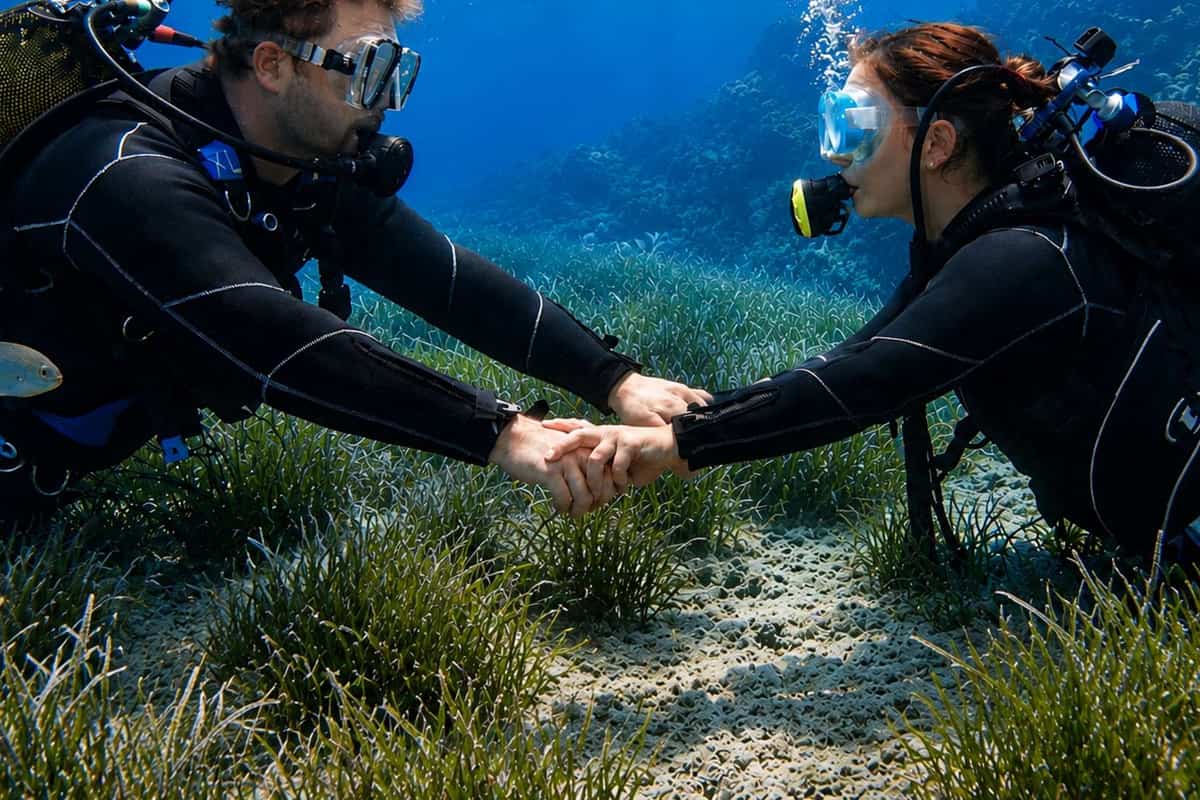
A Kos scuba diving trip takes divers under the Aegean Sea off the island of Kos, with an instructor beside first-time divers. See more Greek tours on the homepage.
This post covers where the dives take place, how an introductory dive works, what divers see, depth, water clarity, who can join, the season and booking. Equipment, a day on Kos and common questions come last.
What is a kos scuba diving trip?
A kos scuba diving trip is a dive in the sea off the Greek island of Kos, led by an instructor. Listings sell it as a private or small-group session with hotel pickup and diving equipment included, from beginner dives to a night dive.
Kos belongs to the Dodecanese group, which lies in the southeast of the Aegean Sea. Its main town and port is also called Kos. Listings add a safety briefing, an experienced instructor, diving equipment and hotel drop-off to the dive. The private listing offers English, and a second listing runs as a small group.
- Format: Private group
- Transfer: Hotel pickup
- Kit: Equipment included
- Language: English offered
A kos scuba diving trip suits travellers who want to see the Aegean seabed with an instructor and hotel pickup.


Where does kos scuba diving take place around Kos?
Kos scuba diving takes place in the southeastern Aegean Sea, off the coast of Kos. Listings name two kinds of start: a beach dive near Kos Town and a dive-boat trip to the small island of Pserimos, so divers enter from the shore or a boat.
The Dodecanese lie in the southeast of the Aegean Sea and include Rhodes, Kos and Patmos. The rocks of the Aegean floor are mainly limestone, though volcanic activity has greatly altered them. On land, Kos holds a wide variety of rocks, linked to how the island formed. Pserimos lies near the coast of Turkey.
- Sea: Southeastern Aegean
- Group: Dodecanese islands
- Base: Kos Town
- Floor: Mainly limestone
Whether a dive starts from a beach near Kos Town or from a boat to Pserimos depends on the listing.
How does kos scuba diving work for first-time divers?
Kos scuba diving for first-time divers starts with a safety briefing and theory from the instructor. An underwater session follows, led by the same instructor. The beginner learns to breathe from the regulator, to control buoyancy and to move with fins.

Entry-level training teaches the basics of a first dive. These include breathing from the demand valve, buoyancy control with weights and a buoyancy compensator, ear clearing, hand signals and safe descents. Divers are taught not to hold their breath. Travellers who want a sea day without a dive can read about a Kos boat trip.
- Briefing: Safety talk
- Air: Through regulator
- Buoyancy: Weights, compensator
- Signals: Hand signals
Kos scuba diving for first-time divers therefore rests on a safety briefing, an instructor and a set of basic skills.
What can divers see during kos scuba diving?
Kos scuba diving takes place in the Mediterranean, the only sea with Posidonia oceanica seagrass meadows. Salema porgies and common octopus also live in this sea, and the meadows give a large number of animals and plants food and protection.
Epiphytic communities play a role in the food chain of Posidonia meadows. Gastropod molluscs, amphipod crustaceans and polychaete worms eat them. Off Corsica, adult salema porgies fed mainly on Posidonia and its epiphytes. The salema porgy has a silvery body with eight to ten golden lines and a black spot at the base of the pectoral fin.
- Seagrass: Posidonia oceanica
- Fish: Salema porgy
- Octopus: Rocky floors
- Grazers: Gastropods, amphipods
Kos scuba diving passes seagrass meadows, salema porgies that feed on them and common octopus on rocky coastal floors.
How deep does kos scuba diving go?
Kos scuba diving follows depth limits set by the certification agencies. Entry level limits reach 18 or 20 metres, advanced limits reach 30, 40, 50 or 60 metres, and junior divers are held to 12 metres, depending on the agency and the certification.
Training agencies limit recreational depths to between 30 and 40 metres. Beyond that, oxygen toxicity and nitrogen narcosis raise the risk, and technical diving needs special skills and equipment. Deep sites also mean divers reduce their time, because more gas is breathed at depth. The Aegean reaches a maximum depth of 2,639 metres, west of Karpathos.
- Junior: 12 m
- Entry: 18-20 m
- Advanced: 30-60 m
- Risks: Narcosis, toxicity
The certification of each diver sets the depth limit, and the training agency defines that limit for every level.
How clear is the water for kos scuba diving?
Kos scuba diving takes place in the Mediterranean, a nutrient-poor sea where chlorophyll and nutrient levels are very low. Plankton, silt and sewage cause poor visibility, and currents or fins can stir settled particles back into the water.
Dive sites close to settlements and river estuaries are more prone to poor visibility. In summer, warm surface water is almost cut off from the deeper water, and the growth of plankton is very low from June to October. Water absorbs red light first and blue light the least. Temperature gradients and salinity gradients also affect visibility.
- Nutrients: Very low
- Particles: Silt, plankton
- Stirring: Currents, fins
- Red: Absorbed first
Kos scuba diving clarity depends on nutrients, particles and light, and stirred sediment lowers it at a dive site.
Who can join kos scuba diving?
Kos scuba diving is open to first-timers who dive beside an instructor. Certified divers can be asked to prove their level when booking, and listings ask for basic swimming skills and comfort in the water. They name pregnancy, heart problems and serious medical conditions as not suitable.
Medical fitness to dive means the medical and physical suitability of a person to work safely in the water with diving gear. A signed statement from the diver can show it, or a physician can examine the diver. As a rule, a recreational diver needs this proof only during training courses. The certifying agency sets the standard.
- Beginners: one-on-one instructor
- Certified: card check
- Swimming: basic skills
- Health: signed statement
Divers join kos scuba diving when swimming skills and health meet the rules of the listing.
Which season suits kos scuba diving?
Kos scuba diving suits the summer months, when the Aegean surface layer holds 19 to 24 °C, against winter lows of 8 to 13 °C across the sea. The island has a hot-summer Mediterranean climate, and the meltemi wind blows periodically until about mid-September.
The surface layer of the Aegean Sea is a veneer 40 to 50 metres thick, and Kos lies in the southeastern part of that sea. The meltemi is a dominant weather influence across the Aegean basin. One listing drives divers to the beach that suits diving best on the day, judged by the weather forecast.
- Summer: warmest water
- Winter: colder water
- Meltemi: periodic wind
- Climate: hot-summer Mediterranean
Warm summer water and the periodic meltemi wind shape the month a diver picks for a dive on Kos.
How do divers book kos scuba diving?
Kos scuba diving is booked ahead on a listing page. Divers pick a private or small-group dive, check availability to see the starting times, and read the pickup details. The listings read also offer free cancellation and a reserve-now, pay-later option.
Listings differ on language and group size. One offers English for a private group. Another offers English, German and Greek for a small group of up to 10 people, and asks for height, weight and shoe number. Guests who prefer to stay dry can book a glass-bottom boat, where passengers watch the underwater world from within the boat.
- Booking: listing page
- Includes: hotel pickup
- Group: private, small
- Languages: English, Greek
Booking kos scuba diving on a listing page keeps the dive, the pickup and the language in one place.
What equipment does kos scuba diving use?
Kos scuba diving uses a scuba set, which is any breathing apparatus carried entirely by the diver, built around a cylinder and a regulator. A mask, fins, a diving suit, ballast weights and a buoyancy compensator complete the kit.
Kos has a hot-summer Mediterranean climate. A diving suit protects against sunburn, abrasion and stings from certain marine organisms. Where warmth does not matter, a lycra suit or diving skin can be enough.
- Cylinder: breathing gas
- Mask: clear vision
- Fins: leg power
- Compensator: neutral buoyancy
Each piece of kos scuba diving equipment has one job, from breathing gas to sight, movement and protection underwater.
How does kos scuba diving fit a day on Kos?
Kos scuba diving fits a day on Kos as one water activity beside beach time or a land visit. Listings show a shore start, a boat trip to Pserimos and hotel pickup, while the island adds Kos town and the Asklepieion on land.
Beaches are the primary attraction of the island. The ruins of the Asklepieion, an ancient place of medical teaching, lie in Kos town, and a Kos island tour covers that site by land.
- Beach: shore start
- Boat: Pserimos trip
- Pickup: from hotel
- Land: Asklepieion ruins
Kos scuba diving suits a day that also holds beach time or a visit to the Asklepieion in Kos town.
What do divers ask about kos scuba diving?
Kos scuba diving questions cover beginners, children, health checks, flying after a dive and hotel pickup. The answers below follow Wikipedia for diving rules and Kos listings for the trip format. Each answer repeats only what its source states.
Can beginners try kos scuba diving?
Yes. Kos has dive listings for beginners, including a small-group dive from the beach and a boat-trip dive to Pserimos. Wikipedia describes introductory scuba experiences for people without certification, and says instructors train divers at the level of their certification.
Can children join kos scuba diving?
Age limits depend on the training agency. Wikipedia states that certain agencies accept trainees as young as 8 years old for supervised scuba experiences, and as young as 10 years old for certification. Supervised experiences and certification therefore start at different ages.
Is a medical check needed for kos scuba diving?
The majority of training organisations require a minimum level of fitness and health, according to Wikipedia. It describes initial training for a person who is medically fit to dive and a reasonably competent swimmer. Each medication case is best evaluated by an expert.
Why do divers wait before flying after kos scuba diving?
Breathing at greater pressure underwater makes tissues absorb more dissolved gas, and lower pressure in flight raises the risk of decompression sickness. Recommended waits rise from 12 hours after an introductory experience to 18 hours for certified divers on multi-day trips.
Does kos scuba diving include hotel pickup?
Listings differ. Four of the five Kos dive listings read show pickup available, and three name hotel pickup in the title. A boat-trip dive to Pserimos shows no pickup tag. Both private-group and small-group formats appear, and starts include the beach and a boat.