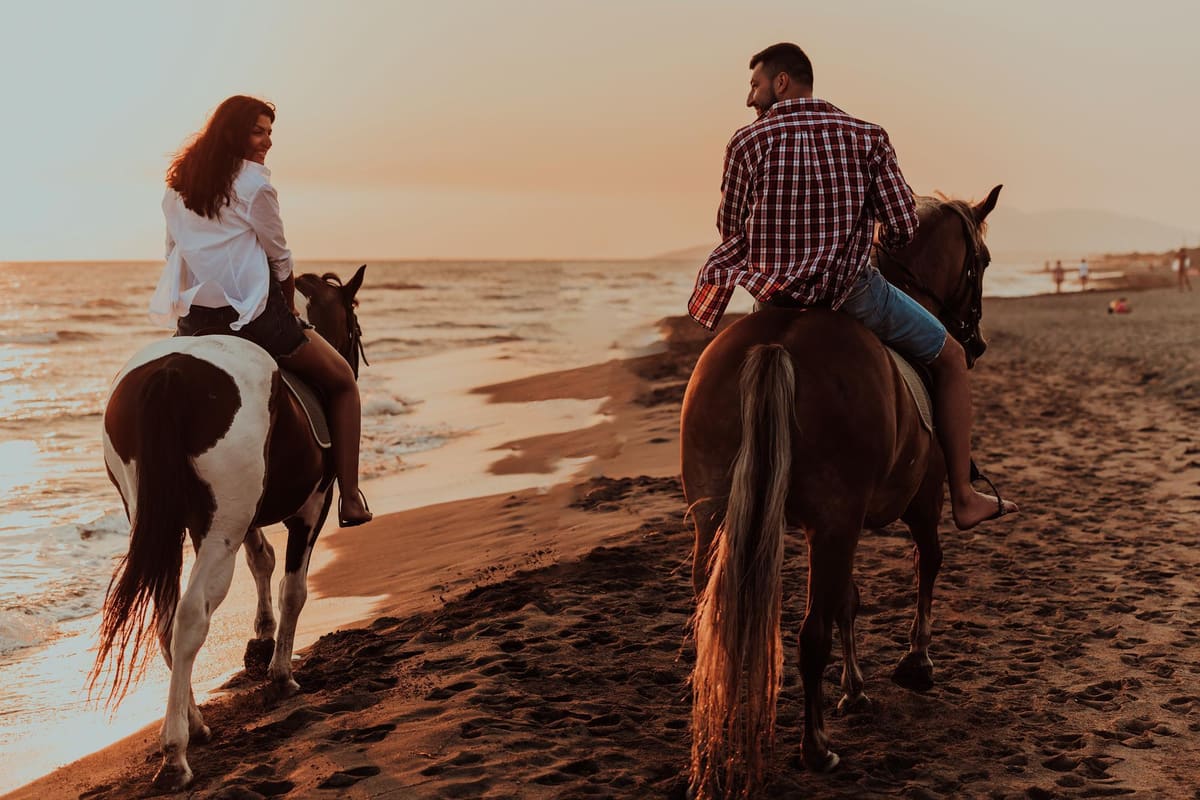
Corfu horse riding takes small groups along olive groves, quiet lanes and long sandy beaches. Rides suit new riders and riders with saddle time. It is one of the equestrian tours in Greece on Greece VIP.
This post covers what a Corfu horse riding tour includes, where it rides and rides along the beach. It also covers the nature on the way, safety for beginners and the history of horses on Corfu. What to wear, the best season and common questions come last.
Each section ends with a Corfu horse riding trip or a nearby tour that can be booked online.
What does a Corfu horse riding tour include?
A Corfu horse riding tour includes a horse fitted with tack, the riding gear. A saddle carries the rider. A bridle and reins let the rider steer. The ride moves at calm gaits, with fun and nature as the goals.
The seat of a saddle sits lower than the pommel at the front. It sits below the cantle at the back. On Corfu horse riding trails, this shape holds the rider securely. On an English saddle, a gap called the gullet keeps pressure off the horse’s spine.
On a Western saddle, the raised front is called the swells. Leather fenders guard the rider’s legs. The first stirrup-like object was a leather toe strap, invented in India in the 2nd century BC.
Herders of the Pontic-Caspian steppes devised the bridle between 3000 BC and 2000 BC. The bit rests on the bars. These are the toothless gap between the front teeth and the molars.
The snaffle, a bit with two rings, is the commonest riding bit. Soft, steady contact causes a horse less stress than sudden pulls. Corfu horse riding is a slow, quiet contrast to jeep safaris across Corfu.
- Rein aids: Rein cues ask the horse to turn, slow down, halt or step backwards.
- Breastplate: It keeps the saddle from sliding back and buys time if the girth breaks.
- Crupper: This loop under the tail keeps the saddle from sliding forward.
At the walk, a horse moves left hind, left front, right hind, then right front. The trot is the working gait, and a fit horse keeps it up for hours.


Where do Corfu horse riding tours ride on the island?
Corfu horse riding tours ride across the west and north of the island. Routes reach hill villages, bays and capes. The south also has lagoon country near Korission. Each area mixes old village history with wide sea views.
Kokkini stands at about 80 m above the Ropa valley. It lies near the beaches of Glyfada, Ermones and Kontogialos. Corfu horse riding here pairs valley views with the nearby coast.
Agios Georgios Pagon is a seaside village at 7 m. It serves as the harbour of the hill villages Pagoi and Makrades. It lies 30 km north-west of Corfu town.
Pagoi stands at 170 m. Above Agios Georgios Bay, Prinylas was the seat of a Byzantine official called a Decarch in 1200. Its church of Agios Nikolaos dates from the 14th century.
Corfu horse riding reaches Magoulades, whose name comes from Magoula, meaning hill. Its Panagia Ypsili monastery dates from the early 10th century. Nearby Afionas stands at 133 m on a mountain cape facing Mathraki, Othonoi and Gravia.
- Korission Lagoon: It lies about 40 km south-south-west of Corfu town.
- Protected status: Korission is listed as a Landscape of Special Natural Beauty.
- Marathias: The island is only about 3,150 m wide here, sea to sea.
Corfu horse riding in the south passes Agios Georgios Argyradon, 32.5 km from Corfu town. Halikounas, 7 km south of Agios Mattheos, was once that village’s seaside settlement. Both lie on the southern coast of the island.
Can a Corfu horse riding tour ride along the beach?
Corfu horse riding along the beach centres on long sandy shores. The south holds the longest stretches, near a coastal lagoon. Dunes rise behind the sand there. The west adds bays with old village ruins and long history.
The beach at Agios Georgios Argyradon is 8 km long. A small harbour splits it in two. It runs into Issos beach to the north and Marathias beach to the south.
Issos and its dunes hosted a beach buggy chase in a James Bond film. Large, sandy Santa Barbara lies about 2 km south-west of Marathias.
Corfu horse riding near Korission meets Halikounas beach, a narrow sand strip about 3 km long. It separates the lagoon from the sea. The land strip is about 250 m wide and carries large dunes.
Corfu horse riding in the north-west reaches Arillas, 5 m above the sea, south of Cape Kefali. At Agios Georgios Pagon, ruins of a village destroyed by landslides survive on land and under the sea.
- Sand supply: Coastal dunes need sand, wind to move it, and a place to build up.
- Dune grasses: Their deep roots bind the sand and help a dune grow.
- Dune ages: Young dunes are yellow dunes, and older, humus-rich dunes are grey dunes.
Corfu horse riding on these shores passes ground that guards the coast. During storms, dunes soak up much of the wave energy moving onshore. Javelin sand boas and two bat species live around Korission.
What nature does a Corfu horse riding tour pass?
Corfu horse riding passes olive groves, tall cypress trees and evergreen oaks. Wetter routes lead past reedbeds full of birds. The ride crosses farm land, woods and wet ground in turn. Each type of ground shelters its own plants and animals.
Olive trees are tough survivors. When hard cold kills the parts above ground, the root base can live on. It sends up new shoots that become new trees. Olive pollen rates 10 out of 10 on the OPALS allergy scale.
Dark cypress trees rise beside Corfu horse riding trails. Planted ones have a crown under a tenth as wide as they are tall. This makes the dark green “exclamation mark” shape of the Mediterranean.
The holm oak is a large evergreen oak. It reaches 21–28 m in good conditions. Its leaves look like holly, and holm is an old name for holly.
Damp ground holds the common reed, a wetland grass 1.5–4 m tall. The great egret, an all-white heron up to 1 m tall, hunts there.
- Flamingos: The greater flamingo stands 110–150 cm tall and gets its pink colour from its food.
- Snakes: Of the snakes of Corfu, only the nose-horned viper is potentially dangerous.
- Reedbeds: Beds over 25 hectares are valuable to the Eurasian bittern and the great reed warbler.
Corfu horse riding moves slowly, so riders notice these details. Riders with hay fever do well to note late winter. Then male cypress cones, 3–5 mm long, release strong pollen.
How safe is Corfu horse riding for beginners?
Corfu horse riding is safe for beginners who follow simple rules. A tested helmet protects the head. Calm habits around the horse prevent surprises. Knowing how a horse sees and hears helps a new rider stay relaxed and confident.
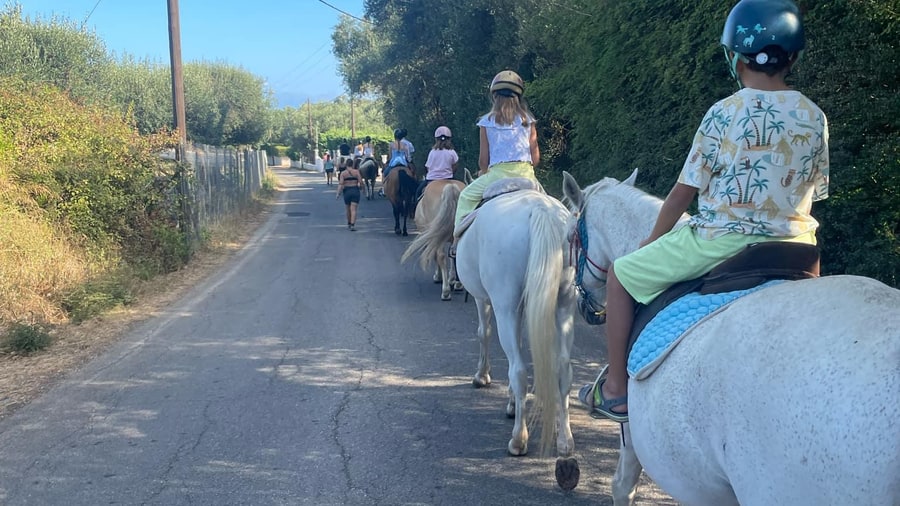
A horse has one of the largest eyes of any land mammal. Still, it sees only blues and greens. Red looks more green to it. Yellows and greens are hard for it to tell apart.
Light changes also matter on Corfu horse riding trails. A horse adjusts to sudden shade more slowly than a person. For a moment, it struggles to judge what is ahead.
Each ear turns up to 180°, so the horse hears all around without moving its head. Its skin feels an insect landing anywhere on its body.
Horses in a group tend to travel in rank order. On Corfu horse riding trails, a calm line keeps them settled. A horse that bucks under saddle is telling the rider it is in pain.
- Near side: All work around a horse traditionally starts on its left, called the near side.
- Helmet: In FEI competition, helmets must meet a tested European, British, North American or Australian/New Zealand standard.
- Hat choice: A hunt cap, derby, cowboy hat or top hat gives little or no protection.
Corfu horse riding stays calm when riders follow these habits. A cold-backed horse arches its back and can buck slightly at first mounting. Riders sit gently and wait for it to settle.
What history ties horses to Corfu?
Corfu horse riding follows a long island story. Homer told of a mule waggon among the Phaeacians. Mercenary cavalry and an Austrian empress who loved riding also left marks. Today, rules even protect carriage horses from heat.
In Homer’s Odyssey, princess Nausicaa asks her father for a big waggon and mules. She drives it herself with whip and reins. She keeps a slow pace so Odysseus and her maids can follow on foot.
In 1716, an Ottoman army gathered at Butrint on the mainland, facing Corfu. Its 3,000 horsemen stood ready to cross the Corfu Channel.
The stradioti were Balkan mercenary cavalry, about 80% of them Albanian. They pioneered light cavalry tactics in early modern European armies.
Empress Elisabeth of Austria had the Achilleion built on Corfu. As a girl, she skipped lessons to ride in the countryside. Fans of Corfu horse riding share her love of open trails.
- Andravida horse: Experts believe this breed comes from Athenian cavalry horses of the fourth century BC.
- Pindos pony: Its narrow but strong hooves rarely need shoeing.
- Pegasus: In the early 1990s, this stallion sired 50 foals and saved the Andravida from extinction.
Corfu horse riding today sits under modern care rules. Carriage horses on Corfu cannot work from 12:00 to 5:00 p.m. at 35 to 39 °C. Above 39 °C, they do not work at all.
What do riders wear on a Corfu horse riding tour?
Corfu horse riding calls for snug, practical clothes. Riders wear jodhpurs or breeches with short boots. Half chaps add grip and protect the lower leg. A body protector, a padded vest, shields the ribs and spine in a fall.
Modern jodhpurs use stretch fabric and fit tightly down the leg. The first jodhpurs flared at the hip to make sitting easier. Elastic straps, called stirrups, run under the boots.
Jodhpurs suit children on Corfu horse riding trips. Short paddock boots cost less to replace than tall boots as young feet grow. Stretch fabrics like nylon and spandex spread through breeches in the 1960s.
Chinks are half-length leather chaps that stop 5 to 10 cm below the knee. They feel cooler and suit very warm climates. The same clothing rules apply to horse riding on Naxos.
An air bag vest for Corfu horse riding weighs about 2 lb. It goes over a standard foam vest. Unlike a car air bag, it can be repacked with a new CO2 cartridge.
- Knee-patch breeches: Grippy suede sits inside the knee for pleasure riders.
- Full-seat breeches: Grippy material covers knee to seat for dressage.
- Gloves: In show jumping, gloves, mostly black, are optional.
Sun care matters too. Studies at the University of Alberta show darker fabrics block more sun than lighter ones. Certain antibiotics, acne medicines and antidepressants make skin burn faster in strong sun.
When is the best season for a Corfu horse riding tour?
Corfu horse riding works well in spring and autumn. September is the calmest month, with a mean wind of 3.5 knots. October keeps a mild daily mean of 18.5 °C. February is the windiest month, peaking at 5.5 knots.
Long-term wind records for Kerkyra, the Greek name for Corfu, show a clear pattern. A southerly wind leads for the first five months of the year. In June, July and August it turns westerly. From September to November it returns to the south.
April has a daily mean of 15.2 °C and a low of 9.6 °C. It brings 12.2 rain days and humidity of 72.5%. The fifth month warms to a daily mean of 19.9 °C.
Corfu horse riding in March is cooler, with a daily mean of 12.1 °C. March gets only 116.0 hours of sunshine. November stays mild, with a daily mean of 14.4 °C.
Summer nights stay mild. Record lows are 10.0 °C in July and 11.3 °C in August. Wind is light then too. The fifth month, July and August each average a mean wind of 3.6 knots.
- December: Wind comes from the south-east; humidity hits 77.1%.
- February: Highs average 14.1 °C and lows 5.7 °C.
- September: Humidity averages 70.3%; the record low is 7.2 °C.
Spring brings wetter, cooler days. Autumn brings calm air and mild warmth. Riders who dislike strong wind can avoid February and pick early autumn for a Corfu horse riding outing.
What do travelers ask about a Corfu horse riding tour?
Corfu horse riding raises questions about safety, instructors and horse welfare. Helmets are a key safety topic. Children and young riders have their own clubs and tests too. Questions about ages and horse rest times come up as well.
Do instructors need a licence for Corfu horse riding?
Across much of the world, instructors face no formal rules or licensing. In Great Britain and across much of Europe, accredited bodies award instructor qualifications. The International Group for Equestrian Qualifications issues International Trainers Passports. They show an equivalent qualification across member countries.
Who runs the sport behind Corfu horse riding?
The FEI governs international equestrian sport, meaning horse sport. It was founded in Paris on 24 November 1921. Its headquarters sit in Lausanne, Switzerland. Greece is a member federation within its European group. That links Greek riding to shared international rules.
Is a helmet needed for Corfu horse riding?
Helmets for beginning riders are becoming a common requirement. Certain liability insurance policies ask instructors to make students wear them. A survey covered 679 riders in Oregon, Washington and Idaho. It estimated one in five gets seriously hurt while riding.
What age suits Corfu horse riding for children?
Harry Faudel-Phillips founded the Pony Club in Britain in 1929. It aimed to get children riding. UK members can stay until the end of the year they turn 25. In Australia, membership is open from 3 to 80 years old.
How heavy can a rider be for Corfu horse riding?
Research found a rider’s weight affects a horse’s pain. A skilled rider balances better and spreads weight well. That eases strain on the horse’s back. Pound for pound, ponies carry more weight than horses, and Connemara ponies carry full-sized adults.
Do horses rest during Corfu horse riding days?
Riding school horses grimace more on days with 1 to 2 hours of riding. Grimacing is a sign of pain. It rises again after 3 to 4 hours. In endurance riding, horses rest 40 to 60 minutes after each vet check.