
A Mykonos wine tour visits the farms and small vineyards of inland Mykonos. Guests taste island wines with local food and walk among low vines. It is one of the wine tastings in Greece on Greece VIP.
This post covers what a Mykonos wine tour includes, the farms and vineyards and the grapes grown there. It also covers the history of wine on the island, local food and how wind and soil shape the vines. Wine tasting, the best season and common questions come last.
Each section ends with a Mykonos wine tour or a nearby food tour that can be booked online.
What does a Mykonos wine tour include?
A Mykonos wine tour includes tasting island wine and learning about local farm life. Barley, grapes and figs are the main farm products of Mykonos. Tastings sit beside local foods like cheese and grape syrup. The visit links wine to old island crafts.
A Mykonos wine tour is a form of agritourism, any farm-based activity that brings visitors to a farm. Winery visits are one direct form. Such visits give small farms income in months without crops.
In the fourth century BCE, Plato listed the main flavours of wine. The word tasting first appeared in 1519. Linnaeus and others had set the tasting method by the 18th century.
The best tasting glass is tulip or egg-shaped, with a narrow opening. Tasters purse their lips and breathe in over the wine. This passes oxygen across it and releases more esters, the smell compounds.
Tyrovolia, called t’rovolia in the island dialect, is an unsalted local cheese. It is the base for the island pies melopita and kremmydopita. Travellers who enjoy it also join food tours in Mykonos Town.
- Petimezi: This is a thick, dark syrup made by boiling grape must, the fresh grape juice.
- Name: The word comes from the Turkish pekmez, and Byzantines called it epsima.
- Uses: It keeps long outside the fridge and replaces sugar in dressings and dessert syrups.
The Agricultural Museum around the old Bonis mill adds farm history to a Mykonos wine tour. This open-air museum shows the threshing floor, oven, well and grape-treading floor. The mill still works in full order.


Which farms and vineyards does a Mykonos wine tour visit?
A Mykonos wine tour visits the farmland around Ano Mera. This lowland village sits in the inland centre of the island. Its average altitude is 100 metres. The village lies at the eastern end of Agios Patapios hill, which rises to 239 metres.
Ano Mera was recognised as a settlement in 1879. It became the seat of its own community in 1912. The rural community covers 41.625 km² and takes in Kalafatis. Since 1988 it has been a listed traditional settlement.
Water shapes farming on the island. Mykonos has only one spring, at the Tourliani monastery, and once relied on wells. The Ano Mera Dam stands on the Maou Lagada stream. Its reservoir holds one million cubic metres of runoff for irrigation.
Stops on a Mykonos wine tour sit close to the Tourliani monastery museum. It keeps a folklore collection and old farm tools. Church heirlooms and icons sit beside them. A windmill stands on a rise above Ano Mera.
- Paleokastro: This 18th-century monastery north of Ano Mera has a gilded iconostasis, a gold-covered screen of icons.
- Gyzi castle: Its 13th-century ruins hold an ancient wall and Geometric, Archaic and Hellenistic pottery.
- Dovecotes: These stone pigeon houses stand on slopes near running water and never face north.
Dovecotes also served owners as country houses, stables and hay barns. Their front slabs form squares, rhombuses and triangles. These shapes can spell the owner’s initials and building date. Visitors on a Mykonos wine tour spot them across the farmland.
Which grapes grow on a Mykonos wine tour?
A Mykonos wine tour shows grapes from the Cyclades, a wide island group. The national wine body calls it a veritable ark of Greek viticulture. That means a store of native vine types. The list holds both white and red grapes.
White grapes allowed in PGI Cyclades wine include Asprouda Santorinis, Gaidouria, Katsano, Kritiko and Maloukato. PGI means a protected regional label for wine. Red grapes include Avgoustiatis, Voydomatis, Kotsifali, Mavrotragano and Fokiano.
Athiri, Aidani and Mandilaria appear in both white and black forms. Mandilaria is a late-harvested red grape. It also goes by Pariano, Vaftra and Koundoura Black. Wines made from it alone are quite rare.
Mavrotragano takes its name from its black, or mavro, and crisp, or tragano, berries. Santorini growers searched the volcanic soil vine by vine to save it. Growing has now spread to Tinos, the island next to Mykonos.
Aidani gives pale lemon-green wines with notes of yellow fruit, citrus, minerals and flowers. Blended with Assyrtiko, it adds roundness and floral depth. Visitors on a Mykonos wine tour meet this white grape.
- Origin: Monemvasia comes from Lakonia, yet today it grows almost only on Paros.
- Terraces: On island mountain slopes, growers plant it on stone terraces.
- Sweet wines: It goes into PDO Malvasia Paros and PDO Monemvasia-Malvasia.
Athiri resists downy mildew, a leaf disease, fairly well. It is very sensitive to powdery mildew, another fungus. Its symptoms warn growers of an attack on every vine planted beside it.
What history lies behind a Mykonos wine tour?
A Mykonos wine tour follows a farming story that began in the Bronze Age. Early islanders grew barley, grapevines and olive trees. Ancient Mykonians honoured Dionysus, the god of wine. Later, Venetian rulers valued the island’s farmland.
In the Cycladic civilisation, farming rested on grain. Barley came first because it needs less water than wheat. Grapevines and olive trees grew beside it. A Mykonos wine tour therefore walks through a very old farming pattern.
Myth links the island to wine as well. Anius of Delos was the father of the hero Mykonos. His three daughters were named Oeno, Spermo and Elais. Dionysus gave them the power to turn anything into wine, wheat and oil.
Ancient Mykonians worshipped Dionysus and his mother Semele with special devotion. They also honoured Demeter, called Chloe, and Poseidon. The island’s coins carry the figure of Dionysus or the head of Poseidon. As a Delian League member, Mykonos paid Athens one talent.
Under Venice, farming, livestock, local trade and ports gave the island its value. Marco Loredan ruled Tinos and Mykonos from 1452 to 1456. He asked for land on Mykonos instead of cash, including terraces and farmland.
- Agricultural Museum: The open-air museum shows a threshing floor, an oven, a well and a grape-treading press.
- Bonis mill: The museum stands around the Bonis mill, which still works.
The Cyclades export wine from Andros, Tinos, Mykonos, Paros, Naxos, Sikinos and Santorini. In 1933, only 2,150 holiday-goers came to Mykonos. A Mykonos wine tour links that quiet farming past with the island today.
What local food pairs with a Mykonos wine tour?
A Mykonos wine tour pairs well with island cheese and sausage. Kopanisti is a pink, spicy local cheese. Tyrovolia is another local cheese with no salt. Local wines and dishes grew up together, so they suit each other at the table.
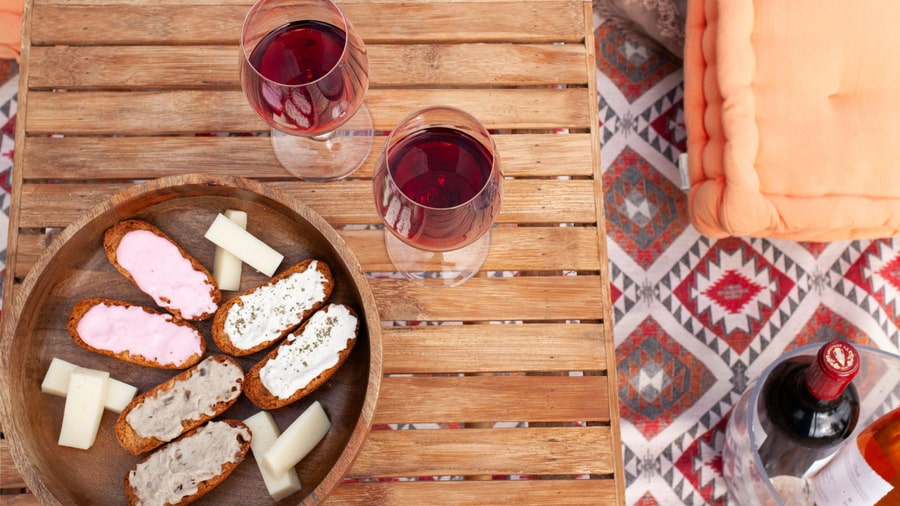
Kopanisti Mykonou gained protected origin status in 1996. Its hotness comes from fungal growth, a kind of natural mould. People sometimes call it the Greek Roquefort. It finishes ripening after 30 to 40 days.
Tyrovolia is called t’rovolia in the local dialect. Mykonian cooks use it to make xinotyro. They also bake the traditional pies melopita and kremmydopita with it. A Mykonos wine tour can set these flavours beside a glass.
Loukaniko, the Greek sausage, takes its name from the Roman lucanica. Greek sausages are sometimes smoked over aromatic woods. Leeks are a common flavour. Unlike other sausages, Greek ones do not use bread as a filler.
Soft, rindless young cheeses go best with dry or off-dry whites, light reds and rosés. Acidity in wine makes the mouth water and wakes the appetite. A wine less tart than the dish tastes thin. A Mykonos wine tour shows these rules at the table.
- Salt and sweet: Sweet wine can contrast with salt, like Stilton with Port.
- Bridge flavours: Slow-cooked onions link well with creamy wines.
- Old roots: Homer’s Odyssey mentions a kind of blood sausage.
Across cultures, local dishes were simply paired with local wines. Cooking and winemaking grew up side by side. A Mykonos wine tour follows that old habit with cheese, pies and sausage.
How do wind and soil shape a Mykonos wine tour?
A Mykonos wine tour crosses stony, windy ground with very little flat land. The island has no forests and only two mountains. Vines there need care against wind and dry soil. Low, compact vines and wide spacing help them survive.
Anomeritis rises in the east and Vorniotis in the north. Each mountain has two peaks. The highest peak of each is called Profitis Ilias.
Granite is a coarse rock made mostly of quartz, alkali feldspar, mica and plagioclase. Acids in rain turn its feldspar into kaolinite, a clay mineral. Broken granite also forms grus, a layer of sharp sand and gravel.
Growers sort vines as high-trained or low-trained by trunk height. The gobelet, or bush vine, sits low to the ground. Egyptians and Romans used it. It suits weak vines, with stakes or none.
A wide, spread-out canopy gives little wind protection. In Châteauneuf-du-Pape, the mistral wind can strip fruit off the vine. Growers there prefer a compact shape. A Mykonos wine tour shows why low vines make sense in wind.
- Wide spacing: Dry farmers space plants wider to give each more soil moisture.
- Weed control: Strict weeding keeps weeds from using water the crop needs.
- Low rain: Dryland farming can succeed with as little as 9 inches of rain a year.
Behind a porous windbreak, wind speed is lowest at 3 to 5 times its height. This calm area is called a wind shadow. A Mykonos wine tour reveals how such ideas fit a dry, windy island.
How does a wine tasting work on a Mykonos wine tour?
A Mykonos wine tour tasting follows a set order. Wines go from dry to sweet and young to old. Tasters look, sniff in short bursts and sip. Each glass shape helps the smell and feel of the wine.
The Oxford Companion to Wine calls the common tasting order wise. Dry wines come before sweet ones. A sweet wine makes later dry wines seem acidic and unpleasant. So each glass gets sweeter.
The tongue senses only sour, bitter, salty, sweet and savoury tastes. Fruit, floral, herbal and earthy flavours come from the nose. The nose tires after around six seconds, so short sniffs work best.
Ann C. Noble and her colleagues at the University of California, Davis built the Aroma Wheel in 1984. It sorts smells into 12 basic groups, and each group splits into narrower aromas.
Red wine glasses have a rounder, wider bowl that lets in more oxygen. Common white wine glasses have a smaller mouth to keep whites crisp. The same holds on wine tours on Naxos.
- Acidity: It prickles the sides of the tongue.
- Tannin: The word comes from French tan, crushed oak bark.
- Cleansers: Bread, apple slices, parsley and mint reset the mouth.
Tasters on a Mykonos wine tour also feel tannin as a dry pucker. This pucker is a touch sense, not a taste. Too much acidity tastes sharp, and too little tastes flat.
When is the best season for a Mykonos wine tour?
A Mykonos wine tour suits summer and autumn. Greek grapes start to ripen in August. Harvest work fills the autumn weeks. In October, Mykonos days average a high of 21.8 °C. Harvest customs add to the season.
On 6 August, Greek winemakers used to fill a basket with the first ripe grapes. They sent it to church for a blessing. On the first harvest day, a priest said a prayer.
Greek autumn weather is unstable, and a sudden rain can ruin the crop. So family, friends and neighbours help finish the picking. At noon, the team stops to share food from the grower.
Night warmth shapes a Mykonos wine tour too. The HNMS station on Mykonos gives August an average low of 22.9 °C. September lows average 20.4 °C, and October lows 17.2 °C.
Warm weather affects the grapes. Grapes lose malic acid, a natural grape acid, faster in warm climates. The acid left in the grape is a key point in choosing the harvest date.
- Hand picking: Pickers choose only healthy bunches and handle grapes gently.
- New wine: Tasting began on 26 October, the feast of Agios Dimitrios.
- Moustokouloura: Greek bakeries sell these grape syrup cookies from late August to early December.
In the past, grapes were trodden by foot. The wine then fermented in wooden barrels for three months. That old rhythm still frames a Mykonos wine tour in the autumn.
What do travelers ask about a Mykonos wine tour?
A Mykonos wine tour raises common questions about age, diet, flights and weather. Clear facts exist for each one. Wine making, cheese making and airline rules all play a part. Health matters, such as pregnancy, count as well.
Can minors drink on a Mykonos wine tour?
Greek Law 3730/2008 banned minors from drinking alcoholic beverages in public. That law does not apply to private events or private premises.
Is the wine on a Mykonos wine tour vegan?
Winemakers use fining agents, substances that clear the wine. Gelatin and isinglass, made from fish bladders, are animal-based. Bentonite clay is a common mineral choice. A UC Davis study found no detectable mineral agents in finished wine. Only trace amounts of protein-based ones remained.
Can wine from a Mykonos wine tour go in a flight bag?
American FAA rules cover drinks of more than 24% and up to 70% alcohol. Each passenger can carry up to 5 L of these. They must stay in unopened retail packaging. Drinks above 70% alcohol are banned from passenger bags.
Which cheeses suit vegetarians on a Mykonos wine tour?
Calf rennet curdles milk for cheese. It comes from the fourth stomach chamber of young, nursing calves. Cheeses made with plant, fungal or microbial rennet suit lacto-vegetarians, who eat dairy. Fermentation-made chymosin costs less, so European industrial cheesemaking uses it more than animal rennet.
Is the wind a problem on a Mykonos wine tour?
The municipality describes wind on Mykonos as moderate. It ranges between 2 and 6 on the Beaufort scale, which rates wind strength. The HNMS station records average humidity of 66.1% in September and 72.2% in October. Damper air comes later in the season.
Can pregnant travelers join a Mykonos wine tour?
Almost all experts, including the World Health Organization, recommend avoiding alcohol during pregnancy. Petimezi is the Greek grape syrup. Before cane sugar spread, it was a common sweetener with carob syrup and honey. Fruits boiled and candied in it are called retselia.