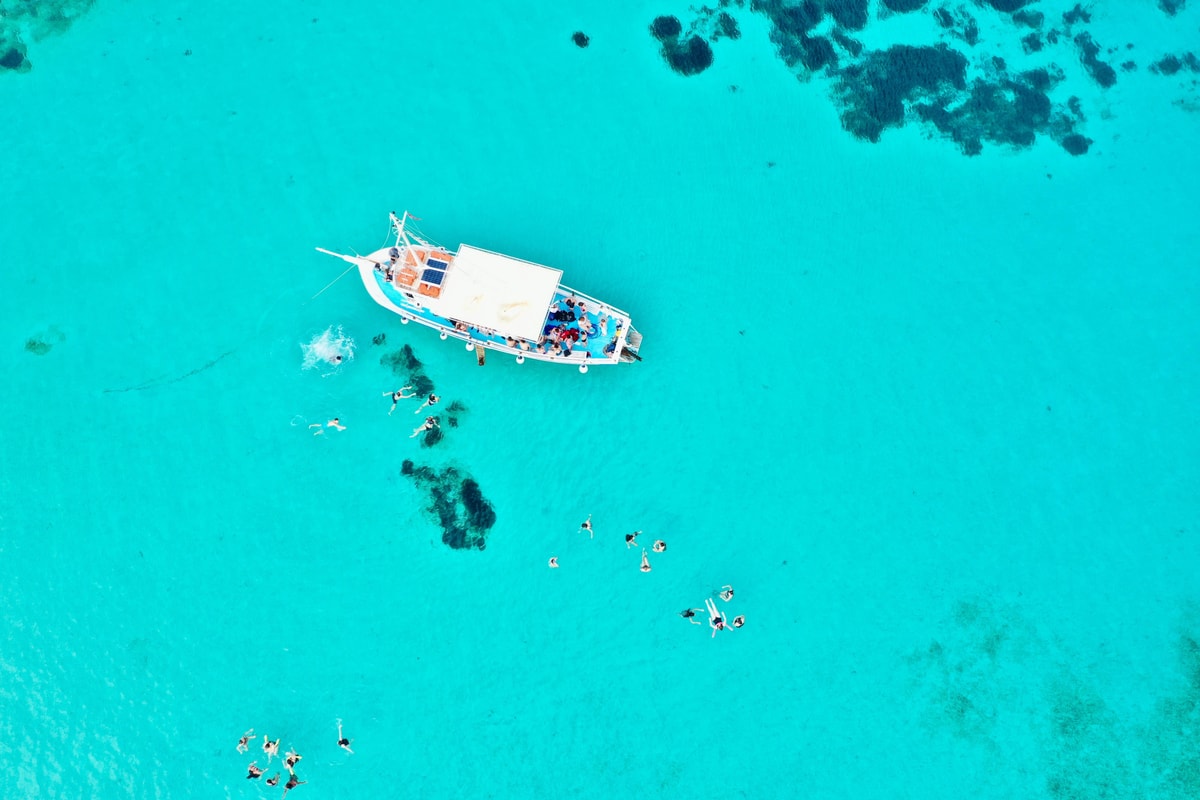
Paros snorkeling means floating face down in clear, shallow water off Paros and Antiparos with a mask, a snorkel and fins. Calm bays, sea caves and seagrass sit close to shore. It is one of the snorkeling trips in Greece on Greece VIP.
This post covers what Paros snorkeling includes, the best beaches and the coast of Antiparos. It also covers sea life, tips for beginners and safety. What to wear, the wind and the boat trips that add snorkeling follow. The seabed, the best season and common questions come last.
Each section ends with a Paros snorkeling trip or a nearby sea tour that can be booked online.
What does Paros snorkeling include?
Paros snorkeling includes a mask, a breathing tube called a snorkel, and fins. Each piece has a simple job. Good gear keeps water out and air flowing. Knowing how the tube clears makes time in the water easier and safer.
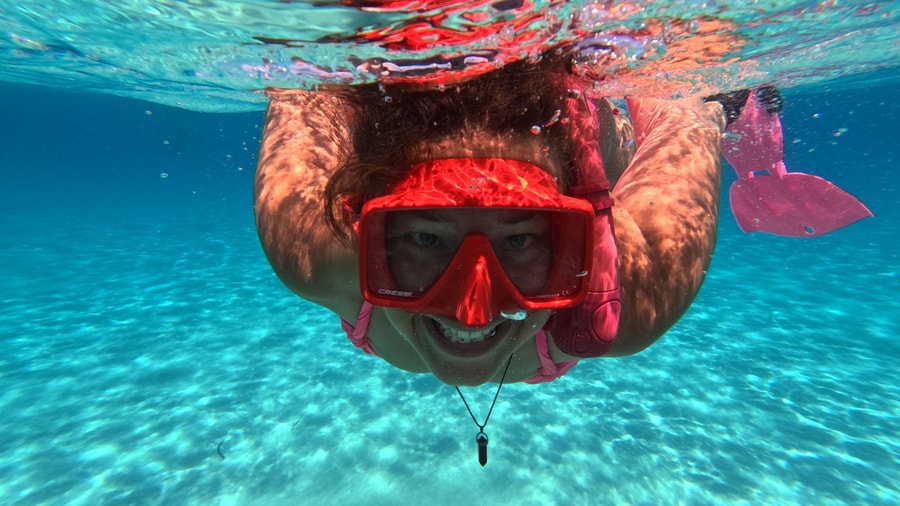
Under the European standard EN 1972 (2015), a tube for larger lungs is no longer than 38 cm. It holds no more than 230 cubic centimetres. A longer tube does not help, because water pressure makes inhaling too hard.
Water in the tube is a normal part of Paros snorkeling. In displacement clearing, the swimmer tilts the head back just before the surface. A strong breath out then pushes the water from the tube. Other snorkels have a one-way drain valve at the lowest point.
Newer tubes also block water at the top. A dry snorkel has a float valve that shuts when a wave passes. A semi-dry snorkel has a splash deflector that cuts the spray over the tube.
A full-face mask lets the wearer breathe through the nose or the mouth. It suits use at or near the surface. The wearer cannot pinch the nose to clear the ears. Deeper dives belong to scuba diving around Paros.
- Bite: Biting the mouthpiece lugs hard shrinks the air gap and makes breathing harder.
- Fog: Breathing out through the nose helps keep a mask clear, except in cold water.
- Floods: A badly flooded full-face mask must come off fully, so quick-release straps matter.
By the 2000s, only two swim masks with attached tubes were still made worldwide. Both, the Majorca sub 107S and the Balco 558, were made in Greece. Owen Churchill gave fins the name swimfins in 1939, and it is still common in English.


Which beaches suit Paros snorkeling?
Paros snorkeling works well at calm, sheltered beaches with clear water. Small Santa Maria, Logaras and Kalogeros suit swimmers who want rocks and seabed views. Monastiri and Faragas offer easy entry. Each beach offers a different seabed.
Small Santa Maria sits in a small sheltered bay about 16 km north-east of Parikia. It has partial shelter from the summer meltemi wind. Rocky formations line its coast. Clear water there serves swimming and Paros snorkeling.
Logaras has tall sea pines that shade the sand. Its seabed is ideal for snorkeling or spearfishing. Kalogeros lies right next to the large sandy Molos beach. Its oddly shaped cliffs give shade in the afternoon, and swimmers bring what they need.
Monastiri is sheltered from the winds and has a lifeguard. Tamarisk trees add shade beside the umbrellas. In summer, kaikia, small local boats, carry swimmers there from Naoussa port. Paros snorkeling at Monastiri needs care, because piers 150 m and 250 m away moor boats.
Faragas has a gently sloping seabed. The 5 m depth line lies about 170 m from shore. Its western part is organised, with services on the sand.
- Agios Fokas: This small sandy beach sits on the northern edge of Parikia bay after Kaminia.
- Kalogeros name: The name means monk, after a legend of one who fell from the cliff.
- Monastiri crowds: The greatest number of bathers there is estimated at 150.
Water quality backs up Paros snorkeling on every coast. The shores belong to the Paros-Naxos coastal water body. Its ecological status is rated High. At Faragas, the greatest number of bathers is estimated at 200.
What does Paros snorkeling show around Antiparos?
Paros snorkeling around Antiparos reveals rocky islets, quiet coves and protected waters. The Amfigeio strait between the two islands is only 4.5 m deep. Small islets sit to the south. Despotiko lies further out, in a zone of absolute protection.
Panteronisi is an islet off south-west Paros, east of Antiparos. It is the largest of the small Panteronisia group. Tigani, a rocky islet, sits between Glaromputa and Panteronisi.
Antiparos has 57 km of coastline. Its western coasts are smooth and sandy. Its eastern coasts are rocky, with small coves for Paros snorkeling. Revmatonisi, a green private islet, lies north-east of Antiparos.
Despotiko covers 7.754 square km and stays uninhabited. It serves as grazing land with fine beaches and excellent fishing waters. Rare fossils in sandy stone turn up on its beaches and on Strongylo.
History lies under the water too. Partly submerged vineyard trenches sit off north-east Antiparos. Matching trenches lie west of the Panagia chapel on Despotiko.
- Pirates: In 1675 the French pirate Daniel lost a sea battle off Antiparos and Despotiko.
- Rock: Volcanic rocks of ash and fragments cover the whole southern part of Antiparos.
- Birds: A bird protection site covers 2414.31 ha of islets and the south of Antiparos.
Seabird colonies need space during Paros snorkeling trips. Tourists disturbing them is a known threat to the protected site. Calm, quiet behaviour near the rocky islets helps the birds rest.
Which sea life does Paros snorkeling show?
Paros snorkeling shows fish, anemones, starfish, sea cucumbers and octopus near the shore. Damselfish shoals live over rocky ground. Sea cucumbers work slowly through the sand. Seabream carry dark marks near their tails, which makes them easy to name.
The damselfish lives in coastal water from 2 to 40 m deep. It eats tiny drifting animals, such as copepods and fish larvae. When the surface gets busy, its shoals dive deeper and leave their food behind.
Paros snorkeling also brings wrasses into view. The Mediterranean rainbow wrasse forages in groups by day for molluscs and crustaceans, such as snails and crabs. Rainbow wrasses longer than 18cm are all males with a white belly and an orange zigzag.
Peacock wrasse males build a seaweed nest in spring and guard it. Females lay sticky eggs inside. The annular seabream has a dark ring at its tail base. Its Latin name annularis means ring-shaped.
The saddled seabream has a white-edged black saddle mark at its tail base. Its name melanurus means black tail. In September 2023, these fish were reported attacking older swimmers with warts, moles or cuts.
- Sea cucumber: The tubular sea cucumber has three rows of tube feet and dark, thorn-like skin bumps.
- Snakelocks anemone: It averages 8 cm across and shelters a goby, a shrimp and a spider crab.
- Starfish: Coscinasterias tenuispina has 6 to 12 arms and splits its disc in summer into two starfish.
Paros snorkeling rewards slow looking. Sea cucumbers in one square metre of sand process nearly 20 kg of sediment a year. The common octopus has three hearts and about 500 million nerve cells.
How does Paros snorkeling work for beginners?
Paros snorkeling for beginners starts with three skills. The swimmer learns to breathe calmly through the tube. Next comes clearing water from the mask. Finally comes the flutter kick, an easy up and down leg motion taught more than any other.
Experienced snorkelers start each breath out with a sharp puff that clears leftover water. Then they breathe out slowly. A slow breath in, right after, lowers the chance of drawing in water.
Beginners also practise displacement clearing. The swimmer tilts the head back just before the surface and breathes out until breaking through. This fills the tube with air. It only works when surfacing.
A soft bite on the mouthpiece keeps breathing easy. A tight grip shrinks the air gap and causes jaw fatigue and pain. A longer tube does not help, because water pressure on the lungs makes breathing far harder.
Breathing out through the nose drives water from a well-fitting mask. It leaves along the bottom edge of the skirt, the soft rim. The human body has a relative density of 0.98 compared to water, so it floats.
- Tube length: Snorkel standards have cut the maximum tube length from 600 to 380 mm.
- Floating: A calm adult with full lungs floats with little effort, while a small child must keep working not to sink.
- Cramps: Switching between the flutter kick and the frog kick uses different muscles and reduces leg cramps.
Paros snorkeling suits shallow reefs from 1 to 4 m deep. Swimmers glide over the top without kicking the bottom. Kicking with the full leg from the hip uses the largest muscles.
How safe is Paros snorkeling?
Paros snorkeling is safe when swimmers follow clear rules and good habits. Greek health rules ban swimming in ports and near outlets. Sea urchins and jellyfish cause the common problems. Breath-hold dives carry a hidden risk of sudden blackout.
This standing public health rule also bans swimming in permanent anchorages and shipyards. It bans swimming within 200 m either side of signed wastewater outlets. The limit is 50 m either side of storm-water outlets.
Paros snorkeling over rocks brings swimmers close to sea urchins. Their calcium carbonate spines break off easily in the skin. Tweezers can remove them, and hot water soaks are thought to ease pain.
Experts rank the mauve stinger as the main stinging jellyfish in the Mediterranean Sea. Wind and currents carry its swarms inshore. Its sting brings pain for 1–2 weeks, but it has no known fatalities.
Weever fish bury themselves in sand, so their stings hit the foot. First aid is soaking the area in water as hot as bearable without scalding. The soak lasts at least 15 minutes.
- Vinegar: Vinegar makes the stinging cells of the Portuguese man o’ war and Atlantic sea nettle fire more.
- Urchin spines: A spine left in the skin can be walled off by a small lump that can show up months later.
- Blackout: Rising carbon dioxide drives the urge to breathe, so low oxygen gives no warning before a blackout.
Paros snorkeling stays calm with simple habits. Swimmers keep clear of ports, outlets and swarms. A diver who blacks out and is promptly brought to the surface wakes within seconds.
What do snorkelers wear for Paros snorkeling?
Paros snorkeling starts with a mask that fits and stays clear. The frame must not touch the bridge of the nose. Anti-fog treatment stops the glass from misting. A rash guard, a tight swim top, protects the skin from waves.
Eyelashes must not touch the glass when blinking. A strap that is too loose does not seal and lets the mask slip. A strap that is too tight causes discomfort or pain.
Fog spoils Paros snorkeling fast. NASA first made anti-fog agents for helmet visors during Project Gemini. On Gemini 9A in June 1966, astronaut Eugene Cernan’s visor fogged on a space walk. Later tests found a small treated patch had stayed clear.
Commercial anti-fog agents are mainly surfactants, which lower the surface tension of water. They come as sprays, creams, gels and wet wipes. New lenses still carry factory silicone. A mask scrub, a rinse and a demister clear it away.
During Paros snorkeling, the mask stays on the face, not on the forehead, where it falls off easily. A swimmer holds it by hand while jumping in. The strap commonly fails first, so a check for cracks and tears helps.
- Clear skirt: A nearly transparent skirt gives wider side vision, though side light causes reflections.
- Swim shirt: This looser top works like a T-shirt and replaces sunscreen.
- Gym tops: Rash guards for Brazilian jiu-jitsu and mixed martial arts are thinner and give no UV protection.
The European standard EN 16805:2015 covers diving masks. A well-kept mask lasts for years of Paros snorkeling. Bathing gear has a long past, as Victorian women wore canvas shoes tied on with ribbons.
How does the wind shape Paros snorkeling?
Paros snorkeling depends on wind direction each day. North is the main wind, followed by north-west and south-east. These winds stay mainly low or medium in strength. Snorkelers choose a shore that faces away from the wind for calm water.
A natural barrier to the north protects Parikia bay. Only strong west winds trouble the port. Parikia town beach faces north-west and has no strong currents or marked tides, which helps Paros snorkeling.
For Paros snorkeling, Golden Beach is sheltered except from south-easterly winds. Pounta Marpissas, in a closed bay 210 m long, shares that weak spot. Tserdakia, or New Golden Beach, faces south-east and has no shelter.
Faragas is sheltered except from southerly winds, and Parasporos except from northerly ones. Logaras is sheltered, and its depth and currents renew the water well. Calm days also suit boat trips around Paros.
The HNMS station on Naxos adds numbers for Paros snorkeling plans. Calm air makes up 9.49 percent of yearly readings. North wind at force 4 is the largest class, at 12.38 percent.
- Punta beach: On the east coast, south-easterly sea winds meet north winds from inland.
- Pounta Beach: Kitesurfers favour this west coast strait between Paros and Antiparos, home to an international competition.
- Environmental Park: A thin strip of land splits the sea here, with rough Karnagio beside calm Monastiri.
Ampelas has a natural breakwater against north winds, so fishermen moor boats in its little harbour. Agia Irini is a closed bay 4 km south of Parikia, with a narrow sandy beach facing north-west.
Which boat trips add Paros snorkeling?
Paros snorkeling fits well into boat trips from Naoussa and Parikia. In summer, caïques, small wooden boats, carry swimmers across Naoussa bay to Kolymbithres. Small coves and islets act as safe havens. Certain beaches open only to visitors arriving by sea.
The Paros tourism site describes snorkeling excursions for visitors new to deep water. A professional leads these outings. Marcello beach, 2.5 kilometres from the port, is reached by boat from Parikia.
In summer, boats leave Naoussa for day cruises to Tinos, Mykonos and Delos, and for trips to Naxos. Naoussa marina takes vessels with a draft of up to 3 meters. Draft means hull depth below water.
Parikia Marina serves speedboats, sailboats, yachts, fishing boats and inflatables. Cruise ships also moor there in summer. Calm bays draw small boats for Paros snorkeling stops. At Livadia, small pleasure boats tie up at piers along the beach.
Small private boats regularly anchor in the bay at Piso Livadi. Agii Anargyri, on the eastern edge of Naoussa town, has two small piers. At Molos, boats moor below a church of Agios Nikolaos, patron saint of sailors.
- Old shipyard: The Environmental Park of Paros holds an old shipyard from the Orlofika period.
- Lighthouse: A lighthouse stands at the northern end of the same park.
- Krios pier: A small pier at one end of Krios beach suits diving in, especially for young swimmers.
The sea near Parikia also holds a sad memory. On 26 September 2000, the ferry Express Samina struck the Portes islets off the bay. The disaster killed 82 people on board.
What does the seabed of Paros show on a snorkel?
Paros snorkeling shows sand, pebbles, granite boulders and seagrass meadows. Kolymbithres has hollow granite rocks and brown algae. Pounta at Marpissa holds seagrass over a shallow sandy floor. Drios drops steeply over pebbles, so deep water starts close to shore.
At Kolymbithres, on the western side of Naoussa Bay, the shore and seabed are sandy. Weather has shaped the granite boulders there. Their hollows fill with seawater and look like baptismal fonts, or church water basins.
Granite forms sand more than any other rock. Its feldspar minerals dissolve faster than its quartz. At Golden Beach on the east coast, green algae grow on small rocky outcrops at both ends.
Paros snorkeling over seagrass shows real underwater meadows. Little Neptune grass grows in shallow Mediterranean water. Its leaves are light green or greyish-green and up to 40 cm long. Posidonia leaves are bright green, turn brown with age and carry 13 to 17 parallel veins.
Pounta on the west coast faces Antiparos. Its sandy seabed turns mainly to pebbles in the northern part. The water reaches about 5 m deep at an average 95 m from shore.
- Psaralyki: This Antiparos beach slopes gently, and the 5 m depth line lies about 240 m from shore.
- Drios: The pebble seabed reaches about 5 m deep at an average 20 m from shore.
- Light: At 1 m depth only 45% of the sun’s energy remains, and at 10 m only 16%.
Paros snorkeling also plays with the surface itself. Underwater, the sky shows through a cone about 96 degrees wide. Outside that cone, the surface looks dark or mirrors the seabed below.
When is the best season for Paros snorkeling?
Paros snorkeling works best in the bathing season, from 1 June to 31 October. Air averages 24 °C in that season. July is the warmest month, at around 28 °C. The water stays clear and the air stays dry.
Paros is a dry island. The HNMS weather station recorded a mean yearly rainfall of 394 mm from 1993 to 2008. Monthly rainfall ranged from 0 mm to a peak of 230.8 mm.
Greek bathing waters are tested through each season under EU Directive 2006/7/EC. A field visit to Aliki found clear, clean water. It had no tar, oil or foam.
At Aliki, the open bay, the depth and the sea currents renew the water well. This works against eutrophication, an overload of nutrients. No rapid algae growth has been recorded there.
Satellite records show a low rate of marine heatwaves in the Cyclades. The same study measured fairly low peak sea temperatures there.
- August wind: At Tserdakia, or New Golden Beach, August brings the strongest and longest winds, ideal for windsurfing.
- Late summer: Mauve stingers, a type of jellyfish, spawn mainly between late summer and early winter.
- Clear water: Posidonia grows deeper where the water is clearer.
Clear water lets light travel far. For Paros snorkeling, calm and clear days in the season give the best views of the seabed.
What do travelers ask about Paros snorkeling?
Paros snorkeling questions cover masks, safety and the sun. Glasses wearers have lens options. Children need close watch in the water. Midday brings the strongest sun, and jellyfish rise near the surface at night. Swim rings are toys, not safety gear.
Can people with glasses enjoy Paros snorkeling?
Yes. Corrective lenses can be ground flat on one side and fixed inside the mask glass. They then correct sight the same above and below the surface. Other masks have removable lenses that take standard corrective lenses. Stick-on plastic lenses can fall off if the mask stays flooded long.
Are contact lenses safe for Paros snorkeling?
Contact lenses can be worn under a mask. However, rough water can knock the mask off, and the lenses can be lost. Swimming in contact lenses is also one way Acanthamoeba reaches the eye. This tiny organism causes a serious eye infection.
Is Paros snorkeling suitable for children?
Children can join with close adult watch. A child found within 2 minutes under water has a far better chance of survival. Deaths mainly follow 10 minutes or more under water. Formal swimming lessons cut drowning risk, best started between ages one and four.
Is a swim ring enough for Paros snorkeling?
No. A swim ring looks like a lifebuoy, but it is only a water toy. It is not designed to save anyone from drowning. The swim ring grew out of old vehicle tyre inner tubes. Supervision, water skills and education can prevent over 85% of drownings.
Which mask type suits Paros snorkeling?
British Standard BS 4532 of 1969 was the world’s first national standard on snorkels and masks. It did not accept combined masks whose snorkel tubes open into the face mask. A separate mask and snorkel follow that older standard.
What time of day is best for Paros snorkeling?
The UV index measures sun strength around solar noon, halfway between sunrise and sunset. That is when the sun is highest. Mauve stingers stay deeper during the day and rise near the surface at night. Daylight hours away from noon balance both points.