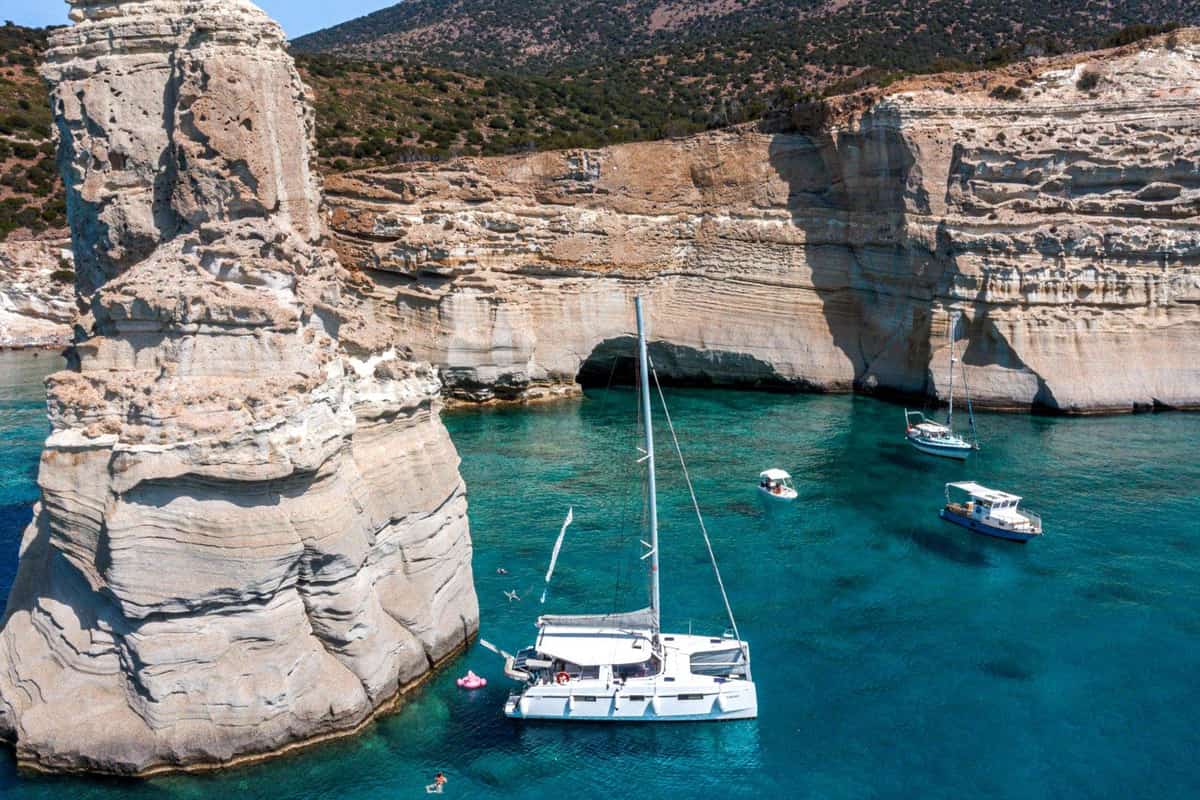
A Milos boat trip takes passengers along the coast of Milos by caique, catamaran or small motor boat. Trips pass white cliffs, sea caves and quiet coves. It is one of the island boat trips in Greece on Greece VIP.
This post covers what a Milos boat trip includes, the route around the island and the small islets on the way. It also covers the Bay of Milos, the island obsidian and safety on board. What to bring, the best season and common questions come last.
Each section ends with a Milos boat trip or a nearby sea tour that can be booked online.
What does a Milos boat trip include?
A Milos boat trip runs on one ticket from boarding to the final landing. Passengers stay with the boat all day. They can go ashore at each beach or bay while the boat waits. Boats range from wooden caiques to fast inflatables.
The classic boat is the caique, a wooden Greek boat. The word came into English from Ottoman Turkish through French and Italian. It has no link to the word kayak. In Greek, its bow is the proura, close to the English prow.
Greek port rules do not class a traditional wooden boat with an inboard engine as a speedboat. An inflatable boat counts as a speedboat once its outboard engine passes 15 HP.
A Milos boat trip can also use a RIB, or rigid inflatable boat. Students and staff at Atlantic College in Wales first developed it. Its air tubes have separate chambers, so it stays afloat if one gets a hole.
Passengers can board and leave from a boat at anchor in a bay. A day boat cannot pick up new passengers along the way, except for safety reasons. Calm paddlers can also try kayak trips along the Milos coast.
- Passenger count: Greek law does not count children under one year old as passengers.
- Windlass: A caique can carry a horizontal windlass, a rope winch, mounted over the bow.
- Beach approach: A day boat can near a bathing beach only with port approval, at a point marked with buoys.
Every Milos boat trip follows the same basic rules. The ticket covers the full voyage. Passengers swim and explore at each stop. Greek law sets the safety rules for everyone on board.


Which route does a Milos boat trip follow around the island?
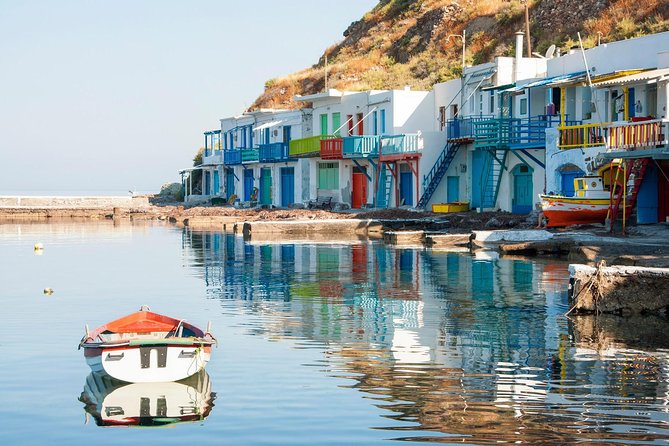
A Milos boat trip starts at Adamantas, the main port, and returns there. Larger boats circle the rest of the coast. They pass the wild western half and quiet sandy beaches. They also reach the volcanic rocks of Cape Vani.
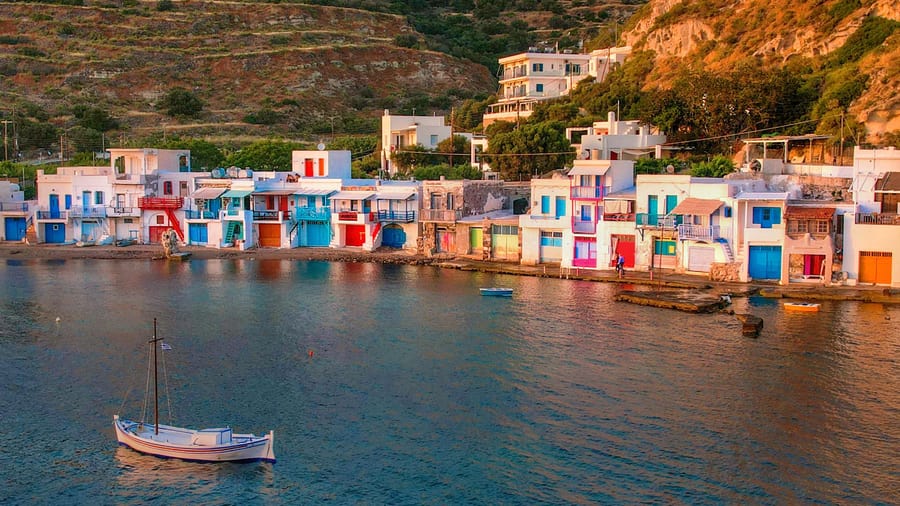
Adamantas is one of the safest ports in the Cyclades, because its bay is very narrow. In the First World War it hosted the English and French fleets of the Aegean.
Milos lies roughly midway between Piraeus and Crete. Across the bay from Adamantas sits Emporio, once a trading place. On the southern side, Provatas is a big bay where boats moor.
A Milos boat trip along the west shows the wildest part of the island. This side has no villages, only small settlements and old mines. Triades, Ammoudaraki and Ai Giannis are the best western beaches.
In the south-west, Gerontas has caves and rocks and is best seen by boat. The south wind sometimes hides its small sandy beach. Kalogria and Agkathia are quiet beaches on the way to Vani.
- Cape Vani: Tall volcanic rocks rise from the sea, and old iron-manganese mines stand on the cape.
- Hot vents: Fumaroles, or volcanic steam holes, reach 100 degrees Celsius at Paleochori.
- Plathiena: This sandy bay in the north-west looks up at the castle of Plaka.
The coast of Milos changes from calm bays to bare volcanic cliffs. A Milos boat trip links these places in one loop. The boat then turns back toward Adamantas at the end.
Which small islets does a Milos boat trip pass?
A Milos boat trip passes small islets around the island. The Akradies guard the northern gulf entrance. Paximadi sits off the south-western tip. Antimilos and the Ananes lie farther out at sea. Each islet has its own story.
The Akradies are two islets opposite cape Lakida, on the north side. Mikri Akradia lies west of Akrathi, 5 nautical miles from Adamantas. Ships found the port hard to enter. So a 7-metre lighthouse has stood there since 1898.
The Germans destroyed that lighthouse in 1941. It worked again from 1945. Paximadi, also called Kremmydonisi, is an empty islet. In 1921 a destroyer ran aground in its shallow water and was wrecked.
A Milos boat trip can show Antimilos, a volcanic dome of about 8 square kilometres. Eleonora’s falcon and the Milos viper live there. Landing needs a permit from the Cyclades Hunting Directorate.
One reading of Homer’s Odyssey makes Antimilos the island of Helios, the sun god. There the companions of Odysseus killed his sacred cattle. The Ananes are 7 empty islets in a crescent shape.
- Arkoudes: Locals call the wave-shaped rocks at Cape Vani the Bears. They seem to show a mouth, eyes and ears.
- Venetsianes: The same rocks also carry this second local name.
- Ananes peak: The highest central rock reaches about 82 metres.
The Ananes lie about 10 nautical miles south-west of cape Psalida. Currents run there even in calm weather, so pleasure craft keep well clear. A Milos boat trip views these islets with care.
What does the Bay of Milos show on a Milos boat trip?
A Milos boat trip across the bay shows a wide natural harbour shaped by the earth. The port town of Adamas sits on its north-east shore. Old ruins, war sites and 25 beaches line the water. Each part of the shore holds a piece of history.
The bay sits in a graben, a sunken block of crust. Its seafloor drops to depths of up to 230 meters. Western faults run east to west, and eastern faults run north to south. The graben splits these two halves of the island.
Off the beach of Adamas, traces of ancient buildings lie about 30 m deep. They point to a very old settlement. It sank when the ground subsided, or dropped lower. A Milos boat trip passes over this drowned past.
The large natural harbour made Milos important for ships. The first naval battle of the Greek War of Independence happened off Milos on 11 April 1821. Long before, in 480 BC, two Melian warships served at the Battle of Salamis.
In the Crimean War, Adamas was the base of the French fleet. Once a year, a French warship still sails into Adamas. It honours the dead in the Anglo-French military cemetery of that war. A Milos boat trip enters the same harbour.
- Occupation: German forces occupied Milos in 1941, and the island was freed in 1944.
- Artemis Pitta: Three RAF Beaufighters blew up this cargo steamer at Adamantas on 21 February 1943.
- Defence works: Remains of German works survive at Trachilas, Kastro, Areti, Provatas, Topakas, Korfos, Bombarda and Nychia.
The north wind pushed debris from the Artemis Pitta onto a beach across the bay. Kanava, Alyki, Papikinou and Klima are among the beaches of the gulf. The wartime shelter of Adamas is now open to the public. It links a Milos boat trip to war history.
What does a Milos boat trip show of Milos obsidian?
A Milos boat trip along the coast passes the old obsidian quarries at Nychia and Dhemenegaki. Obsidian is a natural glass made from lava. For seven millennia, Milos supplied it to settlements around the Aegean. The shore still shows where this trade began.
Obsidian forms from thick lava rich in silica. The thick lava stops atoms moving into place, so crystals cannot start. Fast cooling then turns it into glass. With no crystal structure, it is a mineraloid, not a true mineral.
Nychia lies close to Adamas, on a hill slope north of Cape Bombarda. Dhemenegaki sits on the east coast. Millions of waste flakes and blade cores have been found at both places.
Obsidian also exists on Antiparos and Gyali. Only the obsidian of Milos is good for making tools. It first left the island in small boats with oars. After the third millennium BCE, early Cycladic sailboats carried it.
Pressure flaking, pressing small chips off the stone, became the main way to make blades. A good blade edge is only about three nanometers thick. That is sharper than a steel surgical scalpel.
- Settlers: The first permanent settlements on Milos began after the fifth millennium BCE.
- Later uses: In historical times, obsidian decorated statues, formed vessels and entered folk medical recipes.
Today it is forbidden to buy or sell any piece of Milos obsidian. Each piece can hold archaeological value. Visitors on a Milos boat trip leave the stones where they lie.
How safe is a Milos boat trip?
A Milos boat trip runs under clear Greek and European safety rules. Port authorities stop sailings when the wind gets too strong. Each captain also judges the weather. Passenger boats carry life jackets for everyone on board, plus spares.
A Greek safety manual called EAN-9 sets wind limits for passenger ships. The limits depend on ship length and wind strength. Ships longer than 75 metres stay in port in winds of force 9 and above.
The captain decides whether to leave port in bad weather. At sea, the captain can change course or shelter in a safe cove. Each choice goes into the bridge log. Port officials and passengers hear about it in good time.
Greek port offices come in four grades, each led by a harbour master. A small Class D boat on a Milos boat trip sails only within 3 miles of the coast.
Posters on board show each passenger their assembly station, or meeting spot. They also show what to do and how to put on a life jacket. Ships with over 36 passengers add a speaker system run from the bridge.
- Life jackets: Boats carry one for every person plus five percent more.
- Overboard: If a person falls overboard, nobody else jumps in to help.
- Eyes: Dark sunglasses that block UV rays stop sunburn of the eye, even under clouds.
Chapter V of SOLAS, a world sea safety treaty, applies to all vessels, even small local boats. Calm habits and close attention to the crew make a Milos boat trip safer.
What do passengers bring on a Milos boat trip?
A Milos boat trip goes well with simple items. Passengers pack sun cream, a sun hat and sunglasses. A dry bag keeps phones and towels safe. Water shoes help on rocky shores, and motion sickness needs thought too.
Sun cream comes first. In the EU, labels can go no higher than SPF 50+. The word “sunblock” is banned on labels in the EU and the United States. It can make buyers think the protection is stronger than it is.
Amount matters as much as strength. Studies show people commonly apply only a quarter to a half of the cream needed. With that little, the skin does not get the SPF on the label.
Labels such as “reef-safe” have no agreed meaning, and no agency checks them. Two chemicals, oxybenzone and octinoxate, can harm coral in high amounts. Hawaii banned creams with them in 2018, and Key West in Florida did the same.
A dry bag is a waterproof sack. It closes with a roll-top, folded over and clipped with a buckle. Water shoes have tiny holes in the sole, so water drains out. The same kit suits boat trips around Paros.
- Sun hat: It shades the head, face, neck and shoulders.
- Sunglasses: A high price does not promise good UV protection.
- Water socks: Water socks keep the feeling of going barefoot and suit swimming.
Motion sickness is sickness caused by the rocking of the boat. Pregnancy, migraines and Ménière’s disease, an inner ear illness, raise the risk. After a Milos boat trip, tiredness from it can last hours or days.
When is the best season for a Milos boat trip?
A Milos boat trip fits best from June to September. These months are warm and almost dry. July and August are the hottest. June and September bring mild nights at sea. October brings back the rain on the island.
The figures come from long-term climate records for Milos. June has a mean temperature of 23.5 °C. August reaches 24.6 °C. June nights average a low of 19.8 °C.
July and August are the driest months. Each averages just 0.1 days with 1.0 mm of rain or more. July nights average 21.8 °C, and August nights 21.6 °C. Summer showers are rare.
Heat can be strong. The record high is 41.0 °C for July and 39.8 °C for August. Humidity is lowest in June, at 58.8 %, and stands at 60.1 % in July.
September averages 0.9 rainy days, with nights near 19.6 °C. October brings 3.9 rainy days as the wet season returns. Its rain reaches 42.9 mm. Both months suit travelers who prefer softer heat.
- June: June has 0.3 rainy days and 3.3 mm of rain.
- Records: The coldest reading on record is -2.0 °C, in January and February.
- November: Humidity peaks in November at 73.9 %.
Milos has 46.2 rainy days a year in total. For a Milos boat trip, the calm summer months give the steadiest weather. June to September is the clear choice on the water.
What do travelers ask about a Milos boat trip?
A Milos boat trip raises practical questions. Travelers ask how to reach the island, where boats leave from and how the boat toilet works. Others ask about private mooring, swimming after meals and sun care for children.
How do travelers reach the island for a Milos boat trip?
The official visitor portal lists 2 or 3 daily flights from Athens Eleftherios Venizelos Airport. A conventional ferry from Piraeus takes about 5 hours on a direct route. Boats that stop at Kythnos, Serifos, Sifnos and sometimes Kimolos take 7 to 8 hours.
Where does a Milos boat trip start?
Excursion boats depart daily from the ports of Adamas and Pollonia. They visit beaches that cannot be reached from land. Milos has 15 taxis. They wait at the port and at the airport. So reaching the harbour is simple for travelers.
Can private boats moor during a Milos boat trip?
Private boats can moor at the marina of Adamas. It offers fuel, water and electricity. Pollonia is another option. Kleftiko and Paliochori are among the coves that suit mooring. The right cove depends on the wind direction around the island.
Is it safe to swim after eating on a Milos boat trip?
Eating less than an hour before a swim does not raise the risk of cramps or drowning. That old belief is a myth. Alcohol is a different matter, because it is linked to drowning. Swimmers stay sober before jumping in.
Do children need extra sun care on a Milos boat trip?
Yes. Children younger than six are more sensitive to sunlight. Adults older than sixty are too. Both groups need shade, hats and plenty of sun cream on deck. Extra care on an open deck protects them through the whole day out.
How does the toilet work on a Milos boat trip?
On a boat the toilet is called the head. Old sailing ships placed it at the bow, the front of the vessel. In small boats a hand pump works it. Too much toilet paper easily blocks the pump, so passengers use only a little.