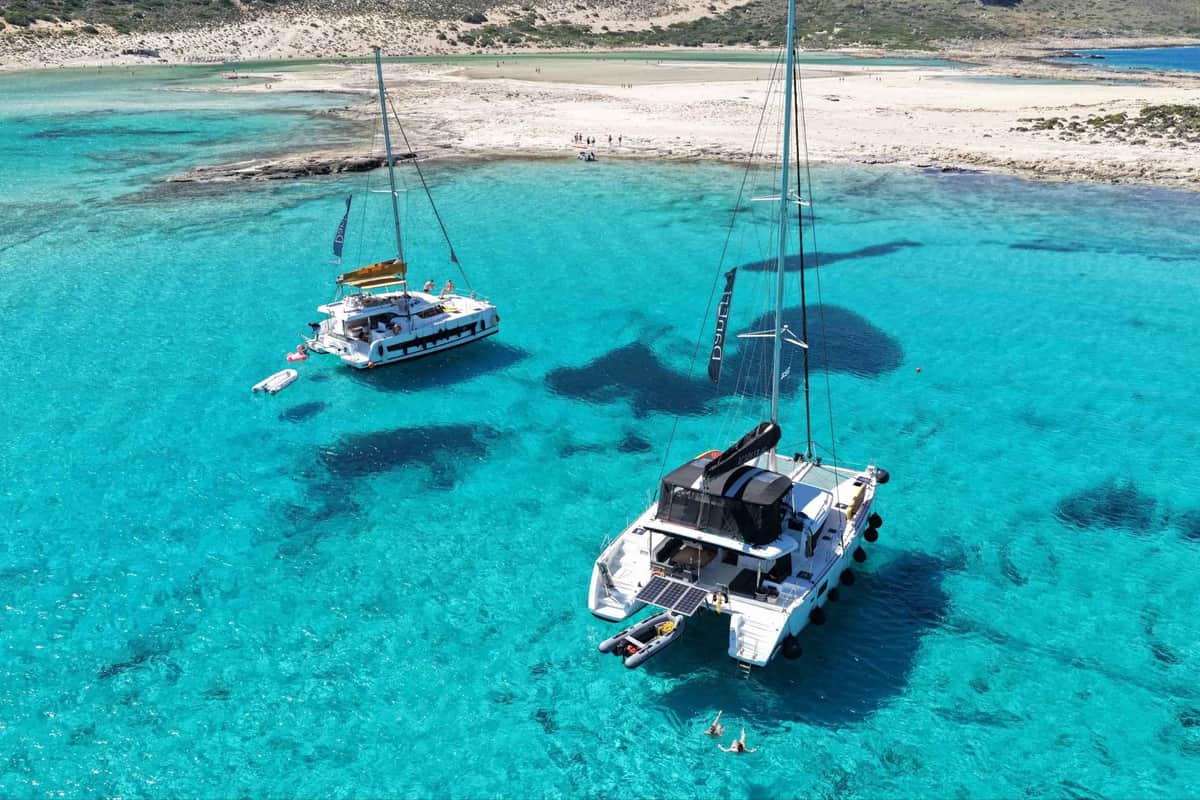
A Crete catamaran cruise takes travelers out on a sailing boat with two hulls from the harbours of Crete. The boat stops in clear bays to swim, and a meal comes on board. It is one of the catamaran trips in Greece on Greece VIP.
This post covers what a Crete catamaran cruise includes, where it leaves from and the islets off Chania. It also covers Balos and Gramvousa, the Mirabello Gulf and sea life. The wind, the best season and common questions come last.
Each section ends with a Crete catamaran cruise or boat trip that can be booked online.
What does a Crete catamaran cruise include?
A Crete catamaran cruise is a sailing outing that starts and ends in a Cretan harbour. Day trips centre on swim stops in clear bays, while evening trips follow the falling light. A skipper sets the course, and the crew serves a Cretan meal on deck.
Crete is the largest Greek island and also has the largest population. In the Mediterranean it ranks fifth in size, after Sicily, Sardinia, Cyprus and Corsica. A Crete catamaran cruise explores only a small stretch of that shore on each outing.
A Crete catamaran cruise by day leaves the quay in the morning. The boat sails to a quiet bay and drops anchor there. Guests then swim, float or snorkel in the clear water before lunch.
An evening Crete catamaran cruise sets out later in the day. The boat follows the coast as the sun sinks toward the sea. Dinner comes on deck before the return to port.
The meal on a Crete catamaran cruise draws on Cretan cuisine, built around plant foods. Olive oil serves as the main fat, in salads and in cooking alike. Dakos, a soaked barley rusk topped with tomato and crumbled cheese, suits a meal at sea.
Faster outings on the island use motor boats or ferries instead of sail. A Crete boat trip by motor covers more distance in a day. A Crete catamaran cruise trades that speed for sail power and space on deck.
- Position: Crete lies about 100 km south of the Peloponnese and about 300 km south-west of Anatolia.
- Cheese: Graviera of Crete is a hard sheep’s milk cheese that ripens for at least five months.
- Pies: Kalitsounia are small Cretan snacks filled with cheese or with herbs.
- Rusk: Paximadi, the barley rusk under dakos, soaks in water or olive oil first.
A Crete catamaran cruise thus blends sailing, swimming and Cretan food in a single outing. The harbour where the boat starts decides which part of the coast it reaches.


Where does a Crete catamaran cruise leave from?
A Crete catamaran cruise leaves from harbours spread along the coast of the island. Kissamos and Chania serve the west, Rethymno and Heraklion the centre, and Agios Nikolaos the east. Each port opens onto its own stretch of sea, bays and islets.
When the harbour of Heraklion silted up under Ottoman rule, shipping moved west to Chania. A Crete catamaran cruise from the city enters the Gulf of Chania. This inlet of the Sea of Crete has the Akrotiri peninsula as one headland.
Kissamos sits at the far western end of Crete. Its other name, Kastelli, comes from a castle that the Venetians built there. The town now works as a port and a fishing harbour. A Crete catamaran cruise from Kissamos serves the north-west tip of the island.
Heraklion, the fourth largest city in Greece, takes its name from Heracleium. That ancient port served Knossos, about 3.7 km away. A Crete catamaran cruise from Heraklion passes Koules at the mouth of the old port. Its Italian name, Castello a Mare, means Fort on the Sea.
Rethymno lies between Chania and Heraklion. The Venetians built a small harbour there, and the town became the third city of Crete. A Crete catamaran cruise from Rethymno leaves that harbour. The Fortezza, a Venetian citadel, crowns the hill of the ancient acropolis.
In the east, a Crete catamaran cruise starts from Agios Nikolaos. The town is the capital of the Lasithi regional unit. Lake Voulismeni, 137 m across, lies at its centre. A channel joins the lake to the harbour, and French soldiers widened it between 1905 and 1907.
- Chania: The municipality counted 111,375 residents in the 2021 census.
- Heraklion: The modern port of the city was completed in 1928.
- Rethymno: The Ottomans captured the Fortezza in 1646.
- Agios Nikolaos: Lake Voulismeni reaches a depth of 48.8 m.
A Crete catamaran cruise takes on the character of its home port. West of Chania, the sea holds a group of small islets with goats, forts and old legends.
Which islets does a Crete catamaran cruise pass near Chania?
A Crete catamaran cruise near Chania passes Agioi Theodoroi, the goat islets off the western shore. Lazaretta, a small islet, lies close to the city. Neither has any residents. Further east, in and near Souda Bay, lie Souda, Leon and Palaiosouda.
A Crete catamaran cruise heading west reaches Agioi Theodoroi, off the coast at Platanias. That beach village lies about 10 km west of Chania. On 25 June 1645, an Ottoman fleet besieged the Venetian fort on the islet. An explosion broke its walls, and the fort fell.
The goats on Agios Theodoros are kri-kri. Cretans call a male agrimi, meaning the wild one, and a female sanada. Genetic studies trace the animal to goats tamed in the Levant around 8000 to 7500 BCE. The goat is thought to have reached Crete with the Minoans.
By 1960, fewer than 200 kri-kri survived. The first herd on Agios Theodoros proved too small to avoid inbreeding, so more animals arrived later. A Crete catamaran cruise passes the cliffs where they climb.
Lazaretta lies close to the northern coast, within the municipality of Chania. Its name also appears as Lazaretto or Lazareto. A lazaretto is a quarantine station for sea travellers. A Crete catamaran cruise from the old harbour stops there for a swim.
Souda and Leon, two islets in Souda Bay, once shared the ancient name Leukai, meaning the white ones. In legend, the Sirens lost a music contest to the Muses. They lost their wings, turned white and fell into the sea as islands.
- Leon: Venetian maps named this round islet Rabbit Island.
- Palaiosouda: The name means old Souda, and the islet draws divers.
- Sapientza: Outside Crete, the kri-kri also lives on this island off the Peloponnese.
- Lazaretto: The word comes from a Venetian island where this kind of station began in 1423.
A Crete catamaran cruise near Chania links wild goats, Venetian forts and old myths. The islets sit close to the shore, so the crossings stay short. Each one adds its own story to a day on the water.
How does a Crete catamaran cruise reach Balos and Gramvousa?
A Crete catamaran cruise reaches Balos and Gramvousa from the port of Kissamos. The boat sails on the Sea of Crete and traces the Gramvousa peninsula to its far end. There it meets Gramvousa, known as the pirate island opposite the Balos lagoon.
The Sea of Crete forms the southern part of the Aegean Sea. Its western limit lies at the islands of Kythera and Antikythera. Kastelli-Kissamos sits in its south-western corner, so a Crete catamaran cruise starts close to that edge. The Myrtoan Sea washes the west side of the island.
The fort that a Crete catamaran cruise sees on Imeri Gramvousa once guarded Venetian sea trade routes. It also stood ready as a base for any new war with the Ottomans. Soon after Ottoman rule began, Cretan rebels used to gather at coastal forts like this one.
In 1823, Emmanouil Tombazis failed to strengthen the defences of the fort. He was the official in charge of Crete for the temporary Greek government. The Ottomans later did not manage to retake the fort from the rebels. Still, they stopped the revolt from spreading to the western provinces.
After the pirate years, the fort came under British control. An old map by Marco Boschini labels the islet Scoglio e Fortezza di Garabuse. In Italian, that means the rock and fortress of Garabuse. A Crete catamaran cruise passes the same rock and its walls today.
- Two ports: An old Roman road map, the Peutinger Table, shows two Cretan ports named Cisamus.
- Old port: Ancient sources place the port of Polyrrhenia at Phalasarna, on the west coast.
- Land area: The municipal unit of Kissamos, where a Crete catamaran cruise sets out, covers about 149 km².
A Crete catamaran cruise to this corner links open sea, a fortified islet and a lagoon. For a day spent mainly at the lagoon, a Balos lagoon cruise covers the same waters.
What does a Crete catamaran cruise see in the Mirabello Gulf?
A Crete catamaran cruise in the Mirabello Gulf sails across the bay of Agios Nikolaos. It then follows the shore north towards Elounda. The gulf holds a chain of islets, from Agioi Pantes and Kolokytha to Pseira and Mochlos. Each one has its own past.
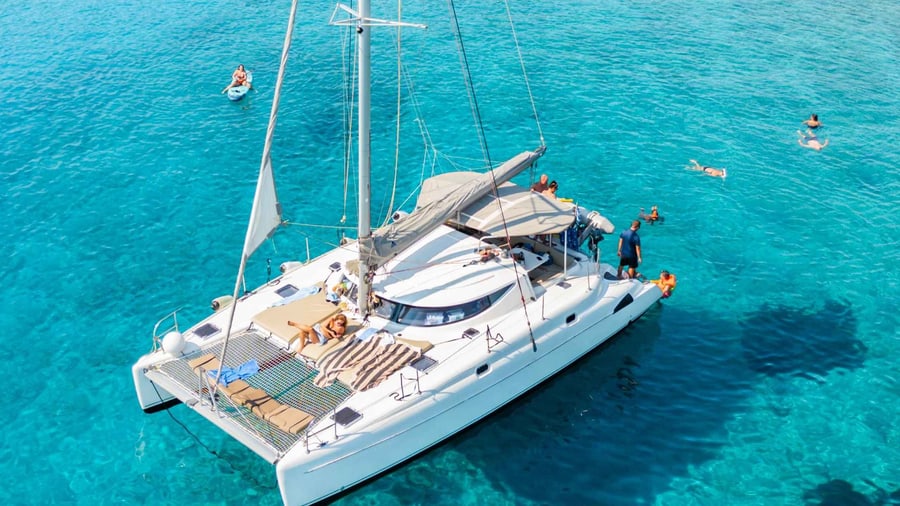
Agios Nikolaos stands partly on the ruins of Lato pros Kamara, its ancient forerunner. Little of that town survives, apart from a large cemetery from Roman times. From the water, a Crete catamaran cruise sees the modern town that grew over it.
A Crete catamaran cruise close to the town sees Agioi Pantes, a small islet off the coast. Its Greek name means All Saints. In ancient times it was called Pyrrha. The islet covers 0.346 km² and has no people living on it.
The earliest known town at Elounda was the ancient Greek city of Olous. Its people fought on and off with hilltop Lato until a peace treaty ended it. The enclosed water between Elounda and the Spinalonga peninsula was once known as Mirabella Harbour.
A Crete catamaran cruise further along the shore also meets Kolokytha, whose Greek name means pumpkin. The islet covers just 0.144 km². Another form of its name is Kolokythia.
Pseira, another islet of the gulf, keeps the ruins of a Minoan seaport from the Bronze Age. Richard Seager explored it in 1906 and 1907. At its peak, the town had about 60 buildings around an open square. Steps along the cliff linked it with the harbour below.
- Mochlos: Only 150 m separates this islet from the village that shares its name.
- Minoan gold: Digs on Mochlos in 1908 found Early Minoan gold jewellery, now shown at Heraklion.
- Karphi: Late Minoan people built Karphi on high ground above the gulf as a refuge.
- Other name: The gulf also goes by the name Bay of Mirabella.
A Crete catamaran cruise in this gulf links a modern harbour town with small, old islets. Its shores and islets keep Minoan, Greek and Roman remains.
What sea life does a Crete catamaran cruise meet?
A Crete catamaran cruise shares its water with three groups of large sea animals. Loggerhead turtles nest on Cretan sand. Mediterranean monk seals feed in shallow coastal water, and dolphins swim offshore. All three live wild, so each sighting depends on luck.
The loggerhead turtle carries the scientific name Caretta caretta. Those seen from a Crete catamaran cruise are smaller, on average, than Atlantic loggerheads. On Crete, a sea turtle society runs field stations, as on Zakynthos. An emergency first-aid centre for turtles opened there in 2005.
Loggerhead eggs stay in the sand for around 80 days. Eggs kept at 32 °C become females, while eggs at 28 °C become males. Hatchlings tend to dig out at night and head for the brighter horizon over the sea. Lights on land lead them inland instead.
Scientists call the Mediterranean monk seal Monachus monachus. Between 250 and 300 of these seals live in Greece. In 2023, the IUCN moved it from endangered to vulnerable. The IUCN is a world body that rates risk to wild species.
A monk seal eats octopus, squid, lobsters and mullets, up to 3 kg a day. Pups are about 1 metre long and weigh 15 to 18 kg. Births happen all year but peak in September, October and November. A Crete catamaran cruise in autumn sails during that peak.
The striped dolphin, Stenella coeruleoalba, lives in warm and mild seas worldwide. In the Mediterranean, it approaches boats at times. It leaps far above the surface, a sight worth watching for on a Crete catamaran cruise. Black bands run from its eyes along its back to the flippers.
- Good omen: Ancient Greeks saw dolphins riding in a ship’s wake as a good omen.
- Minoan art: A hoard found on Pseira held pear-shaped ritual vessels decorated with dolphins.
- Greek waters: About fifteen species of whales, dolphins and porpoises are reported in Greek waters.
- Dolphin diet: Mediterranean striped dolphins feed mainly on hake, sardines and cephalopods, soft sea animals with arms.
A Crete catamaran cruise meets these animals on their own terms. Turtles, seals and dolphins come and go with food and season. Each sighting stays a gift of the day, not a promise.
How does the wind shape a Crete catamaran cruise?
A Crete catamaran cruise follows the wind more than the map. In summer, the meltemi crosses the open sea onto the north coast. The south coast faces the Libyan Sea and a different set of winds. A skipper reads the marine forecast before each departure.
The meltemi is driven chiefly by a depression, a deep zone of low air pressure, over south-west Asia. A spell of this wind can last for days without a break. A Crete catamaran cruise can then stay in port.
On the north coast, boats sail on the Sea of Crete. At Heraklion, the national weather service lists the main wind from June to September as north-west. For the rest of the year, the main wind there comes from the south.
Along the south coast, the boats sail on the Libyan Sea. Its name comes from Libya, the ancient Greek name for much of North Africa west of the Nile. At Ierapetra, the same service lists north as the main wind in every month.
A Crete catamaran cruise in spring or autumn also watches for the sirocco. This wind blows in from the Sahara, and Greeks call it sirokos. It reaches speeds of up to 100 km/h, with peaks in March and November.
In sunshine, land warms much faster than the sea. That difference drives a sea breeze, which blows from the water onto the coast in the afternoon. A morning sail sets out before that breeze adds its push.
Before a Crete catamaran cruise, the skipper checks the marine bulletin of the Hellenic National Meteorological Service. It gives wind strength on the Beaufort scale. It warns that gusts can be 40 percent stronger than the listed wind.
- Etesian: The older name for the meltemi comes from etos, the Greek word for year.
- Meltemi: The modern name is thought to come from the Italian mal tempo, or bad weather.
- Beaufort: Francis Beaufort, a sea surveyor of the Royal Navy, drew up this wind scale in 1805.
- Waves: The bulletin warns that the highest waves can reach twice the listed wave height.
The bulletin lists sea areas named West Kritiko and East Kritiko. Kritiko Pelagos is the Greek name for the Sea of Crete. On a windy day, the skipper looks for a lee, a spot sheltered from the wind.
When is the best season for a Crete catamaran cruise?
A Crete catamaran cruise runs best from late spring to the end of October. Sea water off Heraklion peaks at 26.1 °C in August. June and September bring warm water and nearly dry skies. Late spring and October give milder air for a day under sail.
Heraklion sits further south than Athens, so its winters are warmer. Its summers are cooler, though, thanks to the Aegean Sea. The national weather service puts the average July high there at 28.9 °C.
A Crete catamaran cruise on the south coast meets more sunny days and higher heat. At Ierapetra, the average high reaches 32.0 °C in July and August. Date palms bear fruit on this coast, and swallows stay all year.
Off Heraklion, the sea is coldest in February, at 16.4 °C. By late spring, the water has warmed to 19.5 °C. Swims at that point take place in cool water.
In June, the sea there reaches 23.0 °C. September water matches July, at 25.4 °C. October still holds 23.3 °C, so autumn swims stay warm.
Rain almost vanishes in high summer. Official records show just 0.3 days of rain in July at Heraklion. In October, the count climbs to 7.5 days.
Long days suit early summer sailing on Crete. June brings 14.8 hours of daylight on average, the longest of the year. December offers only 9.7 hours, the shortest.
- Shoulder months: The last month of spring and October share an average high of 23.6 °C at Heraklion.
- Year average: The sea off Heraklion averages 20.7 °C across the year.
- Dry air: July humidity at Ierapetra averages just 49.1 percent.
- Winter: Even in January, highs at Ierapetra average 16.1 °C.
For warm water and mild air together, June and September fit a Crete catamaran cruise best. July and August add peak heat on both coasts. Late spring and October suit guests who prefer cooler days on deck.
What do travelers ask about a Crete catamaran cruise?
A Crete catamaran cruise prompts five common questions. The first two concern seasickness and children on board. The third compares a private boat with a shared one. The last two cover swimming from the boat and a day on land.
Does a Crete catamaran cruise cause seasickness?
Seasickness can affect guests on a Crete catamaran cruise. Adjusting to a boat’s motion is called gaining sea legs. Scopolamine, worn as a skin patch, works better than other drugs against it. It works best when used before symptoms start. The risk falls with age.
Can children join a Crete catamaran cruise?
Children join the boat with an adult, under strong sun. The UV index, a measure of sunburn risk, averages 10 at Heraklion in June and July. Normal summer cloth has a UPF, or sun-block rating, near 6. Sun-protective clothing rates near 30.
How does a private Crete catamaran cruise differ from a shared one?
A private Crete catamaran cruise gives the whole deck to one group. A shared cruise mixes separate parties. Catamarans have grown popular for crewed charters, thanks to large capacity and fuel efficiency. For a shared evening sail, travelers pick a Chania sunset cruise.
Can guests swim during a Crete catamaran cruise?
Guests swim from the boat while it lies at anchor. The Mediterranean grows saltier toward the east, since evaporation is high in its eastern half. Sea urchins hide in cracks in the rock, and their brittle spines cause puncture wounds.
How does a Crete catamaran cruise pair with a land day?
A land day fits well before or after the cruise. Knossos lies about 5 km south of central Heraklion. It is widely seen as the oldest city in Europe. The Heraklion Archaeological Museum holds the great majority of finds from its palace.
Featured photo: Kissamos Balos and Gramvousa luxury catamaran sailing cruise, via GetYourGuide.