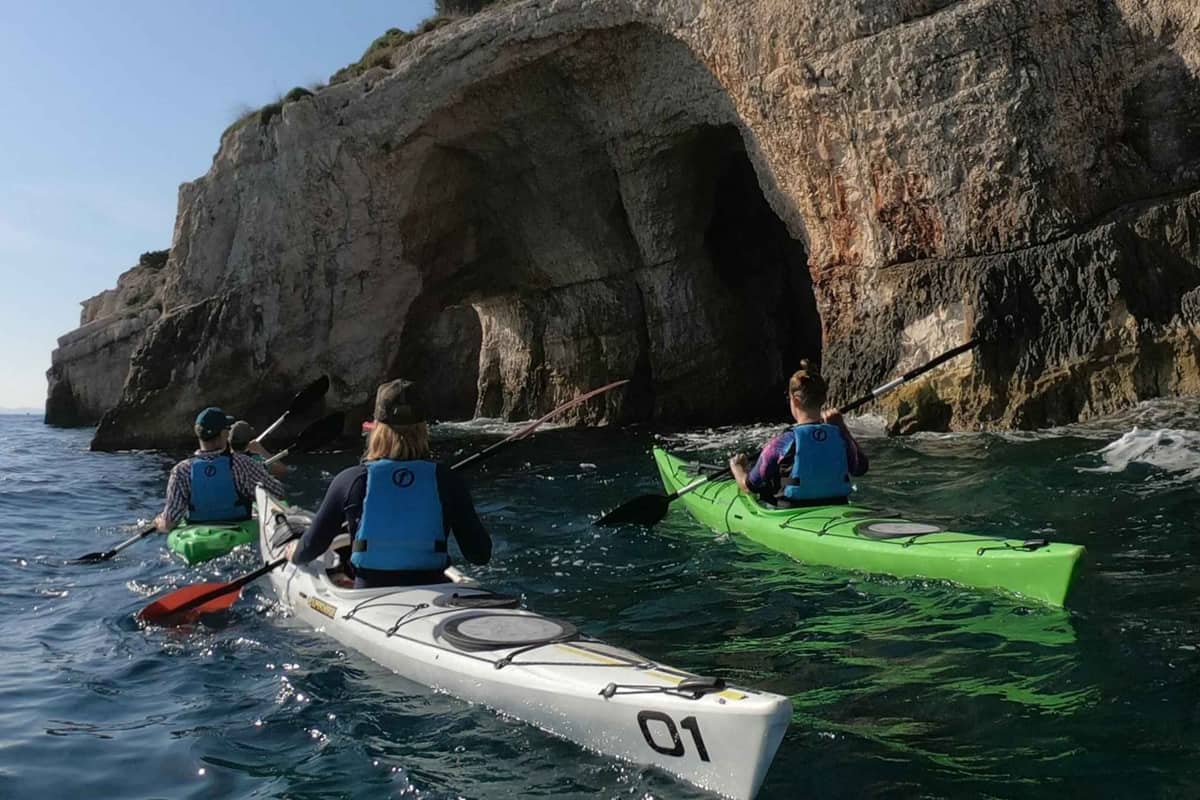
A Zakynthos kayak tour explores the coast of Zakynthos, an island in the Ionian Sea, by paddle. Small groups slip past cliffs and into sea caves, with swims along the way. It is one of the sea kayaking trips in Greece on Greece VIP.
This post covers what a Zakynthos kayak tour includes, the coasts it explores and the sea life it meets. It also covers where tours start, snorkeling from the kayak and the history of the shore. Safety for beginners, the best season and common questions come last.
Each section ends with a Zakynthos kayak tour or sea trip that can be booked online.
What does a Zakynthos kayak tour include?
A Zakynthos kayak tour takes a small group out in sea kayaks along the shore of Zakynthos. The island lies in the Ionian Sea. The paddlers follow cliffs and coves at water level. Calm water opens the way into sea caves, and quiet beaches serve as swim stops.
A Zakynthos kayak tour uses sea kayaks, also called touring kayaks. These boats are built for open water on bays and the sea. Archaeologists have found evidence that kayaks are at least 4,000 years old.
Modern hulls are far younger than that design. Fibreglass kayaks arrived in the 1950s, and moulded plastic kayaks followed in 1984. A small group of these boats fits easily into a narrow cove together.
Sea caves are a highlight, just as on a Zakynthos Blue Caves boat trip. A Zakynthos kayak tour meets such caves right at the waterline. Fragile animals live fixed to cave walls and ceilings. Knocks from visitors harm them, so paddles stay off the rock.
- Paddling: Steady strokes carry the group along the shore from one cove to the next.
- Caves: Kayaks enter a cave mouth only on calm water and keep clear of its walls.
- Swim stops: The kayaks pull up on small beaches, and the group swims in the open sea.
A Zakynthos kayak tour therefore mixes steady paddling with swimming and close views of rock. The coast supplies the scenery, while the state of the sea decides how far the group goes.
Which coasts does a Zakynthos kayak tour explore?
A Zakynthos kayak tour explores four stretches of coast. The north centres on Cape Skinari. The west coast rises in steep, shady cliffs. Keri guards the south with limestone walls, and small islets dot Laganas Bay. Each stretch shows a different side of the island.
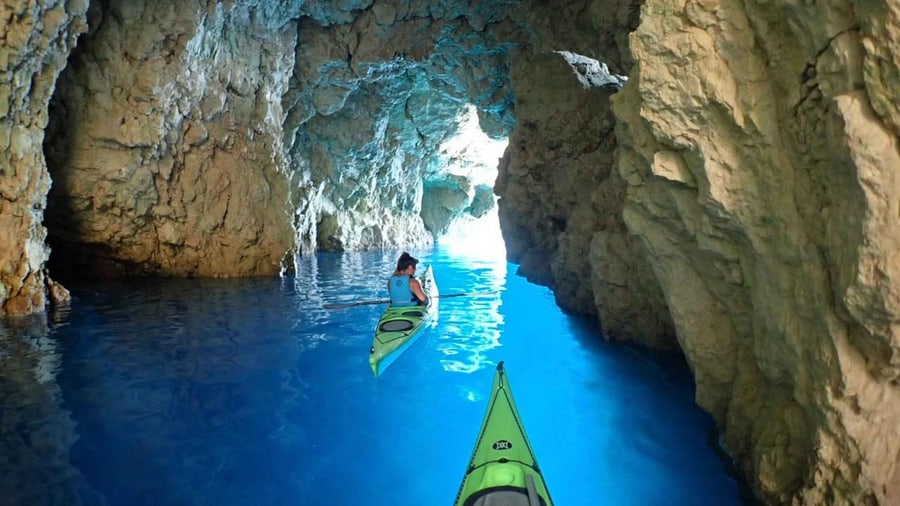
In the north, a Zakynthos kayak tour paddles toward Cape Skinari. The west and northeast coasts form one Natura 2000 site, an area protected under EU law. A national survey named it one of 35 Greek sites with excellent sea caves.
A Zakynthos kayak tour on the west coast passes under steep, shady cliffs. Their shade lets algae that like low light grow close to the surface. Rocky reefs, hard ground rising from the seabed, also line this shore.
In the south, limestone cliffs rise at Keri and on the islets of Marathonisi and Pelouzo. Plants grip the cracks there, above the reach of sea spray. One of them, Asperula naufraga, grows only on Zakynthos and appears in the Keri area.
- Reefs: The reefs of Laganas Bay, Marathonisi and Pelouzo rank among the finest in Greece.
- Flowers: Sea stock, a coastal flower, grows on the rocks of Pelouzo and Agios Sostis.
- Junipers: Phoenician juniper grows low on the steep shores of Marathia, Marathonisi and Pelouzo.
A Zakynthos kayak tour on any of these coasts paddles through protected nature. Rock, reef and plant life change from cape to cape, so each stretch rewards a separate outing.
What sea life does a Zakynthos kayak tour meet?
A Zakynthos kayak tour can meet loggerhead sea turtles, seagrass meadows, fish and sea urchins. In Laganas Bay, the paddle runs inside the National Marine Park of Zakynthos. The park lists canoeing among the gentle activities it allows, beside swimming and pedal boats.
The park’s marine area covers 89 square kilometres in three zones. Zone A is closed to all boats. In Zones B and C, boats stay under 6 nautical miles an hour. Only Zone C allows mooring. Jet-skis and waterskiing are banned all year.
A Zakynthos kayak tour follows the park’s rules for watching turtles. Watchers keep at least 15 metres away and never approach a turtle from the front. Watching ends after 15 minutes, or after 10 minutes when the turtle is near the surface.
Posidonia seagrass is a flowering plant, not a seaweed. It flowers in autumn and grows floating fruits in spring, called sea olives. The park calls these meadows the rainforests of the Mediterranean. Young fish find food and shelter in them.
- Turtle shells: More than 100 animal species and 37 kinds of algae live on the backs of loggerheads.
- Salt: Glands behind each eye let a loggerhead get rid of the extra salt from sea water.
- Protected species: The park’s protected species include the purple sea urchin, the dusky grouper and the common dolphin.
A Zakynthos kayak tour crosses water with over 170 kinds of sea plants. Over 300 kinds of animals live there too. Near Agios Sostis, heavy tourist use has left the seagrass in moderate condition.
Where does a Zakynthos kayak tour start?
A Zakynthos kayak tour starts from a small harbour or a sandy beach near the chosen coast. Agios Nikolaos serves the north, Porto Vromi the west and Limni Keriou the south. The launch point decides which cliffs, coves and small islets the paddle route can reach.
In the north, a Zakynthos kayak tour can set off from the harbour at Agios Nikolaos. The port also serves ferries, with two a day in summer. Paddlers share the harbour mouth with larger ships, then head along the rocky northern shore.
On the west coast, a Zakynthos kayak tour can start at Porto Vromi. A rock on the shoreline there keeps a footprint. Local belief says it belongs to Mary Magdalene. From this start, the whole paddle stays on the open western side of the island.
Wind decides how safe a start is. On a lee shore, the wind blows toward land. A drifting boat gets pushed toward the shore and can run aground. On a weather shore, the wind blows off the land and can carry windsurfers out to sea.
In the south, a Zakynthos kayak tour can launch from Limni Keriou. The village belongs to the Keri community, along with Apelati and Marathias. Lake Keri, a wetland, lies inside the national marine park. The park has held a beach and underwater clean-up there.
A Zakynthos kayak tour treats the beaches of Laganas Bay with care. Loggerheads lay their eggs there in June, July and August. On nesting beaches, visitors stay within 5 metres of the waterline. Kalamaki and Daphni are nesting beaches, and Sekania is closed to everyone.
On the east side, a Zakynthos kayak tour can start near Vasilikos, 11 km southeast of the city. Low hills covered in pine rise above quiet coves. The beaches there are known for good swimming conditions. Turtles nesting at Gerakas have kept large-scale building away.
- Bay of Alykes: Salt flats can be seen from this bay on the northeast coast.
- Porto Roma: This beach resort lies just east of Vasilikos village.
- Kalonisi: This islet, where nobody lives, belongs to the Vasilikos community.
A Zakynthos kayak tour from the north, west, south or east meets a different stretch of shore. The chosen harbour or beach sets the coast. The wind on the day then sets the course.
How does a Zakynthos kayak tour add snorkeling?
A Zakynthos kayak tour adds snorkeling by stopping in calm coves along the coast. Paddlers slip off the kayak with a mask, a snorkel and fins. They float and watch the reef below. The marine park in Laganas Bay names snorkeling routes as one way to visit.
Snorkeling is swimming face down at the surface and breathing through a curved tube. On a Zakynthos kayak tour, this takes no special training. Basic swimming and breathing through the tube are enough. Swimmers stay in pairs, because safety rules say never to snorkel alone.
The mask has a clear front window and a soft rubber skirt. The skirt covers the nose and seals against the face. Air trapped inside lets the eyes see clearly underwater. Before a Zakynthos kayak tour stop, each swimmer checks that the mask fits well.
The snorkel is a tube shaped like the letter L or J. Its lower end holds a mouthpiece. A sharp breath out blasts water from the tube. Fins are rubber or plastic blades worn on the feet. Bare feet are too small for easy swimming.
A sit-on-top kayak has no closed cockpit. Anglers and divers favour it, since they slide on and off from the water with ease. Scupper holes, tubes through the hull, drain water off the seat. Safety rules expect every kayaker to climb back aboard without help.
A Zakynthos kayak tour can meet the parrotfish, which lives on rocky shores. It grazes on algae down to 50 metres. Adults grow up to 52 centimetres long. Females are red, with a grey saddle-shaped patch edged in yellow. Males are grey, with paler undersides.
The noble pen shell is a large clam found only in the Mediterranean. Its shell grows up to 120 centimetres. People once wove its silky anchor threads into cloth. Snorkelers on a Zakynthos kayak tour leave it untouched, as the species is critically endangered.
- Spinefoot: The dusky spinefoot came through the Suez Canal and has venom in its fin spines.
- Spray crab: The nimble spray crab lives in half-flooded caves on Zakynthos. It was first seen in the Mediterranean in 1999.
- Seagrass: Snorkelers never stand on seagrass, because standing can kill it.
Snorkel stops give a Zakynthos kayak tour a second view of the coast. Inside the marine park, more than 30 protected or endangered species live underwater. They include animals without backbones, fish and mammals.
What history does a Zakynthos kayak tour pass along the shore?
A Zakynthos kayak tour passes two old lighthouses. One stands on Cape Skinari at the northern tip. The other stands on Cape Keri in the southwest. Between them, coast towns rose again after a great earthquake. Venice left its name on the island and its fruit.
The Skinari lighthouse dates from 1897, in the reign of King George I. A Zakynthos kayak tour looks up at its round stone tower. The tower stands 9.5 metres tall. Its light sits 66 metres above the sea and carries 21 miles.
In the south, a Zakynthos kayak tour passes below the Keri lighthouse. Its tower is joined to the keeper’s house on the southwest cape. The lamp sits 190 metres above the water. The cliff supplies nearly all of that height. Its beam carries 23 miles.
The two lights seen on a Zakynthos kayak tour serve ships crossing the Ionian Sea at night. The Skinari light was damaged in 1941. It came back into service in 1945. The Keri light stayed dark through the whole of World War II.
Venice ruled the Ionian Islands for centuries and gave them Venetian names. Zakynthos became Zante, and Lefkada became Santa Maura. Ithaki went by Val di Compare. English still calls Kerkyra by its Venetian name, Corfu. A Zakynthos kayak tour paddles the shore of old Zante.
The Venetian name also lives on in food. Venetian merchants traded dried grapes with Greek growers on Ionian coasts. By the 17th century, that trade had shifted toward the Ionian Islands, above all Zakynthos. The fruit took the island’s name: the Zante currant.
Shore towns on a Zakynthos kayak tour carry the mark of 1953. Two strong foreshocks, smaller quakes before the main one, struck on 9 and 11 August. The main shock left Kefalonia and Zakynthos practically flat. Between 445 and 800 people died across the islands.
- Rebuilding: The islands rose again from the ground up under a strict building code.
- Emigration: The larger part of those who fled moved abroad, to Canada, the United States, Australia or Britain.
- St Mark’s: This Catholic church from 1518 fell in the quake and was rebuilt in the 1960s.
The shore keeps changing. A night quake in October 2018 badly damaged the port of Zakynthos. The town itself moved 5 centimetres sideways. A Zakynthos kayak tour passes a coast still shaped by moving ground.
How safe is a Zakynthos kayak tour for beginners?
A Zakynthos kayak tour is safe for beginners when four simple things line up. The kayak is wide and steady, and every paddler wears a buoyancy aid. An instructor reads the sea, and the group sets out only in light wind.
Sit-on-top and double kayaks suit a beginner Zakynthos kayak tour, with two paddlers sharing each double hull. Primary stability describes how much a boat rocks when the paddler shifts weight. A wide, flat-bottomed kayak has high primary stability. It feels very steady on flat water.
A life jacket stays on at all times on the water. The ISO 12402-5 standard sets out buoyancy aids for sheltered water, with rescue close at hand. The wearer still has to take an active part, so basic swimming matters.
- Exit phase: The blade lifts out at the hip, since pulling any further only drags water.
- Light breeze: Force 2 on the Beaufort scale brings 4 to 6 knots and unbroken wavelets.
- Smooth sea: The World Meteorological Organization calls wavelets of 0.1 to 0.5 m a smooth sea.
A whistle on a Zakynthos kayak tour calls for help. Throwing ropes help rescue a paddler in the water. Drowning experts rank the ability to swim as a key defence against trouble.
When is the best season for a Zakynthos kayak tour?
A Zakynthos kayak tour fits late spring, summer and early autumn best. Those months bring dry days, warm water and lighter winds on the Ionian side of Greece. The strong sirocco wind peaks in March and November, well outside that calm window.
West of the Pindus mountains, the Greek climate is wetter and more maritime. Summers east of that range are drier and windier. Zakynthos lies on the western, Ionian side. The etesian winds peak in July and August but keep the Aegean cooler than the Ionian.
The sea around a Zakynthos kayak tour changes temperature slowly. This delay, called seasonal lag, keeps surface temperatures about a month behind the sun. In oceanic places it reaches two or three months. So the water holds summer heat after the air cools.
- June: The daily mean reaches 24.1 °C, and humidity drops to 62.8 %.
- September: Nights on the island still average 18.8 °C, and humidity sits at 66.7 %.
- November: Rain climbs to 159.1 mm, spread over 11.0 wet days.
Spring and autumn bring the sirocco, a wind of up to 100 km/h. It picks up moisture over the sea and can blow for days. Each paddling plan works around those spells.
What do travelers ask about a Zakynthos kayak tour?
A Zakynthos kayak tour raises five practical questions. Travelers ask whether paddling experience is needed and whether children can join. They ask what to bring and whether the Navagio cove shows from the sea. The final one asks how the paddle fits beside a turtle boat tour.
Does a Zakynthos kayak tour need paddling experience?
A beginner departure asks for no earlier paddling skill. Recreational kayaks form the largest group in kayak sales. Their beam, or width, runs from 69 to 91 cm for extra stability. They measure under 3.7 m in length and carry little cargo.
Can children join a Zakynthos kayak tour?
Children join a family paddle according to the rules of each departure. The international standard for buoyancy aids applies only to children above 25 kg of body mass. Drowning experts call for close watch on young swimmers, because drowning can happen silently.
What do travelers bring on a Zakynthos kayak tour?
Polarized sunglasses help on a Zakynthos kayak tour. Their lenses reduce glare off water at certain angles and let the wearer see into the sea. American rules ban the word waterproof on sunscreen labels. A water-resistant label must state how long the cream works.
Can a Zakynthos kayak tour see the Navagio cove from the sea?
Navagio is an exposed cove on the island’s coast. State earthquake experts advised closing its beach after a landslide. Under that ruling, boats were free to approach, but swimming near the shore stayed banned. Whether a paddle reaches the cove depends on the route.
Can a Zakynthos kayak tour pair with a turtle boat tour?
A paddle and a Zakynthos turtle boat tour fit well on separate days. Kayaks work in shallow water and land on the shore. They reach quiet spots away from crowds, out of range for bigger boats. Ecotourism based on kayak trips keeps growing.
Featured photo: Zakynthos sea kayaking tour with snorkeling, via GetYourGuide.