

A Zakynthos turtle boat tour sails into Laganas Bay to look for loggerhead sea turtles and passes Marathonisi and the Keri coast. This post covers what a Zakynthos turtle boat tour shows, the turtles, the National Marine Park and its rules, the boats, the season and the sights that combine with the trip. More Greece tours are listed on the Greece VIP homepage.
Each section ends with a turtle boat tour that can be booked online.
What does a Zakynthos turtle boat tour show?
A Zakynthos turtle boat tour shows loggerhead sea turtles in the Bay of Laganas, the main nesting area for this species in the Mediterranean. The route also takes in the islet of Marathonisi, its sea caves, and the steep cliff coast around Keri in the south.
The loggerhead sea turtle is the animal at the centre of a Zakynthos turtle boat tour. The species lives in the Atlantic, Pacific and Indian Oceans and in the Mediterranean Sea. Greece is the leading nesting country in the Mediterranean, with more than 3,000 nests each year, and Kyparissia Bay holds the second largest nesting site after Zakynthos. The Mediterranean also serves as a nursery for young loggerheads, and almost 45% of its juveniles migrate there from the Atlantic Ocean.
Loggerheads stay active mainly during the day, both in the wild and in captivity. Up to 85% of their day passes under water, and an average dive lasts 15 to 30 minutes. A turtle therefore comes into view on a Zakynthos turtle boat tour when it rises to the surface to breathe. Adults swim by moving their limbs in turn, and they cannot pull the head or flippers into the shell.
Zakynthos sits in the eastern Ionian Sea, with the Peloponnese mainland around 20 kilometres to the east, and measures about 40 kilometres long by 20 kilometres wide. Its eastern half is a fertile plain with long sandy beaches, while its western half is a mountainous plateau, and steep cliffs form the bulk of the southwest coast. A Zakynthos turtle boat tour links these two landscapes along the south coast of the island.
- Turtles: Loggerheads are part of Cheloniidae, an ancient turtle family, and first appeared around 40 million years ago.
- Coastline: Zakynthos has about 123 kilometres of coastline, and the route follows part of its south side.
- Marathonisi: The small islet in Laganas Bay also goes by the name Turtle Island.
- Sunset: The Keri cliffs, at the western end of the route, are known for their sunset view.
A Zakynthos turtle boat tour joins three settings on one stretch of coast: open water where the turtles surface, a small islet with sand and caves, and the high cliffs of Keri. All three lie at the southern end of Zakynthos, the southernmost of the main Ionian Islands when distant Kythira is left out of the count.


Which sea turtles live on the route of a Zakynthos turtle boat tour?
A Zakynthos turtle boat tour looks for the loggerhead sea turtle, Caretta caretta, a marine reptile that comes ashore to nest on the sandy beaches of Laganas Bay. The International Union for Conservation of Nature classifies the loggerhead as a vulnerable species.
The loggerhead takes its English name from its large head. It is the largest hard-shelled turtle in the world, and adults average around 135 kilograms, with a straight carapace length of 70 to 95 centimetres. Loggerheads in the Mediterranean are, on average, smaller than those in the Atlantic. The colours run from yellow-orange to reddish brown on the head and upper shell, with a pale yellow underside. On a Zakynthos turtle boat tour, the reddish brown shell and broad head mark out the species.
Nesting takes place on six beaches of Laganas Bay: Gerakas, Daphni, Sekania, Kalamaki, East Laganas and the islet of Marathonisi. Their combined length is about 5 kilometres, and Sekania holds one of the densest concentrations of loggerhead nests in the world. The nesting beaches of the bay receive between 900 and 2,000 nests each year. Females come ashore at night to lay eggs and spend the rest of their time at sea, where a Zakynthos turtle boat tour finds them.
A female crawls out of the sea, moves up the beach and clears the top layer of sand to make a body pit. Her hind limbs then dig an egg chamber, and after laying she buries the chamber and pit before heading back to the water, a sequence of one to two hours. An average clutch holds 112.4 eggs. Females return to nest every 12 to 17 days, lay about four clutches in a season and then pause for two to three years.
- CITES: Listing under Appendix I of the Convention on International Trade in Endangered Species bans commercial international trade in loggerheads.
- United States: Agencies in the United States list the Mediterranean Sea population segment as endangered under the Endangered Species Act.
- Hatchling sex: The temperature of the sand decides the sex of the young, and high sand temperatures favour females.
- Lifespan: Wild loggerheads reach an estimated maximum age of 47 to 67 years.
The conservation status of the loggerhead reflects a slow life cycle. Late sexual maturity and high natural losses among eggs and young turtles add to the decline that human activity causes. Eggs are exposed to land predators, while a fully grown loggerhead is big enough that only large sea animals, sharks among them, hunt it. The adults seen on a Zakynthos turtle boat tour have already passed the riskiest stages of life.
Where does a Zakynthos turtle boat tour sail?
A Zakynthos turtle boat tour sails across the Bay of Laganas on the southeast side of the island, passes the islet of Marathonisi in the same bay, and continues to the Keri coast, where cliffs, rock arches and a lighthouse mark the south of Zakynthos.
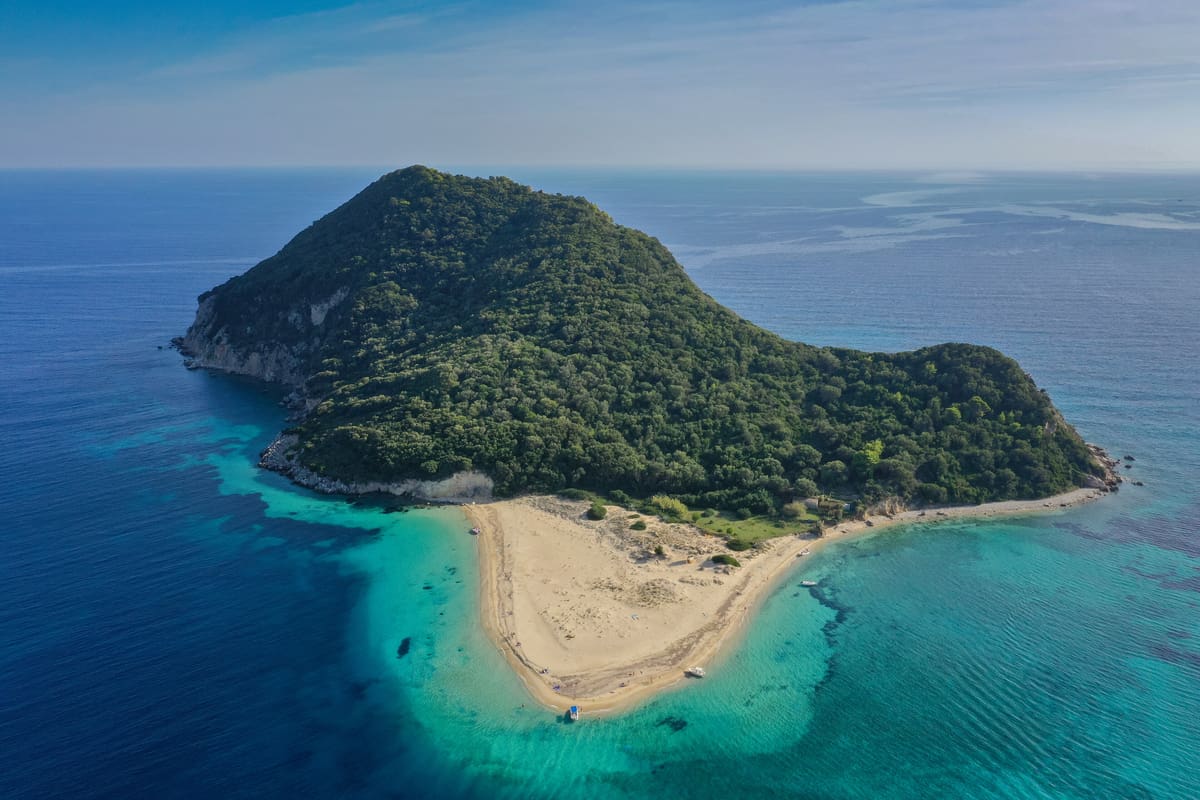
Laganas Bay forms the first leg of a Zakynthos turtle boat tour. Two peninsulas frame this wide, shallow bay, Vassilikos on the north side and Marathia on the south side. Three small uninhabited islets sit in its water: Marathonisi, Pelouzo and Agios Sostis. The beach village of Laganas lies on its shore, and its name traces back to lagini, the Greek word for jug, a link to the pottery once produced around Lithakia and Kalamaki.
Marathonisi lies near Limni Keriou, a village of the Keri community, and a Zakynthos turtle boat tour reaches the islet after crossing the bay. Its shore offers beaches, sea caves and turquoise water, and the islet holds tropical vegetation. People lived on Marathonisi until the Second World War, and it has stood empty since then. The islet now falls within the Zakynthos National Marine Park and the Natura 2000 network, and loggerheads breed there.
Keri, a village on a hillside close to the Ionian Sea, lies 15 kilometres southwest of Zakynthos town, and its community includes Cape Marathia, the southernmost point of the island. Near the village, the Keri cliffs rise more than 300 metres from the sea, and a 7-metre lighthouse from 1925 stands on top. This cliff coast forms the final stretch of a Zakynthos turtle boat tour. Rock formations, arches among them, line the western shore from Keri to Cape Skinari.
- Laganas area: The municipal unit of Laganas covers 74.104 square kilometres in the southernmost part of Zakynthos.
- Kalamaki: The village of Kalamaki, on the eastern side of the Laganas area, sits next to Zakynthos International Airport.
- Lake Keri: Ancient Athenians took tar from the bottom of Lake Keri to protect the hulls of their warships.
- 1953 earthquake: The Ionian earthquake of 1953 caused heavy damage in both Keri and Laganas.
Every leg of a Zakynthos turtle boat tour stays inside the south of the island. The land of the Laganas area is flat in the centre and east and rises to hills of up to 450 metres in the west. The boats follow that change from the water, moving from the low beaches of the bay toward the high ground around Keri, where the shore turns to cliff.
What is the National Marine Park on a Zakynthos turtle boat tour?
A Zakynthos turtle boat tour in the Bay of Laganas takes place inside the National Marine Park of Zakynthos. Founded in December 1999, the park covers 135 square kilometres and was the first national park in the Mediterranean set up to protect sea turtles.
The park grew out of pressure on the bay. Rapid growth of local tourism was seen as a threat to the protected area, obstacles on the sand made the yearly journey of loggerheads to their nesting beaches riskier, and speedboats broke the boating ban off those beaches. The park was set up in response, to protect Caretta caretta, the Mediterranean monk seal and other wildlife and plants.
The park belongs to the Natura 2000 network and covers the marine area of the Bay of Laganas, on the southern shores of the island. Its nesting habitat spans six separate beaches, about 5 km long in total. Beyond the waters that a Zakynthos turtle boat tour crosses, the park also takes in the wetland of Keri Lake and the two small Strofadia islands, 50 km south of Zakynthos.
The park is built on zones. Three marine zones, marked A, B and C, lie in the Bay of Laganas, and the nesting areas are strictly protected. A terrestrial zone and a peripheral zone complete the layout. Fishing is strictly banned inside each marine zone, and boats face a ban off the nesting beaches. A Zakynthos turtle boat tour has to respect this layout like every other vessel in the bay.
Management follows a bottom-up approach, with monitoring and surveillance, accreditation, certification and work with local stakeholders. A code of conduct for ecotourism aims to bring tourism into line with the biodiversity and cultural authenticity of the area. Separate codes cover sightseeing, awareness activities, rambling and marine excursions, and the last of these is the code that applies to a Zakynthos turtle boat tour.
- Founded: The park dates from December 1999 and was the first in the Mediterranean created for sea turtles.
- Size: It covers 135 square kilometres and belongs to the Natura 2000 network.
- Zones: Three marine zones sit beside strictly protected nesting areas, a terrestrial zone and a peripheral zone.
- Boat rules: Fishing is banned in all three marine zones, and boating is banned off the nesting beaches.
The park protects more than turtles. Its habitats include sand dunes, Posidonia oceanica beds, submerged reefs and the critically endangered sea daffodil, and a resident population of the critically endangered monk seal is present on the west coast of Zakynthos. For visitors, the park explains why a Zakynthos turtle boat tour follows set rules on the water: the bay is a protected nesting ground, not an open harbour.
Which boats run a Zakynthos turtle boat tour?
A Zakynthos turtle boat tour runs on one of four boat types: glass-bottom boats, small boats, speedboats or private boats. Each type suits a different group size and pace, while the same park rules on the water apply to every vessel in the bay.
A glass-bottom boat has sections of glass or another clear material below the waterline. Passengers look down at the sea and its life from inside the hull. The glass gives a clearer view than a look over the side, since the broken surface of the water does not get in the way. The effect resembles a diving mask, yet everyone stays dry. On a Zakynthos turtle boat tour, this format suits families and travellers who prefer not to swim.
A small boat takes a small group, and its quiet deck suits travellers who want time to watch the water. A speedboat covers more coast in one outing. Traffic carries a risk in turtle waters, since boats can injure or kill turtles when they strike them at or near the surface. Speedboats that broke the boating ban off the nesting beaches helped lead to the park, so a Zakynthos turtle boat tour on a fast hull needs a skipper who slows down.
Private boats give one party the whole deck and its own choice of stops within the park rules. A private charter is still a marine excursion, and the park drew up a specific code of conduct for marine excursions. Before booking a private Zakynthos turtle boat tour, travellers can ask whether the skipper knows the three marine zones and follows that code. The park’s own work on accreditation and certification with local stakeholders makes that a fair question to ask.
- Glass-bottom boat: Clear panels below the waterline show the sea while passengers stay dry.
- Small boat: A smaller passenger count leaves more room at the rail for each traveller.
- Speedboat: A fast hull covers more coast, but slow speed in the bay protects turtles near the surface.
- Private boat: One party has the deck, and the park code for marine excursions still applies.
The right boat depends on the group more than on speed. Families who want a dry view can pick a glass-bottom boat, small groups can look for a quiet deck, and couples or friends can weigh a private charter. Whatever the format, a Zakynthos turtle boat tour takes place in protected water, so a slow, careful skipper matters more than engine power.
When is the season for a Zakynthos turtle boat tour?
A Zakynthos turtle boat tour has its season in summer, when loggerhead females come ashore in the Bay of Laganas at night, from late spring to August, to lay their eggs. The eggs incubate for around 80 days before the hatchlings dig out.
The season starts before the first nest. In the Northern Hemisphere, loggerheads mate from late March to early June, mainly along migration routes rather than at the nesting beach. The Mediterranean is a common place for adults in spring and summer. Each year in June, July and August, turtles travel to the Bay of Laganas to lay eggs, so a Zakynthos turtle boat tour in those months shares the bay with them.
Nesting comes in waves. During the season, a female returns to lay at intervals of 12 to 17 days, on or near the beach where she hatched. Water of 27 to 28 °C suits nesting females best. The marine park hosts between 900 and 2,000 nests each year. Each of these nests sits on a protected beach, so a Zakynthos turtle boat tour belongs on the water, away from the nesting sand.
Hatching comes later. After around 80 days of incubation, the young turtles dig up through the sand, mainly at night, when darkness helps them escape predators and the sand surface is not as hot. They head for the brighter horizon made by moonlight and starlight on the sea. Eggs laid in August therefore hatch well after the laying season has closed, which stretches the turtle calendar beyond the nesting months.
Zakynthos has a hot-summer Mediterranean climate, with hot, dry summers and mild to cool, rainy winters. The yearly average temperature is around 18.5 °C, and humidity stays fairly high even in summer. In this climate zone of Greece, which takes in the Ionian Islands, summer rain comes as showers or thunderstorms, and coastal heatwaves tend to stay mild because the cooler sea and the sea breeze temper the heat.
- Mating: In the Northern Hemisphere, loggerheads mate from late March to early June.
- Laying: Females nest at night in the Bay of Laganas from late spring to August.
- Hatching: Young turtles dig out around 80 days after laying, mainly at night.
- Weather: Zakynthos has hot, dry summers and mild to cool, rainy winters.
For travellers, the calendar is simple. June, July and August bring turtles to the bay and hot, dry weather to the island, while hatching carries on after the laying season ends. A Zakynthos turtle boat tour in these months calls for a hat, sun cover and drinking water, as summers on the island are hot and sunny.
How do visitors protect turtles on a Zakynthos turtle boat tour?
A Zakynthos turtle boat tour protects turtles when the boat stays clear of nesting beaches, slows down near the surface and follows the marine park code of conduct for marine excursions. Passengers help by watching quietly, keeping hands off the animals and leaving no litter.
The direct danger from boats is a collision. A boat that strikes a turtle at or near the surface can injure or kill it. Speedboats that broke the boating ban off nesting beaches were one of the threats behind the creation of the National Marine Park of Zakynthos. For this reason, a careful skipper on a Zakynthos turtle boat tour keeps a low speed inside the bay and keeps a lookout ahead of the bow.
The park management drew up a code of conduct for ecotourism, aimed at keeping tourism in step with the protection of wildlife. Separate codes cover sightseeing, awareness activities, rambling and marine excursions, and the last of these applies to a Zakynthos turtle boat tour. Fishing is strictly banned inside each of the park’s marine zones. Sekania beach holds such a dense cluster of nests that it is completely closed to visitors, and the WWF bought the land behind it to block construction.
Loggerheads can mistake floating plastic for jellyfish, one of their common foods, and swallowed bags, pellets, balloons or fishing line cause blockages and starvation. Artificial light on a beach discourages females from nesting and draws hatchlings inland, away from the sea. Greek authorities even ban night take-offs and landings on Zakynthos to spare the nesting turtles. Simple habits help: swimmers keep their distance, never touch, feed or chase a turtle, and carry all rubbish back on board.
ARCHELON, the Sea Turtle Protection Society of Greece, was founded in 1983 and works through research, public awareness campaigns, habitat restoration and a rescue centre built in 1994. Zakynthos hosts its original project, still the largest in scope, where founders Dimitris and Anna Margaritoulis began collecting data in the late 1970s. The group monitors six nesting beaches, all in Laganas Bay. In 2014 it reported 1,066 nests there, and its awareness work reached about 63,600 people, largely tourists.
- Rescue centre: Over 50 injured or sick turtles receive care each year at the centre in Glyfada, Athens.
- Nest protection: The society shields over 2,500 nests a year from human threats, predators and the sea.
- Tagging: Close to 4,000 turtles carry tags that track their movements at sea.
- Field stations: ARCHELON runs three permanent and 10 seasonal stations on Zakynthos, the Peloponnese and Crete.
Ecologists watch over the Laganas nesting beach at all times, and the park carries out the protection of every beach and the waters of the bay. About 200,000 tourists meet ARCHELON programmes each year. Each passenger on a Zakynthos turtle boat tour adds to this work by choosing a crew that respects the code of conduct, by keeping noise low near a turtle and by reporting an injured animal.
Which Zakynthos sights combine with a Zakynthos turtle boat tour?
A Zakynthos turtle boat tour in Laganas Bay pairs well with four other sights: Navagio, or Shipwreck Beach, on the northwest coast, the Blue Caves near Cape Skinari, Zakynthos town in the east, and the cliffs and lighthouse of Keri in the south.
Navagio, also called Shipwreck Beach or Smugglers Cove, is a cove on the northwest shore, cut off by high cliffs and reachable only by boat. Its original name was Agios Georgios. On 5 October 1980 the coaster MV Panagiotis ran aground there in stormy weather, and the wreck still lies buried in the limestone gravel. A cliff collapse in 2018 and a landslide after an earthquake in September 2022 led to closures and swimming bans, so the current access rules are worth checking first.
The Blue Caves line the coast between the harbour of Agios Nikolaos and Cape Skinari, the northernmost point of Zakynthos and the tip of its arrowhead shape. The caves are shallow openings in white cliffs, mixed with rock arches, and take their name from the turquoise blue colour of the sea. Only small boats can reach them. Agios Nikolaos lies about 30 kilometres northwest of Zakynthos town and also sends ferries to Pesada on Kefalonia.
Zakynthos town is the capital of the island and is also called Chora, meaning the Town. It draws visitors from across the island for boat trips, nightlife and food. A statue of the 19th-century poet Dionysios Solomos stands in the main square, and the Museum of Solomos and Eminent Zakynthians on St Mark’s plaza holds local art from the 18th and 19th centuries, sculptures and ceramics. A small Venetian castle stands on Bochali hill above the town.
Keri is a hillside village in the south, 15 km southwest of Zakynthos town. Its community reaches Cape Marathia, the southernmost point of the island. The nearby Keri cliffs rise over 300 metres above the Ionian Sea, are known for their sunset and carry a 7-metre lighthouse built in 1925. Ancient Athens took tar for its warships from Lake Keri. The Marathia peninsula closes Laganas Bay to the south, so Keri pairs easily with a Zakynthos turtle boat tour.
- Road link: The EO35, the island’s main road, runs from Zakynthos town to Keri.
- Mainland ferry: A ferry links the port of Zakynthos town with Kyllini on the mainland.
- West coast: The whole shore from Keri to Skinari holds rock formations, arches among them.
- Navagio fame: The cove ranks among the famous and widely photographed beaches of the world.
The turtle trip and Keri share the south, Navagio and the Blue Caves share the northwest coast, and Zakynthos town suits an evening of food and a walk up Bochali hill. Planning by area keeps transfers short and lets a Zakynthos turtle boat tour stay focused on the turtles and the park rules.
What do travelers ask about a Zakynthos turtle boat tour?
A Zakynthos turtle boat tour prompts four practical questions from travelers: whether it suits children, whether passengers swim, whether a turtle sighting is certain and which trip suits a first visit. The answers below use park and turtle facts, plus plain advice.
Does a Zakynthos turtle boat tour suit children?
Children can join when the boat carries life jackets in children’s sizes and shade on deck. Laganas Bay is wide and shallow, enclosed by the Vassilikos and Marathia peninsulas. Parents can pack hats, water and sun cream, and explain before boarding that turtles are wild animals that nobody touches.
Do visitors swim on a Zakynthos turtle boat tour?
Swim stops depend on the boat plan and the park rules, so the crew decides them. Five of the six monitored nesting beaches in Laganas Bay see heavy use by tourists, while Sekania stays closed. A swimmer who spots a turtle stays still and lets it pass. Swimwear and a towel help if a stop is offered.
Is a turtle sighting certain on a Zakynthos turtle boat tour?
No Zakynthos turtle boat tour can promise a sighting, because loggerheads are wild and spend the larger part of their lives at sea. The Mediterranean is a common place for adult loggerheads in spring and summer, and no Mediterranean site has more loggerhead nesting than Zakynthos. A calm sea and a quiet, patient deck make spotting easier.
Which Zakynthos turtle boat tour suits a first visit?
A first visit suits a small-group, expert-led trip that follows the marine park’s code of conduct and keeps a slow speed near turtles. Trips in the summer months match the season when turtles come to Laganas Bay to lay eggs. Travelers can then add Navagio, the Blue Caves, Keri or Zakynthos town on other days.
Featured photo: Funfood, CC BY-SA 3.0, via Wikimedia Commons.