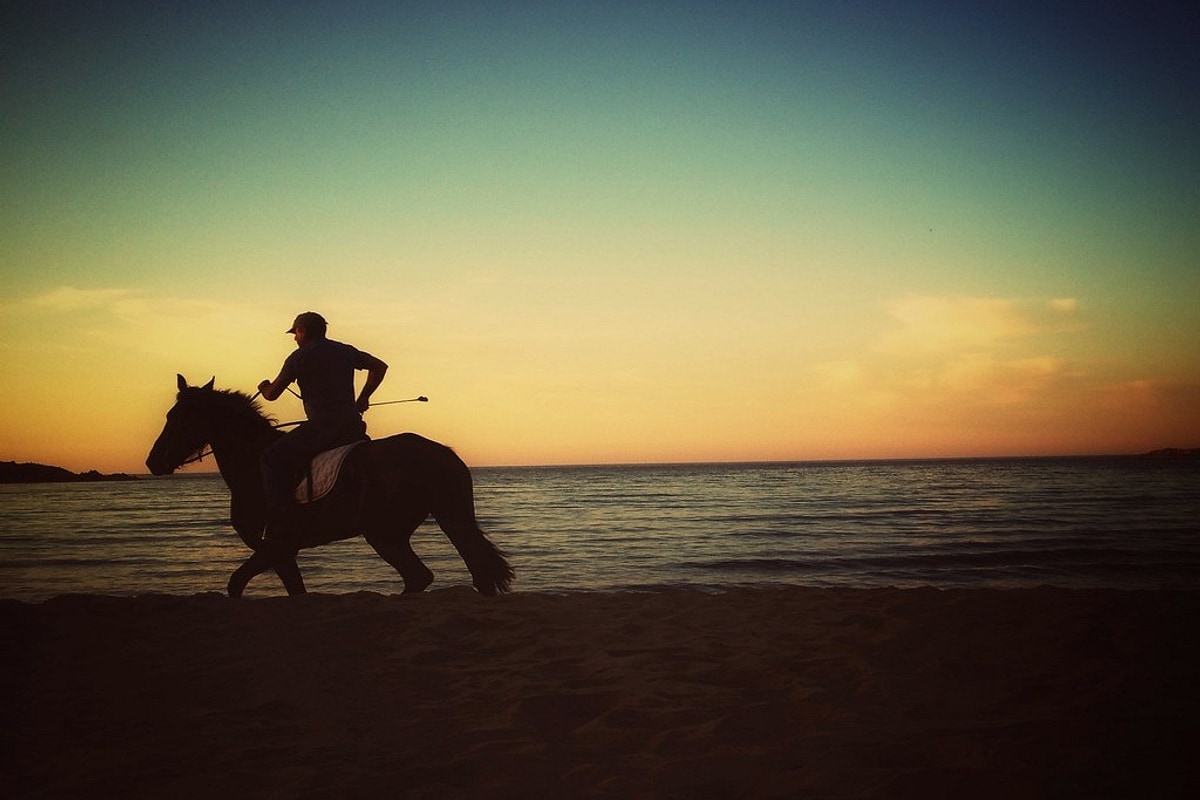
Crete horse riding explores the island on horseback. Rides run from the sea to the mountains. It is one of the outdoor tours in Greece on Greece VIP.
This post covers what Crete horse riding includes and the Cretan horse. It also covers beach rides, mountain and village trails, riding levels and safety.
Later parts cover the areas near Heraklion, Chania and Rethymno. They also cover choosing a stable and the best season. Each section ends with a Crete horse riding tour that can be booked online.
What does Crete horse riding include?
Crete horse riding takes riders on horseback across coastal ground, olive country, hills and village lanes. It fits a first ride or a more active outing. The horse and the route are chosen to match the experience of each rider.
Crete horse riding takes place on an island in the eastern Mediterranean Sea. Crete is the largest island of Greece by area and by population. In the 2021 census, an official count of every resident, the population reached 624,408.
The Sea of Crete lies to the north, and the Libyan Sea lies to the south. On a Crete horse riding route, the setting changes from open water to fields and village edges.
Crete has a coastline of 1,046 kilometres. Yet the shore is only one part of a much wider land area. A Crete horse riding route follows the ground underfoot, not a road network.
The operator, the company that runs the ride, sets the shape of each route. Riding gives a rider time to hold the reins and follow the horse. The reins are the long straps a rider holds to steer and slow the horse. It also leaves time to notice changes in surface and slope.
- Coastal ground: routes run on sand and on open land beside the sea.
- Olive country: rural tracks wind through farmed plots and olive trees on the island.
- Hill paths: rising and falling ground beyond the shore forms another part of the island terrain.
Crete horse riding is an outdoor activity, so weather on the day decides the route. It differs from a motor outing, as the rider works with a living animal.
The rider moves at the pace of the horse. A Crete quad safari is a separate overland option for visitors who seek a motor-based route. It uses quads, which are four-wheeled motorbikes.

Which horses does Crete horse riding use?
Crete horse riding can involve the Messara, a light riding and draft breed from the island. A draft horse is one used for pulling loads. The Messara has a compact height and a long history. It is known for sure footing on rocky or uneven ground.
Crete horse riding introduces a horse tradition tied to the Messara Plain. A native mountain-type Messara pony has lived on the island for at least 1,000 years. The breed name comes from the plain where these horses are found.
In the 17th century, the 1600s, the Ottoman Empire occupied and ruled Crete. During that occupation, Arabian horses were brought to the island. Crossings between them and native horses shaped the modern breed.
The breed still keeps traits of its Arabian ancestors. Crete horse riding can use horses with bay, brown, black or gray coats. A bay coat is reddish brown, with a black mane and tail. A Messara stands between 12.2 and 14 hands high, and one hand equals four inches.
The breed has a natural pacing gait. In this way of moving, both legs on one side step together. This gait gives a smooth ride over a long stretch.
The build of the breed suits a rider who needs a steady horse. Yet the Messara is now rare, with around 100 horses left. A studbook, the official record of the breed, dates from 1994.
- Breed name: the animal also carries the plain name of the Cretan horse.
- Local work: the breed has served for light farm work and for transport.
- Riding use: stallions are sometimes crossed with female donkeys to produce hinnies.
A conservation programme, a plan to save the breed, also started in 1994. The Messara is used for riding and racing too. So it links leisure riding with the working life of the countryside.
Crete horse riding is not limited to one breed, yet the Messara gives a clear reference point. However, the history of a local breed differs from the single horse chosen for an outing. A rider gains from knowing this difference.
What does Crete horse riding see on the beaches?
Crete horse riding on beach ground places a rider beside sand, shallow water and open sea. Dawn and dusk light change the look of the coast. The horse walks at a steady rhythm. This keeps attention on the surface, the tide line and the space ahead.

Crete horse riding can show a coast of wide open shores and narrow coves. A cove is a small stretch of sea with land curving around it. Elafonisi is a protected nature reserve close to the southwestern corner of Crete. It is known for pink sand.
The colour comes from deposits of pigmented microorganisms, which are tiny coloured living things. They live in a relationship with the native seaweed. Sand of this kind forms a soft surface.
Crete horse riding can pass long sandy shores such as Falasarna beach. Falasarna sits on the west end of Crete, and its valley holds olive groves.
In the east, Vai has a palm beach inside a protected forest. The forest served as a camping ground for years. Then it gained national park status, which protects it by law.
Balos Lagoon is shallow sea water, partly cut off by land, between an island and Crete. Cape Tigani, a point of land reaching into the water, forms part of a cape through the lagoon.
- Sand: a beach carries horses only where the ground is firm.
- Sea edge: wind, tide and season change the surface along the water.
- Protected land: local rules decide where riders go in places such as Elafonisi.
Crete horse riding shows this coastline from horse height, not from a vehicle. Preveli beach and lagoon lie where the Kourtaliotiko gorge, a deep and narrow valley, meets the sea. A grove of Cretan date palms grows behind the sand.
What does Crete horse riding see in the mountains and villages?
Crete horse riding beyond the coast can cross foothill tracks, plateau lanes and village approaches. The White Mountains, Psiloritis and the Lasithi Plateau show the range of high land on the island. It runs from mountain peaks to farmed plains and settlements.
In the western uplands, Crete horse riding brings the White Mountains into view. Their Greek name is Lefka Ori. The range covers a large part of central western Crete.
The range is formed mainly of limestone. Limestone is a pale rock that rainwater slowly wears away. Its highest summit is Pachnes, at 2,453 metres. It holds more than 30 summits above 2,000 metres and about 50 gorges.
Crete horse riding on the lower tracks stays in a band of low bushes, fields and paths. Village approaches give each route a contrast with the high peaks.
A ride can also frame Psiloritis, the massif, or mountain block, that includes Mount Ida. At 2,456 metres, Mount Ida is the highest mountain on Crete.
The Psiloritis Natural Park includes the mountain. It belongs to the UNESCO Global Geoparks Network, a world list of areas with special rocks and landforms.
The Lasithi Plateau is a high, flat plain in eastern Crete. Its average altitude, or height above the sea, is 840 metres. It stretches 11 kilometres east to west and 6 kilometres north to south.
The plateau is endorheic, which means its water has no outlet to the sea. A road network connects the settlements around it. Agriculture and animal farming give the main income for people who live there all year.
- Foothills: lower paths sit beneath the main ranges rather than on summit terrain.
- Village lanes: settlement approaches and farm ground pass at a controlled pace.
- Plateau land: broad cultivated ground fills the landscape of the Lasithi Plateau.
Crete horse riding gives mountain and village terrain a different rhythm from a shore route. The surface changes from sand to stone, soil, lane or field edge.
Which riding levels suit Crete horse riding?
Crete horse riding suits complete beginners as well as riders who already manage walk, trot and canter. A good start includes a clear level check and the right protective equipment. An experienced tour leader gives clear directions from the first step.
For a new rider, Crete horse riding starts at the walk. The walk gives a calm beginning on unfamiliar ground. A beginner stays at the walk until the instructor is happy with the basic position in the saddle.
The walk is a four-beat gait, where each hoof lands on its own beat. The trot is a two-beat gait, where the legs move in diagonal pairs. The canter is a controlled three-beat gait.
These are the natural horse gaits before the gallop, the fastest gait. Before a longer Crete horse riding route begins, an instructor can use arena practice or quiet ground. An arena is a closed riding ring.
There, the instructor checks rein contact, the steady link from the hands to the mouth of the horse. The instructor also checks how the rider responds to the movement of the horse.
Crete horse riding needs a level match, since horseback activity carries a built-in risk. A fall is the main cause of horse-related injury. At a higher level, Crete horse riding still depends on the ground and the horse.
A riding helmet lowers the chance of head injury in a fall and makes it less serious. Helmets used in competition meet defined safety standards. Separate assessment bodies test and certify their designs, which means they confirm each design meets the standard.
- First-time riders: a session can begin with mounting help and basic rein instruction.
- Developing riders: controlled trot work follows once the tour leader checks balance in the saddle.
- Established riders: canter belongs on suitable ground and with a horse matched to that pace.
Age rules, weight limits and health requirements are set for each Crete horse riding activity. They appear in its booking information, so a rider needs to read them before booking. A measured pace adds one more practical safeguard.
Where does Crete horse riding take place near Heraklion, Chania and Rethymno?
Crete horse riding near Heraklion, Chania and Rethymno uses farmland, foothills and mountain plateaus. The rides take place outside the three cities. Heraklion rides begin south of the city, and Chania rides head inland from the coast. Rethymno rides follow valleys between the tallest peaks.
South of Heraklion, Crete horse riding uses the Messara Plain, the largest plain on the island. It stretches about 50 km from west to east and 7 km from north to south.
Olive trees, vineyards and garden crops cover the ground there. Routes along its southern edge reach the Asterousia Mountains. This range separates the plain from the Libyan Sea and rises to Kofinas, at 1,231 m.
West of Chania, Crete horse riding tracks climb into the Lefka Ori range. Plateaus inside it lie between 500 and 1,100 m above the sea.
Above 1,800 m, the ground is bare rock and high desert, a dry land with little plant life. The range also holds the two deepest caves in Greece.
- Heraklion: the largest city and administrative capital of Crete puts rides near a large visitor base.
- Chania: the Omalos plateau, 1,041 m high and about 38 km south, leads to high Lefka Ori tracks.
- Rethymno: the Amari Valley separates the Ida massif from Mount Kedros, which rises to 1,777 m.
- Lasithi: the plateau is crossed on the Lasithi Plateau tour.
Crete horse riding in the Rethymno regional unit follows the same pattern. Its tallest peaks are Ida and Kouloukonas, which reaches 1,084 m. The countryside economy still rests on agriculture and herding.
Tracks used by herders link the villages of the area. A herder is a person who looks after grazing farm animals. The villages of Mount Kedros sit on its slopes, between 400 and 600 m high.
How do riders choose a stable for Crete horse riding?
Crete horse riding operators are compared on four points: animal condition, group size, head protection and paperwork. A careful yard keeps clean stabling and rested animals. It gives a safer day out than a yard that leaves the details open.
Animal condition is the first signal for Crete horse riding. A horse in regular work is groomed before it is ridden. Grooming means brushing and cleaning the coat of the horse. Grooming lets the handler check for injuries.
Stabled animals need daily exercise and turnout, which means free time loose in a field. Body condition scoring is the accepted way to check the build of an animal. It shows whether the animal is too thin or carries extra weight for its work.
Head protection follows for Crete horse riding. In a fall, a helmet cuts the risk of traumatic brain injury fivefold. A rider’s head can sit up to 4 m above the ground.
A horse can travel at speeds of up to 65 km/h. So a helmet is replaced after any impact and again every three to five years.
- Group size: rides stay small, from one rider to a small group or a club outing.
- Feet and coat: hooves are picked out and checked before work starts.
- Head protection: a hard helmet built to EN 1384, the European standard, replaces a soft cover.
- Cover: the operator carries public liability insurance for the day.
Crete horse riding bookings work best when the animal fits the rider. Light riding horses stand between 14 and 16 hands and weigh 380 to 550 kg.
Larger riding horses weigh from 500 to 600 kg. A yard that makes this match shows that it plans the day around the animal, not the timetable.
When is the best season for Crete horse riding?
Crete horse riding suits spring and autumn best. Then the ground is softer, and daytime temperatures sit below the summer peak. Early mornings and late afternoons work through the warm months. Winter rides stay possible near the coast, where snow and frost are rare.
Crete lies across two climate zones. It falls mainly in the hot-summer Mediterranean type. Parts of the south and east have a hot semi-arid, or fairly dry, type.
Higher elevations have a cold-summer Mediterranean type. Above 2,000 m, the peaks can have a continental climate. A continental climate has a wide gap between winter and summer temperatures. Snow on the mountains is common from November to April.
So Crete horse riding at height belongs to the warmer half of the year. In Chania, the average daily high reaches 30.5 °C in July.
June averages a daily high of 29.0 °C there, and July brings only 1.4 mm of rain. Strong heat waves above 38 °C are not common in Chania.
The reason is the etesian winds from the Aegean Sea, which ease the heat. These seasonal winds reach their peak in the months of July and August.
- April: Chania averages a daily high of 19.9 °C, and clear skies are almost daily from April on.
- September: the average daily high at Chania eases to 27.5 °C as the season turns.
- October: the average daily high is 23.4 °C, and rain returns with 61.5 mm for the month.
- January: the coast is mild and wet, with 126.4 mm of rain at Chania.
Crete horse riding in summer meets heat and hard, dusty ground. In the shoulder months, between high and low season, the island is green after winter rain. The upper slopes have also shed their snow.
What do travelers ask about Crete horse riding?
Crete horse riding questions cover children, clothing, experience, weight, swims and the rest of the day. Young riders do best on small mounts, and beginners start on level ground. Weight limits protect the horse. A jeep safari pairs with a morning ride.
Is Crete horse riding suitable for children?
Crete horse riding for children starts with the mount. A German study compared riding with cycling. It found the risk of injury nine times higher for teenagers and 5.6 times higher for children.
A pony is a horse under 148 cm at the withers, the top of the shoulders. It gives a small rider a lower platform and a shorter fall.
What does a rider wear for Crete horse riding?
A helmet comes first, then a riding boot with a clear heel and a smooth sole. The heel stops the foot sliding through the stirrup. A stirrup is the loop that hangs from the saddle and holds the foot.
The sole avoids catching on the stirrup tread during a fall. Crete horse riding yards set their own dress rules for every other item of clothing.
Can a rider with no experience book Crete horse riding?
Crete horse riding welcomes beginners. New riders had three times the injury rate of intermediate riders. Their rate was five times that of advanced riders and nearly eight times that of professionals.
The risk falls a great deal only after about 100 hours of experience. A first ride on level ground keeps the day within reach for a new rider.
Are there weight limits for Crete horse riding?
Yards set limits because the animal carries the load. Draft horses stand at least 16 hands and can weigh 700 to 1,000 kg. Ponies carry far less.
A horse needs a steady daily ration of forage, such as hay or grass. On a healthy horse, the ribs are not meant to show.
Can Crete horse riding be combined with a jeep safari?
A morning ride through pine woods can be followed by a vehicle route over higher ground. Together they show two sides of the island. In the Dikti range, pines fill the Selakano valley.
The Katharo plateau lies above the tree line, the height where trees stop growing. Crete horse riding bookings are paired with the rest of the day on the Crete jeep safari page.
Can Crete horse riding include a swim with the horses?
On certain Crete horse riding beach rides, the group spends a short time in the sea. The horses walk into shallow water with their riders still on board.
The swim depends on the stable, the horses and the sea conditions. So riders who want it ask when they book, and they bring clothes that can get wet.
Featured photo: 612gr, CC BY 2.0, via Wikimedia Commons.