
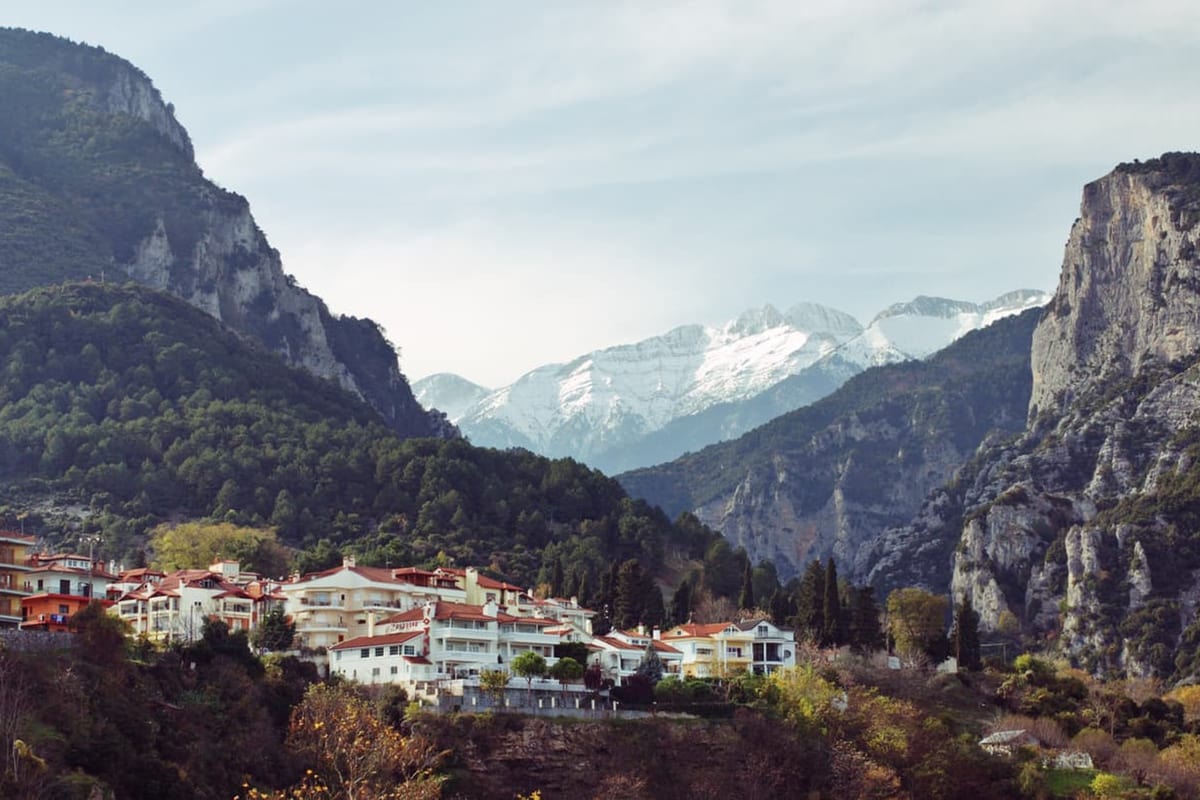
A Mount Olympus day trip leads to the highest mountain in Greece, with its national park, the ancient city of Dion at its foot and the town of Litochoro. This post covers what a Mount Olympus day trip includes, the peaks and gorge, Dion, Litochoro, the myths, the journey from Thessaloniki or Athens, the hikes and the best season. More Greece tours are listed on the Greece VIP homepage.
Each section ends with an Olympus tour that can be booked online.
What does a Mount Olympus day trip cover?
A Mount Olympus day trip covers the highest mountain in Greece, the national park on its slopes, the ancient site of Dion at its north-east foot and the town of Litochoro on its eastern side, in the Pieria regional unit of Central Macedonia.
Mount Olympus is a wide massif close to the Thermaic Gulf of the Aegean Sea. It sits on the border between Thessaly and Macedonia, between the regional units of Larissa and Pieria, about 80 kilometres south-west of Thessaloniki. It counts 52 peaks, cut by deep gorges. Its shape is almost circular, with a circumference of 80 kilometres. Rain and wind shaped it into an isolated tower almost 3,000 metres above the sea. A Mount Olympus day trip sees this tower rise above the plain of Dion.
In 1938, Olympus became the first national park in Greece. The declaration set out to keep the wild plants, the animals and the natural landscape of the region for all time, along with its cultural values. Studies count about 1,700 plant species and subspecies in the park, or 25% of the Greek flora. Thirty-two mammal species and 108 bird species have been recorded, among them the Balkan chamois and the golden eagle. A Mount Olympus day trip passes through this protected habitat.
Dion lies at the north-east foot of the mountain, 5 kilometres from the sea. In antiquity, the Macedonians held it as a sacred city of Zeus and the Twelve Olympians, and it thrived from the 5th century BC to the 5th century AD. Digging at the site began in 1928 and has revealed finds of the Classical, Hellenistic and Roman periods. The modern village beside the ruins carried the name Malathria until 1961. For a Mount Olympus day trip, Dion is the leading archaeological site at the mountain.
- Region: Pieria, with its capital at Katerini, takes its name from the Pieres, an ancient Thracian tribe.
- Highest point: Mount Olympus is the highest point of Pieria, and the Thermaic Gulf is the lowest.
- Heritage zone: The whole Pierian side of Olympus has been declared an archaeological and historical site.
- Old coastline: In Hellenistic times, Dion stood only 1.5 kilometres from the sea.
Litochoro, on the eastern side of the massif, is the principal base for trips to the mountain, and almost all climbing routes begin to its south-west. The town lies about 8 kilometres south of Dion, at the point where the Enipeas river splits the massif. A Mount Olympus day trip links these three places: the ancient city on the plain, the town at the foot of the slopes and the national park above them.



What does a Mount Olympus day trip see on the mountain?
A Mount Olympus day trip sees Mytikas, the highest peak in Greece at 2,917.727 metres, the Enipeas gorge on the eastern side above Litochoro, the springs of the river at Prionia and a national park that UNESCO lists as a Biosphere Reserve.
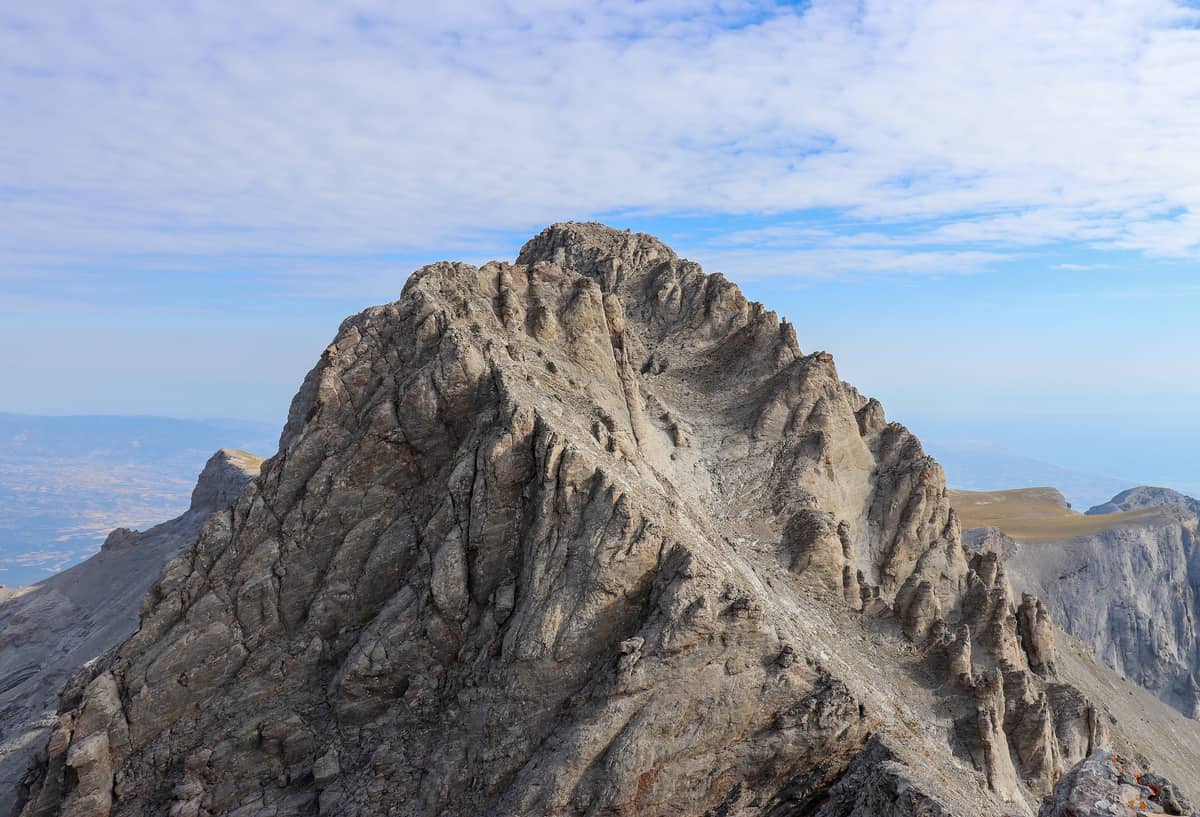
Mytikas, whose name means “nose”, tops every other summit in Greece, and in topographic prominence it ranks among the highest peaks in Europe. Seen from Litochoro, the crest of the mountain forms a “V” between two peaks of almost equal height. Mytikas, also called Pantheon, is the left arm. Stefani, or the Throne of Zeus, at 2,902 metres, is the right arm, and its last 200 metres rise sharply. Skolio, at 2,911 metres, is the second highest sub-peak. A Mount Olympus day trip views this crest from below.
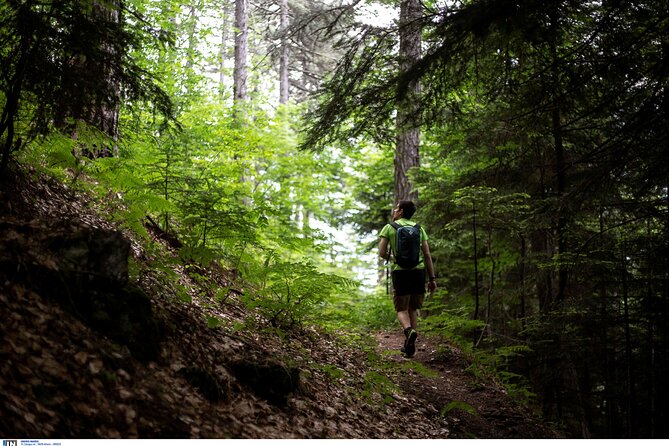
The Enipeas is a small river that rises at Prionia and flows to the Aegean Sea. Its ravine, Mavrologos-Enipeas, runs for 14 kilometres, and together with the Mavratzas-Sparmos ravine it divides the massif into two oval parts. The gorge holds a rich mix of trees and shrubs: elm, European yew, hazel, holly, cornel cherry, manna ash and maple. Oriental planes, willows and black alders line the gorges and ravines of the mountain. A Mount Olympus day trip follows this ravine up from Litochoro.
A road leads to Prionia, at 1,100 metres, where the hike to the peaks begins. Lumberjacks once brought timber to water-driven sawmills there. Lower in the gorge stand the ruins of the Old Monastery of Dionysios. Saint Dionysios of Olympus founded it in 1542 and dedicated it to the Holy Trinity. German forces destroyed it in April 1943. Partly restored, it now operates as a dependency of the New Monastery outside Litochoro. A Mount Olympus day trip reaches the old monastery by car.
- Core zone: Laws ban every form of exploitation in a core area of about 4,000 hectares on the eastern side of the mountain.
- Park size: The park now covers 24,000 hectares, from 600 metres up to the summit of Mytikas.
- Natura 2000: The European network lists the park as a special protection area and a site of community interest.
- World Heritage: The wider area of Mount Olympus is inscribed on the UNESCO World Heritage List as a mixed site, for its natural and cultural value.
Park rules allow entry only by the existing roads and allow parking only in the set parking lots. Hunting any animal, collecting plants or seeds and damaging geological formations are all forbidden. Children under 14 need an escort to enter. The European Union also lists Olympus among its regions of significance for birdlife. A Mount Olympus day trip inside the park keeps to these rules.
What does a Mount Olympus day trip see at Dion?
A Mount Olympus day trip sees the Archaeological Park of Dion, where the ancient Macedonians worshipped Zeus at their main sanctuary, and the Archaeological Museum of Dion, which displays statues, coins, mosaics and a rare water organ found in the ancient city.
Dion takes its name from Dios, “of Zeus”, since the city grew beside the chief Macedonian sanctuary of the god. The first written mention comes from Thucydides, who records that the Spartan general Brasidas reached it in 424 BC. At the end of the 5th century BC, King Archelaus set up a nine-day festival of athletic and dramatic contests there in honour of Zeus and the Muses. In 334 BC, Alexander the Great gathered his armies at Dion and made sacrifices before his campaign to Asia.
The sanctuary of Zeus Olympios stood on a sacred grove outside the city. In the Hellenistic period, a large temple rose there, with gilded statues of the Macedonian kings. Its central square held an altar 22 metres long, and the ceremonies for Zeus included the sacrifice of 100 cattle. Archaeologists found the sanctuary only in 2000, near the Roman theatre. On a Mount Olympus day trip, the sanctuary of Zeus Hypsistos also comes into view, reached by a sacred road lined with small columns and marble eagles.
The city walls, built from Olympus limestone under King Cassander between 306 and 304 BC, ran for 2,625 metres. The park covers 150 hectares, with houses, baths, shops, a market and churches inside the old city. The Hellenistic theatre still hosts the yearly Olympus Festival, while the older theatre on the site saw the premiere of the Bacchae of Euripides. Demeter, Asklepios and Isis each had a sanctuary here. A Mount Olympus day trip follows the main street past the Villa of Dionysus.
- Water organ: The hydraulis, found in the summer of 1992 and dated to the 2nd century AD, is the oldest known instrument of its kind in the world.
- Statues: The museum shows the statue of Dionysos, the daughters of Asklepios and the votive statues of Isis and Aphrodite Hypolympidia from the Isis sanctuary.
- Coins: The collection includes a gold stater of Philip II and a silver tetradrachm of Alexander the Great.
- Dionysus mosaic: The Archaiothiki, a separate building west of the museum, displays the mosaic from the Villa of Dionysus.
The Archaeological Museum of Dion was built in 1983, half a kilometre west of the park, in the modern village. It holds finds from Dion, from Olympus, from ancient Leivithra and from the wider Pieria regional unit. Its basement shows the daily life of the ancient city, with vases, keys, locks and stone-working tools. A Mount Olympus day trip pairs the park with this museum.
Why does a Mount Olympus day trip stop in Litochoro?
A Mount Olympus day trip stops in Litochoro because the town lies at the base of the mountain, on the western shore of the Thermaic Gulf. Almost all climbing routes begin to its southwest, and the Enipeas river splits the massif at the town.
Litochoro is a town in the southern part of the Pieria regional unit. Since the 2011 reform, it has served as the seat of the Dio-Olympos municipality. The town spreads over the eastern slopes of Mount Olympus, and its position at the foot of the mountain gave it the name City of Gods. Its first written mention comes from a 16th-century account of a visit by Saint Dionysios.
This position makes Litochoro the principal base for excursions on Olympus, and the town has hotels and taverns for visitors. A Mount Olympus day trip that stops here can visit the Olympus National Park Information Center, which opened in Litochoro in June 2016. Its displays explain the geology, archaeological sites, mythology, monasteries, plants and animals of the mountain, and professional rangers there assist hikers.
The Enipeas river shapes the view that a Mount Olympus day trip finds in Litochoro. It rises at Prionia, flows past the town and reaches the Aegean Sea at its estuary. Its ravine, Mavrologos-Enipeas, runs for 14 km. The gorge holds a rich mix of trees and shrubs, including elm, cherry plum, European yew, hazel, holly, cornel cherry, manna ash and maple.
Saint Dionysios built a monastery beside the Enipeas gorge in 1542. It first carried the name Agia Triada, meaning Holy Trinity, and later took the name of its founder. German troops destroyed it in April 1943, and the monks moved to the Metochion, three kilometers outside the town, which became the new monastery. A Mount Olympus day trip can reach the old site by car from Litochoro, and the building has been partly restored.
- Nautical Museum: The Nautical Museum of Litochoro presents the long maritime history of the town.
- Alexandreion: This monument-building beside the A1 motorway covers the life and military campaign of Alexander the Great.
- Churches: The two main churches are Agios Nikolaos in the town center and Agios Dimitrios in the north.
- Coast: The nearest beach lies 5 km east of the town, and Gritsa serves as its port.
On a Mount Olympus day trip, Litochoro also places two ancient sites within short reach. Dion lies about 8 km to the north, and Leivithra, with its acropolis, lies about 9 km to the south. Pine, cedar and fir forests of the mountain rise to the southwest and northwest of the town, while farmland covers the land to the north.
What myths does a Mount Olympus day trip recall?
A Mount Olympus day trip recalls the twelve Olympians, the major gods of the Greek pantheon. Ancient tradition placed their home on the mountain, and the names of its peaks, such as the Throne of Zeus, still carry those myths on the skyline above Litochoro.
In ancient Greek religion, the twelve Olympians were the principal gods of the pantheon. The group is commonly given as Zeus, Poseidon, Hera, Demeter, Aphrodite, Athena, Artemis, Apollo, Ares, Hephaestus and Hermes, with either Hestia or Dionysus as the twelfth, since no one canonical list exists. Their name comes from the tradition that they lived on Olympus itself, the massif that a Mount Olympus day trip approaches from Pieria.
The Olympians gained their power in a war of the gods that lasted ten years. Zeus led his brothers and sisters against the Titans, the older ruling generation and the children of Gaia and Uranus. The first Olympians were the offspring of the Titans Cronus and Rhea: Zeus, Poseidon, Hera, Demeter and Hestia. The principal children of Zeus, among them Athena, Apollo, Artemis, Hermes and Dionysus, completed the family.
Hades was a brother of Zeus, yet his realm lay in the underworld, far from Olympus, so he stood outside the Olympian circle as a rule. Other figures lived on the mountain too. Heracles settled there after his apotheosis and married Hebe. Diodorus Siculus records a claim that Heracles turned down a seat among the twelve, since taking it meant casting out one of the original gods.
The origin of the name Olympus is unknown. In the Odyssey, it marks the seat of the gods without pointing to a specific peak. Greek settlers tended to give the name to the highest local summit in each region. No peak in any land of the ancient Greeks rose higher than this Olympus, and by the 5th century BC at the latest, it counted as the seat of the gods for all Greeks.
- Throne of Zeus: Stefani, the right peak of the V that a Mount Olympus day trip sees above Litochoro, is also called Thronos Dios.
- Pantheon: Mytikas, the left peak of the same V and the highest in Greece, also bears the name Pantheon.
- Sanctuary of Zeus: Archaeological finds discovered in 1961 show that Agios Antonios, the third highest peak, held a sanctuary of Zeus in antiquity.
- Orpheus: Tradition ties the towns of Pimblia and Leivithra to Orpheus, son of Apollo and the Muse Calliope.
The myths also reach the plain below the peaks. Tradition placed the nine Muses, daughters of Zeus and the Titaness Mnemosyne, in Pieria at the northern foot of Olympus. Pieria also holds the Pierian Spring, and from its Mount Pierus, Hermes takes flight to visit Calypso. A Mount Olympus day trip crosses this land of myth on the way to the peaks.
How does a Mount Olympus day trip travel from Thessaloniki or Athens?
A Mount Olympus day trip from Thessaloniki or Athens follows the A1 motorway, part of European route E75, to Pieria, or uses the main Athens–Thessaloniki railway. Litochoro lies 90 km from Thessaloniki and 420 km from Athens, with Katerini 22 km to its north.
Pieria is a regional unit of Central Macedonia, with the Pierian Mountains to the west and the Thermaic Gulf to the east. Mount Olympus rises in its southern part, so a Mount Olympus day trip from either city heads for Pieria. Its capital, Katerini, stands on the plain between the mountain and the gulf and serves as the rail and bus hub of the unit.
From Thessaloniki, the road route follows the A1 motorway along the Athens–Thessaloniki–Evzonoi corridor. Katerini lies 68 km from Thessaloniki and joins the motorway at its South, East and North interchanges, while the A2 motorway reaches the city from the north. Litochoro uses exits 70A and 71 of the A1, and Provincial Road 5 runs south from Katerini toward Limenas Litochorou.
From Athens, the A1 runs north along the same corridor. Work in the mid-1990s raised parts of the old EO1 between Athens and Evzonoi to motorway standard, and Litochoro stands on the northern part of the resulting six-lane dual carriageway, 420 km from Athens and 58 km north of Larissa. Intercity buses from the Pieria bus terminal in Katerini also link the city directly with Athens and Thessaloniki.
By rail, a Mount Olympus day trip uses the Piraeus–Platy railway, the electrified double-track line that carries the main Athens–Thessaloniki connection through Thebes, Larissa and Katerini. Intercity trains between Athens and Thessaloniki call at Katerini but not at Litochoro. Line T1 of the Thessaloniki Regional Railway runs between Thessaloniki and Larissa and stops at both towns, and Larissa offers an interchange with the main line to Athens.
- Airport: For a Mount Olympus day trip by air, the nearest international airport is the one at Thessaloniki.
- Stations: Litochoro, Katerini and Leptokarya are the railway stations that serve the mountain.
- Bus: A regular bus service runs between Litochoro and Katerini.
- Taxi: Taxis wait at a stand in the central square of Litochoro.
Litochoro railway station lies about 6 km from the town and 1 km from the nearest bus stop. For this reason, rail travellers on a Mount Olympus day trip tend to use Katerini station and the bus link instead. The former coastal line at Platamon, which ran along the eastern slopes of Olympus to Katerini, was abandoned after the section was shortened in 2004.
Which hikes suit a Mount Olympus day trip?
A Mount Olympus day trip can take in three kinds of walking: the Enipeas gorge on the eastern side, a stretch of the E4 European long distance path, and the climb from Prionia toward the refuges. All three link to the town of Litochoro.
The Enipeas is a small river. It rises at Prionia, cuts through the massif at Litochoro and flows on to the Aegean Sea. Its ravine, Mavrologos-Enipeas, runs for 14 km and stands out among the ravines of Olympus. The gorge holds a rich mix of trees and shrubs, such as elm, cherry plum, European yew, hazel, holly, cornel cherry, manna ash and maple. Oriental planes, willows and black alders cover the gorges and ravines of the mountain.
The Old Monastery of Dionysios lies in the Enipeas gorge at 820 metres and can be reached by car from Litochoro. A Mount Olympus day trip can pair the gorge with this stop. Higher up, in the Dionysios Monastery forest, the Stavros refuge stands at 930 metres, 9.5 km by asphalt road from Litochoro. It belongs to the Greek Mountaineering Club of Thessaloniki. It works all year round, mainly as a refreshment room and restaurant, and takes up to 30 guests.
The E4 European long distance path runs for more than 10,000 kilometres, from Cabo de San Vicente in Portugal to Cyprus. Its Greek section passes Dion, Litochoro, Olympus and Kokkinopilos on the way to Meteora. On the mountain, the E4 leads from Kokkinopilos to Skala, past the Kalyva tou Christaki emergency refuge at 2,430 metres. That shelter has beds only and serves as cover from bad weather. Aluminium signs mark the route with a yellow rhombus and the words E4/6.
The usual climb starts in Litochoro, where a road leads up to Prionia, at 1,100 metres. Walkers set off from there, at the foot of the mountain. The first refuge of the area, Spilios Agapitos, stands at 2,100 metres in the centre of Mavrologos. Petrostrouga, at 1,900 metres on the D10 path to the Muses’ Plateau, sits among Bosnian pines. The Hellenic Rescue Team runs it, with space for 60 people in every season.
- E4 waymarks: Coloured marks on rocks and trees place a yellow parallelogram beside a black one on a white base.
- E4 upkeep: The Hellenic Federation of Mountaineering and Climbing and its clubs set up and maintain the E4 in Greece.
- Heliports: Olympus has three emergency heliports, at Petrostrouga, Skourta and Spilios Agapitos.
- Rangers: Professional rangers at the Olympus National Park Information Center in Litochoro help hikers.
For a Mount Olympus day trip, the gorge, the Old Monastery of Dionysios and the Stavros refuge stay low and close to Litochoro. The E4 and the road to Prionia lead to high ground, where Petrostrouga, Spilios Agapitos and the Kalyva tou Christaki shelter stand along the paths. Day walkers on the upper paths pick a turning point before the start and keep to the marked route.
When is the best season for a Mount Olympus day trip?
A Mount Olympus day trip to the high paths fits the period from mid-June to early October. Snow can cause problems on the mountain until mid-June, and the Greek National Tourist Office ends its E4 hiking window in early October.
Olympus has a Mediterranean climate with a continental influence. In Litochoro and the foothills, summers are hot and dry, and winters are humid and cold. Higher up, the air is more humid and the weather can turn severe. Snow is common there through the winter, and even summer brings rain or snow at times. The coastal northeast slopes take more rain than the continental northwest, and their plant cover is thicker as a result.
On the mountain, winter temperatures range from −10 °C to 10 °C, and summer temperatures from 0 °C to 20 °C. In the 1960s, the highest weather station in Greece took readings on the summit of Aghios Antonios, at 2,815 m. The alpine zone averages −5 °C in winter and only 10 °C in summer, so walkers on the high ground still need warm layers in summer.
Above 2,000 metres, snow covers the mountain for about nine months, from September into late spring. In places the wind piles it 8–10 metres deep, in drifts known in Greek as anemosouria. Certain deep ravines keep their snow all year. The Greek National Tourist Office notes that, along the E4, snowfall starts in November and can linger into June. In the north of Greece and at higher altitudes, spring arrives only in June or even July.
Average yearly precipitation ranges from 149 cm at Prionia to 170 cm at Aghios Antonios. About half falls as rain and hail in summer, and the rest as snow in winter. Summer rain is frequent and comes as evening thunderstorms, which can bring hail and strong winds. The weather can change more than once in a single day, and higher up the shifts in temperature and humidity tend to be sudden. On a Mount Olympus day trip, a clear morning sometimes ends in a stormy evening.
- Altitude: The temperature falls by 1 °C for every 200 m of height.
- Wind: Winds blow on the mountain almost every day.
- Months: August is the hottest month on Olympus, and February is the coldest.
- Day and night: Along the E4 in Greece, day and night temperatures differ widely.
The Tourist Office opens its E4 hiking window earlier in spring, but snow lasts longer on the high ground of Olympus. A Mount Olympus day trip before mid-June or after early October keeps to the lower ground around Litochoro, where the climate is Mediterranean. Inside the window, an early start helps the climb finish before the evening storms.
What do travelers ask about a Mount Olympus day trip?
A Mount Olympus day trip raises four common questions: the summit, children, park rules and what to carry. In short, the summit needs a rock scramble, children under 14 enter only escorted, walkers keep to formed paths, and water and weather gear come first.
Does a Mount Olympus day trip reach the summit?
Reaching the top takes more than a walk. Up to the Skala summit, the climb is a non-technical hike. The final section from Skala to Mytikas, the highest peak in Greece, is a class 3 rock scramble with high exposure. Of the 10,000-plus yearly visitors, the majority stop at the Skala and Skolio summits.
Does a Mount Olympus day trip suit children?
Park rules do not allow children under 14 to enter unescorted, so young hikers stay with an adult. For families, a Mount Olympus day trip can centre on low stops reached by car, such as the Old Monastery of Dionysios and the Stavros refuge. The park information centre in Litochoro explains the geology, myths, plants and animals of Olympus.
Which park rules apply on a Mount Olympus day trip?
On a Mount Olympus day trip, visitors enter the park only by the existing roads and walk only on formed paths, from sunrise to sunset. Cars park only in the set parking lots. Picking plants, shrubs or seeds is banned, as is hunting at any time of year. Pets and other animals with visitors cannot roam free.
What do visitors bring on a Mount Olympus day trip?
Water comes first on a Mount Olympus day trip, since springs above 2,000 metres are scarce. Clothing for any weather comes next, because conditions turn fast as the path climbs. Sturdy boots, sun protection, a map of the marked paths and a charged phone complete the kit. Food for the whole day matters too.
Featured photo: E.asphyx, CC BY 3.0, via Wikimedia Commons.