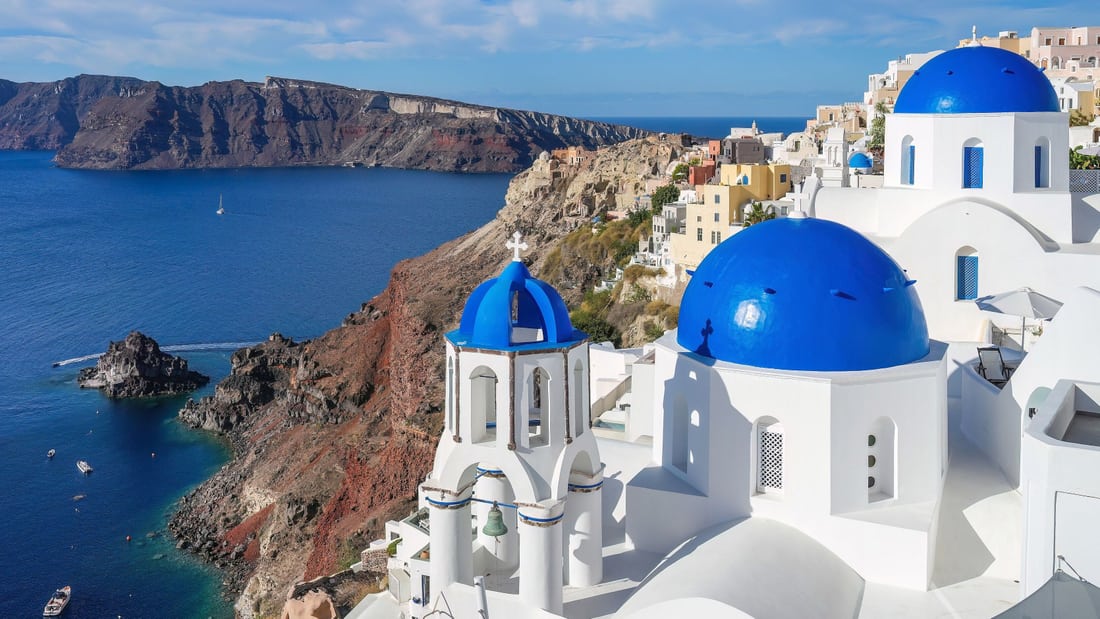
A Santorini cooking class brings visitors into a village kitchen, a farm or a winery kitchen to cook the dishes of the island with produce grown in volcanic soil, from fava and cherry tomatoes to capers, and then to share the meal. This post covers what a Santorini cooking class includes, where classes are held, how the volcanic soil shapes the food, the dishes, the local produce, the story of the tomato on the island, its place in Cycladic cooking and the best season. It is one of the tours in Greece on Greece VIP.
Each section ends with a Santorini cooking class that can be booked online.
What does a Santorini cooking class include?
A Santorini cooking class teaches the food of a volcanic Aegean island. A session covers local produce, cooking by hand and a shared meal at the end. The setting varies from a village house to a farm or a winery kitchen.
The food of Santorini belongs to Greek cuisine, which has a written and pictured record from ancient times. Dishes of fish are common on the islands, and goats and sheep suit the climate better than cattle. Under late Ottoman rule, the majority of Santorini residents were farmers and seafarers who exported their abundant produce. A Santorini cooking class starts from that record of land and sea.
A class has three parts. The first is local produce from the island’s farms. The second is cooking by hand in a working kitchen. The third is the shared meal. Eating out is common across Greece, and tavernas and estiatoria are widespread places that serve home cooking, so a table of home-cooked dishes is a familiar way to end a day.
A tasting tour and a class answer different questions. A Santorini wine tour travels between cellars to taste what others have made, while a Santorini cooking class has each visitor prepare the food. The island keeps a small wine industry, and a farm cooperative formed in 1947 to promote its farm products, in particular its wine. That industry is the setting for the winery kitchen.
- Village house: The class cooks in a home kitchen.
- Farm: The class starts among the island’s crops.
- Winery kitchen: The class cooks within the wine industry.
Wine and olive oil have always been central to Greek cooking, and the ancient spread of grapes and olive trees across the Mediterranean is connected with Greek colonization. That history places wine and oil at the centre of any Greek kitchen, including the kitchen of a Santorini cooking class. The next section covers where classes are held.



Where is a Santorini cooking class held?
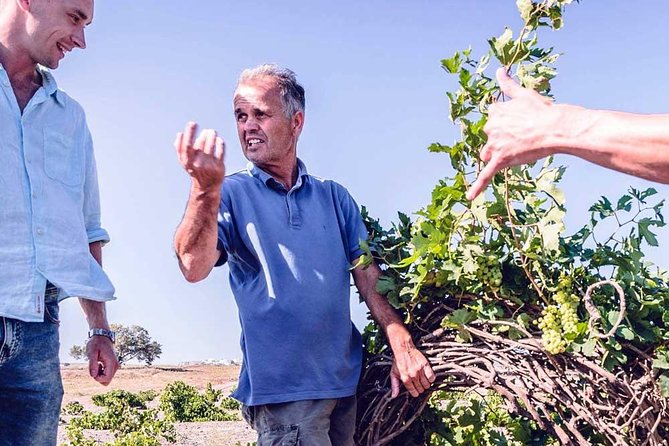
A Santorini cooking class is held in the inland villages of Pyrgos, Megalochori and Emporio, and in the caldera villages of Oia and Fira. The caldera villages stand on a sheer cliff rim, and the inland villages lie away from it.
Pyrgos Kallistis is part of the municipality of Thira. The village is one of the sites where non-volcanic basement rock, made of metamorphosed limestone and schist, is exposed. The castle at Oia was part of the same Venetian defence system as Pyrgos, whose own castle now stands in ruins. A Santorini cooking class in Pyrgos works in a medieval village of narrow streets and fortified walls.
Megalochori is a Cyclades village on the island of Santorini. The Exo Gialos desalination plant supplies its water, along with Fira, Imerovigli, Karteradou, Pyrgos and Vourvoulou. Emporio lies by the Profitis Ilias mountains. Its community groups four villages and had 3,704 inhabitants at the 2021 census. A Santorini cooking class in Emporio sits in a community more than three times the size of Pyrgos, with 1,078 inhabitants.
Oia sits in the north of the island, 70 to 100 metres above sea level on the caldera rim, and its sunlight hours are much longer than in Fira town. Fira, the modern capital of the island, stands on a caldera rim 400 metres high, and its houses are whitewashed. A Santorini cooking class on the rim sits above the water-filled crater.
- Pyrgos: The village lies about 7 km from Fira.
- Oia: The village lies 11 km from Fira.
- Emporio: The village lies 12 km from Fira.
Oia had only 306 inhabitants in 1977, after renewed emigration following the 1956 earthquake, and 1,087 at the 2021 census. In the late 19th century, wine was produced in quantity in its hinterland and exported to France. A Santorini cooking class in Oia stands in a former seafaring town on the caldera rim.
Why does volcanic soil shape a Santorini cooking class?
A Santorini cooking class draws on produce grown in volcanic ash soil on an island that the Minoan eruption reshaped. Without irrigation, the crops live on dew from early-morning fog, so the soil and the dry climate set what reaches the kitchen.
The Minoan eruption circa 1600 BC destroyed communities and agricultural areas on nearby islands and on the coast of Crete. On Santorini, pumice sediments covered the whole landscape during the eruption. Its tephra now serves as a marker layer in nearly all archaeological sites in the Eastern Mediterranean. Every Santorini cooking class therefore takes place above a landscape that the eruption buried.
Water is scarce on the island, and the soil is part of the reason. Santorini has no rivers, and its single spring is Zoodochos Pigi, the Life-giving Spring. The soil is largely volcanic ash, which, with the lack of rivers, left very little surface water. Elaborate underground cisterns stored the rain that fell on roofs and in courtyards, and in the 20th century water was also imported from other areas of Greece.
Scarce water pushed islanders toward crops that need no irrigation, vines and olives among them. Both live on the scant moisture that a common early-morning fog leaves as dew on the soil. The island’s prized produce is credited to the ecology, the climate and, above all, the volcanic ash soil. Greek cuisine counts olive oil as its leading characteristic and ancient element, and a Santorini cooking class works with it throughout the menu.
- Erosion: Erosion moved pumice from higher altitudes to lower ones.
- Coast: Thick tuff buried parts of the coastline.
- Rock: Eruptive products range from basalt to rhyolite.
The Minoan eruption is one entry in a long record. Santorini has erupted repeatedly, with at least twelve large explosive eruptions. The island is the result of repeated sequences of shield volcano construction followed by caldera collapse, and the ground behind every ingredient in a Santorini cooking class belongs to that record.
Which dishes does a Santorini cooking class teach?
A Santorini cooking class teaches Santorini fava, a split-pea purée; tomatokeftedes, tomato fritters; sfougato, an oven-baked omelette; and melitinia, a sweet cheese dessert. Reference articles tie each of the four dishes to Santorini, so each one gives the class a local recipe.
Fava heads the dish list of a Santorini cooking class. Despite the name, Greek fava is not made from fava beans. The peas, mainly yellow ones, are cooked with chopped onion and mashed with seasonings, garlic, lemon juice and oil into a thick, creamy paste. The dish began in Byzantine cuisine and was widely served in tavernes. The Santorini version uses the seeds of Spanish vetchling in place of peas.
In a Santorini cooking class, tomatokeftedes are fried tomato balls served as an appetizer, a dish of Santorini and the Cyclades. Cooks crush or purée the tomatoes and knead them with flour into a dough. Spices, parsley, onion and mint go into the dough, and the portions are fried in oil. Island-grown tomatoes are preferred, as pumice-laced soil makes for more robust fruits.
Sfougato is an oven-baked omelette of eggs, grated zucchini, scallions and dill, with feta, kefalotyri or another cheese. Greek cuisine records the well-known version from Mytilene, Santorini and Crete, and the omelette is also served as a breakfast dish. Melitinia end the list of a Santorini cooking class as the sweet dish, made from sweet cheese, sugar and eggs with a hint of mastic.
- Fava: Served warm or cold, the purée also works as a dip.
- Tomatokeftedes: Greek cuisine also lists potato, pumpkin and cheese fritters.
- Sfougato: Greek cuisine lists it beside scrambled eggs with tomato.
The four dishes work as one lesson in a Santorini cooking class, because each starts from a plain base of a pulse, a tomato, eggs or cheese. Greek cuisine is founded on wheat, olive oil and wine, and these recipes add pulses, vegetables and dairy to that base. The next sections turn to the produce behind them.
Which local produce does a Santorini cooking class use?
A Santorini cooking class uses the Santorini cherry tomato, capers and aubergine, along with the legume behind fava. The island’s ecology, climate and volcanic ash soil give Santorini prized produce, and sources name the cherry tomato as one example of it.
The cherry tomato of a Santorini cooking class, known in Greek as tomataki Santorinis, has a round, slightly flattened shape. The fruits carry pronounced flutes, especially those growing lowest on the plant. The flesh is firm and not particularly moist. A widely held belief credits an abbot of the Capuchin monastery in Ano Syros with bringing the first cherry tomatoes to Greece in 1818.
The capers in a Santorini cooking class are the flower buds of the caper bush, a plant that needs a semiarid or arid climate. Pickers collect the buds in the morning and return each day, because the youngest, smallest buds are worth more. After picking, the buds are pickled in salt, or in salt and vinegar, and drained. Each bud releases glucocapparin, and the intense flavour is sometimes compared with black pepper or mustard.
The aubergine in a Santorini cooking class, also called eggplant, ranks among the important vegetables of Greek cuisine, beside tomatoes, potatoes, green beans, okra and green peppers. Certain cultivars have egg-shaped, glossy purple fruit with white flesh, while other cultivars are white and longer in shape. The English name, first recorded in 1763, was originally applied to white cultivars that look like hen’s eggs.
- Tomato: The fruit tastes sweet and strongly acidic.
- Caper: Ancient Greece used the caper as a carminative.
- Aubergine: The Arabic word bāḏinjān entered Greek by the eleventh century CE.
A Santorini cooking class connects these crops to everyday Greek cooking. Home-cooked meals include seasonal vegetables stewed with olive oil, herbs and tomato sauce, a style called lathera, and green beans, peas, okra, cauliflower, spinach and leeks suit it. Tomatoes are a New World plant, yet tomato sauce now runs through island recipes and mainland home cooking.
What does a Santorini cooking class teach about the island’s tomato industry?
A Santorini cooking class teaches that Santorini was known as tomato island before the 1950 eruption, and that its paste factories closed as growing declined. The Tomato Industrial Museum at Vlychada keeps the machinery, archives and oral histories of that industry.
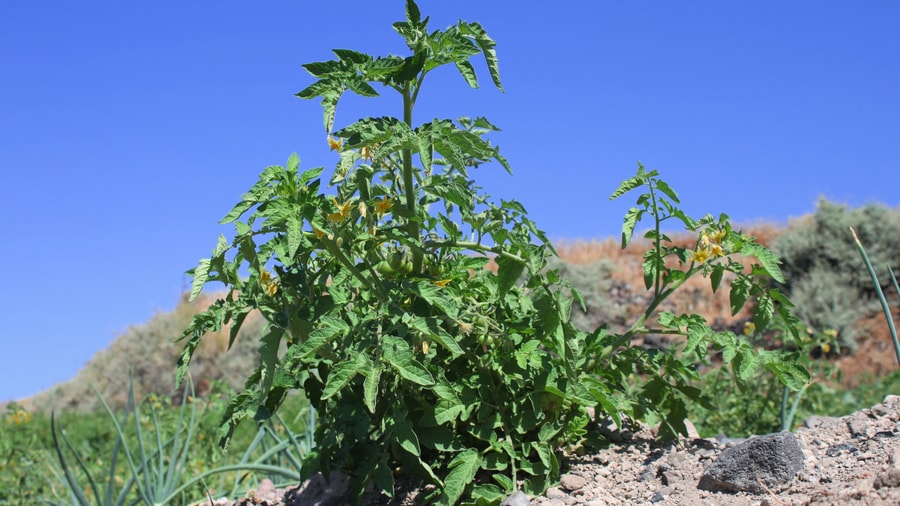
The tomato story of a Santorini cooking class begins with the Nomikos family. Dimitros Nomikos started his first tomato processing business in Messaria in 1915. By 1922 he had founded a cannery at Monolithos, described as one of the first canneries in the Balkans. His son George founded the Vlychada tomato processing plant in 1945 and named it after his father.
Tomatoes were a significant crop, and over centuries the island developed a variety suited to volcanic soils that needed little water. The variety had a thin skin, thick flesh and a strong taste, qualities ideal for tomato paste. During its busiest periods, the Vlychada factory processed 3,500 baskets of tomatoes a day. In 1956 the site was flooded and shaken by an earthquake.
The island’s economy declined after the Second World War. A number of factories closed as industry moved to Athens, and the Union of Santorini Cooperatives, founded in 1947 to process, export and promote island produce, built a factory near Monolithos in 1952. The Vlychada plant closed in 1981 as less tomato was grown, and the site reopened as an industrial museum in 2014.
- Collection: Machinery, tools, archival materials and oral histories fill the collection.
- Power: Boilers once generated electricity for paste production.
- Technology: Holographic fans and augmented reality explain the processes.
A Santorini cooking class links this industrial record to the plate. The museum covers the cultivation, processing and production of tomato paste, and in 2017 The Independent described visitors meeting the island’s triple-concentrated paste there. The tomato in a Santorini kitchen therefore carries a history of farms, boilers and factory floors.
How does a Santorini cooking class fit into Cycladic cooking?
A Santorini cooking class fits into Cycladic cooking as the dry-farmed, volcanic branch of one island cuisine. The Cyclades share cheeses, fish and omelettes, while Santorini adds fava, tomato fritters and a sweet cheese dessert, shaped by ash soil.
The Cyclades are an archipelago of about 220 islands in the Aegean Sea. Greek cuisine counts the cooking of the group, called Kykladitiki, as a regional style. The climate is dry and mild, and apart from Naxos the soil is not very fertile, so farm produce includes wine, fruit, wheat, olive oil and tobacco. A Santorini cooking class starts from that shared base.
Island cheese marks the Cycladic table. Kopanisti is a salty, spicy cheese with protected designation of origin, made on Mykonos, Tinos, Andros, Syros and Naxos. Fish dishes are common on the islands, and kakavia is a fish soup tied to fishing villages. Capers arrive as kaparosalata, a caper salad, while oregano, mint and dill flavour Greek dishes more heavily than other Mediterranean cooking.
Santorini differs from the other islands in its ground. With Milos, it is one of two volcanic islands in the chain, and the rest are summits of a sunken mountain landscape. Naxos is the fertile exception among them. Cooks prefer Santorini tomatoes, as the rugged terrain and pumice-laced soil make sturdier fruit, and the legume behind Fava Santorinis grows only on Santorini and nearby islands.
- Mykonos: Kopanisti has been made there for more than 300 years.
- Sifnos: Mastelo is a roast lamb dish from the island.
- Milos: Pitarakia are small half-moon pies filled with mizithra cheese.
Syros, in the same chain, printed the first Greek cookbook in 1828, so island cooking has a long written record. Cheeses, fish and omelettes frame the wider Cycladic table. A Santorini cooking class adds its own local chapter, grown on ash and pumice, with 3,500 years of legume farming behind it.
When is the best season for a Santorini cooking class?
A Santorini cooking class has a food calendar rather than one best season. Summer brings fresh tomatoes, late summer brings the grape harvest, and the wetter months fill the cisterns. The climate is hot semi-arid, so the crops follow the weather.
Climate records file Santorini under the Köppen code BSh, hot semi-arid, with the Csa pattern of a dry summer and a wetter winter. The yearly average sits near 19 °C, and rain totals around 270 mm. Those figures set the calendar for a Santorini cooking class, because the crops, the harvest and the cisterns follow the dry and wet halves of the year.
Summer is the tomato season. Strapatsada, eggs scrambled into tomatoes cooked down in olive oil and pepper, is especially popular in summer, when fresh tomatoes abound, and the Cyclades call it koskosela. The caper bush thrives in a hot, dry summer, pickers cut its buds in the morning, and capers are then pickled in salt or a salt and vinegar solution.
Late summer brings the grape harvest, and growers on Santorini pick in mid-August. The harvest feeds the kitchen as well as the cellar. Moustalevria is a pudding of grape must, the juice of pressed grapes before fermentation, boiled with flour until thick, and it is popular while the must is fresh. Moustokouloura are the biscuit version, and petimezopita is a grape syrup cake.
- Spring: A rainy spring suits the caper bush, and lazarakia mark Lazarus Saturday.
- Autumn: The grape harvest season of the Northern Hemisphere runs to October.
- Winter: Rain from roofs and courtyards once filled underground cisterns.
No single month suits every dish, so the choice follows the ingredient. Home cooks on the islands lean on lathera, seasonal vegetables stewed with tomato sauce, herbs and olive oil, so the weather decides the pot. A Santorini cooking class that follows the calendar cooks what the island offers that month.
What do travelers ask about a Santorini cooking class?
A Santorini cooking class prompts practical questions on vegetarian diets, recipes, the shared meal, wine and village visits. The answers below rest on the dishes and the island itself, and every host sets the final terms. Travelers confirm the details when booking.
Does a Santorini cooking class cater for vegetarians?
A Santorini cooking class can draw on a plant-based table. Fava is a legume purée with onion, olive oil and lemon juice, tomatokeftedes are fried tomato balls, and sfougato is an oven-baked omelette of eggs, zucchini, dill and cheese. Travelers name any diet when booking.
Are recipes shared at a Santorini cooking class?
Whether recipes are handed out depends on the host. The dishes rest on short ingredient lists: melitinia combine sweet cheese with sugar, eggs and a touch of mastic, and fava needs cooked legume seeds, onion, olive oil and lemon juice. Travelers ask about written copies when booking.
Do travelers eat what they cook at a Santorini cooking class?
Tomatokeftedes are served as an appetizer, fava is eaten warm or cold, and melitinia are a dessert, so the three dishes form a meal. Hosts confirm whether the group sits down to eat the finished food, and diners flag any dish they skip.
Is wine served at a Santorini cooking class?
Wine is one of the three pillars of Greek cooking, and Santorini has made wine since ancient times, well before Venetian trade made it famous. The white grapes of the island include Assyrtiko, Athiri and Aidani. Hosts confirm whether wine is poured at all.
Can a Santorini cooking class include a village visit?
Hosts confirm whether a village stop is offered. Emporio, Megalohori and Pyrgos Kallistis are among the 12 local subdivisions on the island, and the municipality of Thera, created in 2011 from the former Oia and Thera municipalities, includes the settlements of Santorini and Therasia.
Featured photo: Giles Laurent, CC BY-SA 4.0, via Wikimedia Commons.