
An Arkadi monastery tour takes a coach from the Rethymno area to Arkadi Monastery, a cave, a pottery village and a traditional olive oil mill. Among the Greek tours, it is a Cretan day of history and craft.
This post walks through the day stop by stop, from the cave to the potters of Margarites, the mill and the monastery’s story. Season, booking, packing and quick answers come after.
What is an arkadi monastery tour?
An arkadi monastery tour is a day-long coach outing from the Rethymno area on Crete that visits four places: Melidoni Cave, the pottery village of Margarites, a traditional olive oil mill and Arkadi Monastery. Two languages are offered, English and German.
The stops follow a set order: Melidoni Cave first, the village of Margarites second, the olive oil mill third and Arkadi Monastery last. Each stop includes free time to look around.
On an arkadi monastery tour, travellers ride in an air-conditioned coach from stop to stop, which keeps the journey comfortable. The booking also covers transfers to and from the hotel.
Monasteries are homes and workplaces of monks or nuns, as one building or a complex. Such a complex includes a place for prayer and can add a library, school or farm buildings.
Pickup details vary by hotel area, and the booking page tells travellers to check availability. At the end of the day, travellers return to their original pickup point.
- Stops: four places
- Transport: air-conditioned coach
- Languages: English, German
- Pickup: hotel, both ways
An arkadi monastery tour joins a cave, a pottery village, an olive oil mill and a monastery in one day.


Where is the monastery on an arkadi monastery tour?
An arkadi monastery tour reaches Arkadi Monastery, a Greek Orthodox site on a plateau southeast of the city of Rethymno on Crete. The plateau lies on the northwest side of Mount Ida, 500 metres above sea level, in the Rethymno region.
The last stop on an arkadi monastery tour lies in fertile land. The region holds vineyards, olive groves and forests of pine, oak and cypress, and hills surround the plateau.
The west side of the plateau drops away into gorges. They run from Tabakaria to Stavromenos, east of Rethymno, and hold a rich variety of plants and native wildflowers.
Arkadi is one of four former municipalities that now form the municipality of Rethymno, a city of Crete. The city itself has a separate Rethymno tour post on this site.
Of Greece’s islands, Crete is the largest. A mountain range crosses it from west to east, and its highest point is Mount Ida, on whose northwest side the monastery stands.
- Region: Rethymno, Crete
- Direction: southeast of Rethymno
- Mountain: Mount Ida
- Setting: plateau, olive groves
An arkadi monastery tour stops at a plateau on the side of Mount Ida, southeast of Rethymno.
Why does the history matter on an arkadi monastery tour?
An arkadi monastery tour visits a site that served as a centre of learning and manuscript copying and later took part in the 1866 uprising on Crete against Ottoman rule. Today it is a national sanctuary for Cretan resistance, commemorated on 8 November.
The exact founding date is not known. Tradition names either the Byzantine emperor Heraclius or the emperor Arcadius, while another theory points to a monk named Arkadios as the founder.
By the 16th century, science and art had a home at the monastery, which kept a school as well as a rich library. It also gave local Christians an education.
An Ottoman army laid siege to the monastery in November 1866. The rebellion had its headquarters there, and 259 defenders and over 700 women and children sheltered inside.
After days of fighting, the Ottomans broke in, and the rebel Kostis Giaboudakis lit the gunpowder kept in the vaults. The blast did not end the revolt but drew world attention.
- Founding: date unknown
- Revolt: 1866
- Refuge: women and children
- Memorial: 8 November
An arkadi monastery tour visits the monastery where the events of 1866 unfolded.
What does the building look like on an arkadi monastery tour?
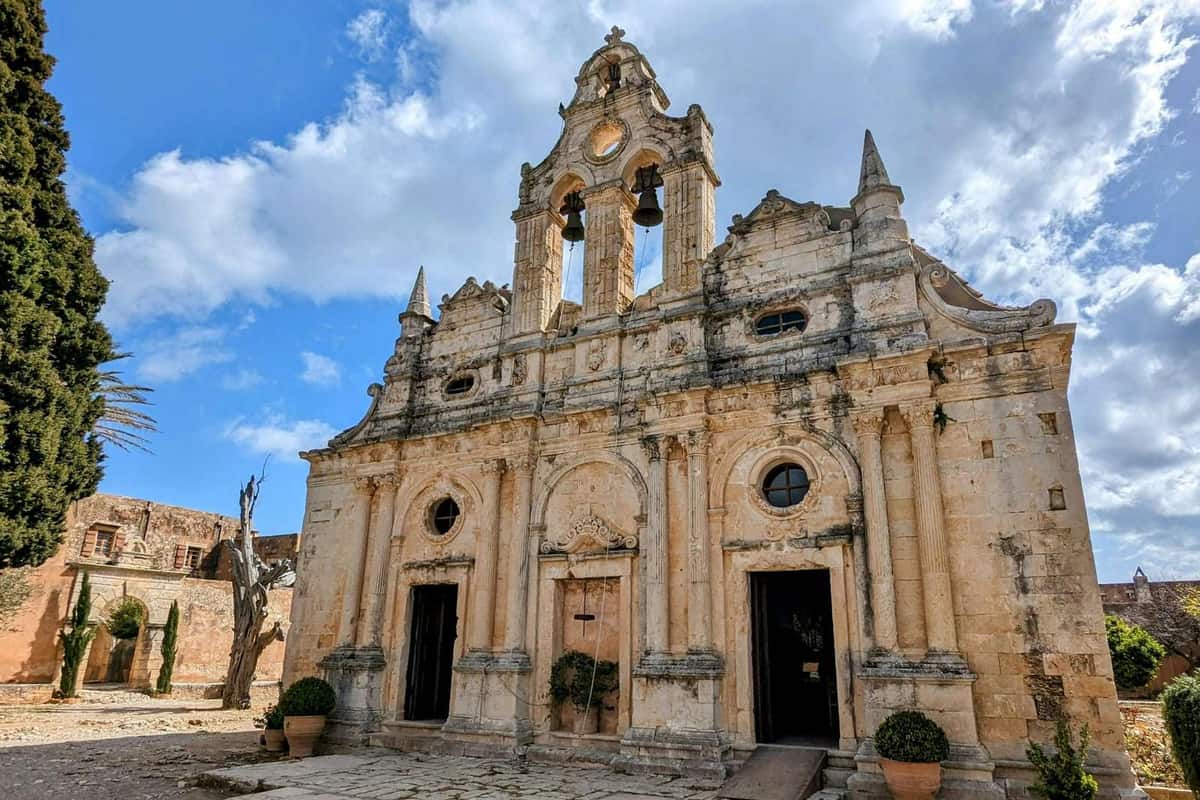
An arkadi monastery tour ends at a walled compound with a nearly rectangular plan and a fortress feel. Inside stand a 16th-century church, a powder magazine, a refectory and a hospice, while a memorial for fallen Cretans lies outside the monastery.
The wall encloses 5,200 square metres and carries embrasures on three sides. The west door is called Rethemniotiki or Haniotiki, and the east door Kastrini. Both current doors date from 1870.
The church, or katholikon, was built while Venice ruled Crete and mixes Renaissance Revival style with Roman and Baroque elements. Baroque is a decorative, theatrical style from late 16th-century Italy.
The powder magazine is oblong and vaulted. The refectory, where monks took meals, dates from 1687 and is a rectangular room under a vault, with kitchens in the east.
A hospice fills the northwestern part and was finished in 1906. The octagonal memorial, a former windmill, stands about 60 metres west of the monastery, on the same plateau.
- Columns: four Corinthian pairs
- Clock: church front centre
- Obelisks: Gothic style
- Stables: outside western door
Walls, church, refectory and hospice make up the architecture that an arkadi monastery tour lets visitors admire.
What is Melidoni Cave on an arkadi monastery tour?
An arkadi monastery tour begins at Melidoni Cave, the first stop of the day, where travellers get free time to explore the cave and admire its rock formations. The entrance fee is paid in cash at the site, so travellers carry cash.
Caves are natural voids under the Earth’s surface, and rock weathering can form them. These facts describe caves in general and give background for the cave stop on an arkadi monastery tour.
Limestone caves form when rainwater and groundwater holding carbonic acid dissolve the rock. That process creates a landform called karst, which features sinkholes and underground drainage.
A speleothem is a mineral formation built by deposits that collect over time inside natural caves. Common forms include stalactites, stalagmites and flowstones, shaped by whether water drips, seeps or flows.
A stalactite hangs from the cave ceiling and starts as one drop of mineral-rich water that leaves a thin calcite ring. Growth averages 0.13 millimetres a year.
- Lava caves: volcanic activity
- Sea caves: wave action
- Glacier caves: melting ice
- Erosional caves: flowing streams
Basic cave science gives visitors on an arkadi monastery tour a way to read the rock formations.
What is Margarites on an arkadi monastery tour?
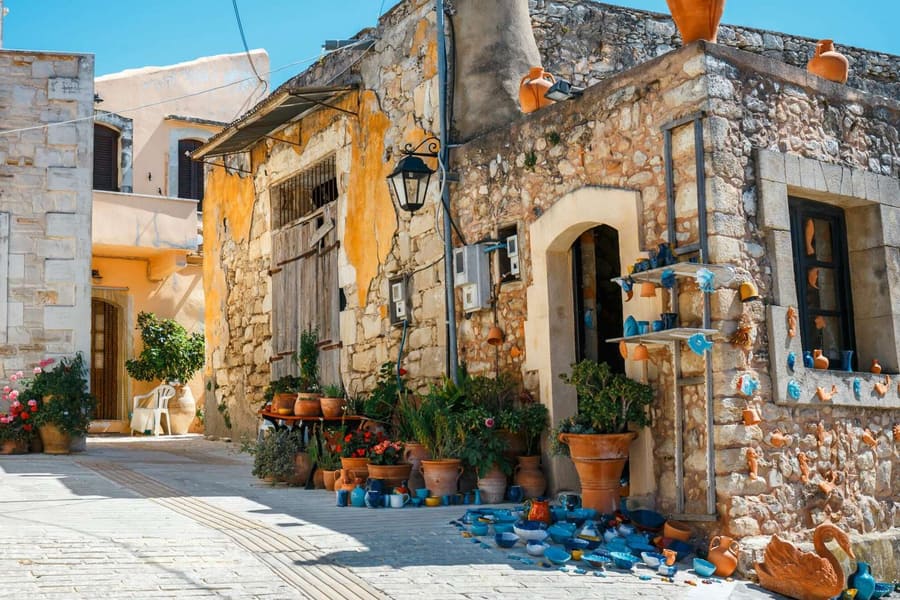
An arkadi monastery tour stops at Margarites, a traditional village famous across Crete for its pottery. Travellers get free time to wander the streets, visit pottery workshops and shops, look at handmade Cretan products and eat lunch in a taverna.
Pottery means shaping clay into vessels and other objects, then firing them until hard and durable. A person who makes it is a potter, and the workshop is also called a pottery.
Pottery falls into three traditional groups: earthenware, stoneware and porcelain. Porcelain is fired hottest of the three, in a kiln at temperatures between 1,200 and 1,400 degrees Celsius.
Because pottery is durable, it supplies much of the evidence about ancient Greece. Minoan pots of oils and ointments, exported from Crete in the 18th century BC, have been found in Egypt.
A pithos was a large ceramic storage jar for grain and liquids. Visitors who want more local dishes can pair an arkadi monastery tour with the Rethymno food tour.
- Earthenware: low-fired clay
- Terracotta: reddish earthenware
- Larnakes: Minoan burial urns
- Krater: wine-diluting vessel
These pottery facts add background to the village stop on an arkadi monastery tour.
What is the olive oil mill stop on an arkadi monastery tour?
The arkadi monastery tour includes a visit to a traditional Cretan olive oil mill, set between the pottery village of Margarites and the monastery. Passengers see how local oil is produced, and the visit includes a free olive oil tasting.
The mill stop explains why olive oil matters in Cretan culture. The visit also shows an everyday part of Cretan life and tradition beyond the historic sites.
An olive press squeezes olive paste to force the liquid oil and watery juice away from the solid material. The oil and the watery juice are then parted by decantation.
Traditional presses used a large cylindrical millstone to grind the olives, and in earlier times a blindfolded animal turned it. Modern mills spread paste on stacked fibre discs and press them.
The arkadi monastery tour keeps the oil theme to a single stop. Travellers wanting a trip built around olive oil can also read about the Crete olive oil tour.
- Stop: traditional oil mill
- Included: free tasting
- Topic: Cretan olive culture
- Process: pressing olive paste
The mill stop adds a taste of Cretan olive tradition to the arkadi monastery tour.
Which olives grow near an arkadi monastery tour?
The arkadi monastery tour reaches fertile land where olive groves grow beside vineyards and forests. Olive trees stood on Crete as far back as 2500 BC, evidence shows, and Koroneiki is the Greek variety grown more widely than any other for oil.
The olive tree is an evergreen that grows to around 10 metres, with grey bark and grey-green leaves. Its fruit is a small drupe, similar to a cherry or a peach.
The Koroneiki is a Greek olive grown for oil. Its fruits are small, yet the oil yield is high in quality. Between 50 and 60 percent of Greece’s olive acreage grows it.
Extra virgin olive oil has a free acidity cap of 0.8 percent and is rated as having favourable flavour. Cooks add it uncooked, as a condiment or in salad dressings.
Olive oil composition shifts with the variety, altitude, harvest time and extraction method. Fruit turns from green to violet to black, and taste follows the ripeness at picking.
- Tree: evergreen, grey bark
- Fruit: small drupe
- Variety: small Koroneiki olive
- Grade: extra virgin oil
Koroneiki olives and extra virgin oil are the terms to know on an arkadi monastery tour.
What does Rethymno add to an arkadi monastery tour?
The arkadi monastery tour runs on the Rethymno side of Crete, so Rethymno adds a base city with Venetian roots, the Fortezza citadel and Cretan food. The monastery itself lies in the Rethymno region, to the southeast of the city.
Rethymno city serves as capital of its own regional unit, one of four on Crete. Travellers staying in the old town join the arkadi monastery tour at a municipal garden bus stop.
Venetian rule on Crete began with a conquest between 1205 and 1212. Under it, Rethymno gained a small harbour and ranked third in importance on the island, behind Heraklion and Chania.
The Fortezza, the Venetian citadel of Rethymno, was built on Paleokastro hill between 1573 and 1580. The Ottomans took it in 1646, and today the citadel is open to the public.
Rethymno also suits a taste of Cretan cuisine. Traditional cooking rests on plants, with olive oil as the main fat, and pulses, wild herbs and cereals formed its base.
- City: Rethymno, Crete
- Fortress: Venetian Fortezza
- Rule: Venetian period
- Food: Cretan cuisine
Rethymno gives an arkadi monastery tour a base with Venetian history and Cretan food.
Which season suits an arkadi monastery tour?
An arkadi monastery tour suits any season, because the listing says the day runs rain or shine. Crete has a hot, dry summer and a mild, wet winter, so the real difference between seasons is heat against rain for visitors.
In summer, an arkadi monastery tour meets clear skies and strong heat, because a subtropical ridge keeps the air dry and the clouds thin. Rain is rare in that season.
Nearly all rain in this climate falls in winter and spring. Crete’s winter stays mild, and snow falls on the mountains from November to April but is rare on low ground.
A Mediterranean climate can stay dry for four to six months across summer and early autumn. Visitors who plan around that stretch face little rain risk at outdoor stops of the day.
Crete spans a Mediterranean zone and a semi-arid zone, and its higher elevations fall in a cold-summer class, so the weather depends on place as well as on the month.
- Summer: hot, dry
- Winter: mild, wet
- Mountains: winter snow
- Rain: tour runs
Heat and rain shape comfort, so travellers choose the month for an arkadi monastery tour by the weather they prefer.
What else in Crete pairs with an arkadi monastery tour?
An arkadi monastery tour pairs with Heraklion and its Minoan palace of Knossos, the high peaks of Mount Ida and the White Mountains, and the Cretan dialect. Each adds a different side of the island to a longer trip.
An arkadi monastery tour is a day of villages and history, while Heraklion adds Crete’s capital and biggest city. That city is home to over a quarter of the island’s residents.
The Minoan palace at Knossos lies on the southern edge of Heraklion, and the Minoans were Europe’s first advanced civilization. Visitors who want that past can read the Knossos tour post.
Mount Ida is the highest point of Crete, and myth places the infant Zeus in a cave there. The White Mountains, or Lefka Ori, hold 30 summits above 2,000 metres.
The Cretan dialect belongs to Modern Greek and is spoken across the island and abroad. It differs little from standard Greek, and Cretans rarely write it, preferring speech with each other.
- City: Heraklion
- Palace: Knossos
- Peak: Mount Ida
- Range: White Mountains
These places widen an arkadi monastery tour into a longer look at the island, from palace ruins to high peaks.
Who can join an arkadi monastery tour?
An arkadi monastery tour welcomes travellers who follow English or German, ride an air-conditioned coach from a hotel pickup in the Rethymno area and walk between the stops. The listing marks the whole day as not suitable for wheelchair users.
The live tour leader speaks English and German. Anyone joining an arkadi monastery tour therefore needs one of those two languages to follow the talk, because other languages are not named.
Travel is by air-conditioned coach, with hotel pickup and drop-off included. Pickup covers the Rethymno area, but certain resorts are not served, and listings differ on the exact pickup lists.
Walking is part of every stop. Visitors explore a cave, wander the streets of a pottery village and see a monastery and its grounds, all on foot during free time.
Children and age limits are a point where listings differ, so families check the booking page before reserving. The day ends back at the original pickup point, where it began.
- Languages: English, German
- Transport: air-conditioned coach
- Pickup: Rethymno area
- Excluded: wheelchair users
Travellers who speak English or German and can walk between stops match the format of an arkadi monastery tour.
How do travellers book an arkadi monastery tour?
An arkadi monastery tour is booked ahead through a marketplace listing. Free cancellation and a pay-later setting keep the plan flexible, and the booking covers lunch, drinks, an olive oil tasting and hotel pickup, with entrance fees paid in cash.
Travellers pick a date on the listing and check availability, which shows the starting times. The notes name the areas with no pickup, so travellers check their hotel against that list.
Reserve now and pay later holds a spot without any payment on the booking day. Free cancellation then works up to a day before the start and returns the full amount.
Entrance fees for Melidoni Cave and Arkadi Monastery are paid in cash at the two sites. The notes ask travellers to carry cash for both entrances on the day of the tour.
Lunch and drinks are included, and the olive oil mill offers a free tasting. The tour runs rain or shine. Travellers planning a second day compare it with the Crete wine tour.
- Payment: pay later
- Cancellation: free, full refund
- Fees: cash at sites
- Included: lunch, drinks, tasting
Free cancellation up to a day ahead keeps an arkadi monastery tour booking flexible.
What do travellers ask about an arkadi monastery tour?
An arkadi monastery tour raises practical questions: whether lunch is included, whether entrance fees are covered, which languages are offered, whether the coach is air-conditioned and whether wheelchair users can join. The answers below come from the booking listing.
Is lunch included in an arkadi monastery tour?
Yes. Lunch and drinks appear on the list of inclusions, so travellers do not pay for them separately. The description places the meal in a traditional taverna in the pottery village of Margarites, during free time.
Are entrance fees included in an arkadi monastery tour?
The answer is mixed. The includes list names entrance fees, yet the notes ask for cash at the cave and the monastery. As listings differ on this point, travellers keep cash ready at both sites.
Which languages are offered on an arkadi monastery tour?
A live tour leader speaks English and German, according to the listing. No other language appears on it, so travellers who need another one check the list of languages on the booking page before they reserve.
Is the coach air-conditioned on an arkadi monastery tour?
Yes. The inclusions list transport by air-conditioned bus, and the description says travellers cover the full-day route on it, from Melidoni Cave through Margarites and the olive oil mill to Arkadi Monastery, with hotel pickup and drop-off.
Can wheelchair users join an arkadi monastery tour?
No. The listing marks this tour as not suitable for wheelchair users. The exclusion applies to the tour as a whole, so travellers who use a wheelchair book a different activity instead of joining this one.