A Mount Athos cruise sails from Ouranoupoli along the coast of the Athos peninsula in Halkidiki, where monasteries stand above the sea at the edge of a self-governed monastic community. This post covers what a Mount Athos cruise shows, why the boats stay offshore, Ouranoupoli, the monasteries on the route, Simonopetra, the history, the islands nearby and the best season. It is one of the best tours in Greece on Greece VIP.
Each section ends with a Mount Athos cruise that can be booked online.
What does a Mount Athos cruise show?
A Mount Athos cruise shows the coast of the Athos peninsula in Halkidiki from the water. It takes in a forested mountain that rises to 2,033 metres and the shore of a self-governed monastic community of 20 monasteries, where entry needs a special permit.
The Athos peninsula is the easternmost of the three legs of Halkidiki, a large peninsula in central Macedonia, Greece. From west to east, the legs are Kassandra, Sithonia and Athos, and two gulfs, the Toronean Gulf and the Singitic Gulf, lie between them. Athos runs 50 kilometres into the Aegean Sea. Its width is between 7 and 12 kilometres, and its area is 335.6 square kilometres. A Mount Athos cruise travels along part of this long, narrow shore.
The main summit lies in the south of the peninsula. Its steep, densely forested slopes climb to 2,033 metres. That is far higher than the other two legs of Halkidiki, whose top points reach 350 metres on Kassandra and 817 metres on Sithonia. In geological terms, Athos continues the Rhodope Mountains of northern Greece and Bulgaria. Sweet chestnut and holm oak grow on the slopes, with black pine higher up, and at least 35 plant species are endemic. A Mount Athos cruise passes along this wooded coast.
The mountain and the larger part of the peninsula form an autonomous region of Greece, governed by the monastic community of Mount Athos. In church matters, the community falls under the direct jurisdiction of the Ecumenical Patriarch of Constantinople. It includes 20 monasteries and their dependent settlements. Around 2,000 Eastern Orthodox monks live there, from Greece, Serbia, Romania, Bulgaria, Georgia, Russia and other countries. Karyes is the administrative centre, and Dafni is the main port. A Mount Athos cruise shows the coastline of this community from the sea.
UNESCO inscribed the monastic community of Mount Athos on the World Heritage List in 1988. Three reasons stand behind the listing: the long religious history of the place, the well-preserved architecture of the monasteries, and the preserved natural environment of the peninsula. Wildlife records for Athos include the Mediterranean monk seal, the golden eagle, the black stork, the yelkouan shearwater and Audouin’s gull. In modern Greek, the name Agio Oros, meaning Holy Mountain, is also in use for the land that a Mount Athos cruise passes.
- Peninsula: Athos is the easternmost leg of Halkidiki and runs 50 kilometres into the Aegean Sea.
- Summit: The mountain reaches 2,033 metres, with steep slopes under dense forest.
- Community: Twenty monasteries and around 2,000 monks form a self-governed region of Greece.
- Heritage: UNESCO added the monastic community to the World Heritage List in 1988.
- Route: A Mount Athos cruise follows the coast of the peninsula on a sightseeing tour.
A Mount Athos cruise brings together the geography of the easternmost leg of Halkidiki, the forested summit of the mountain and the coastline of a self-governed monastic state. Pilgrims who land need a permit, while cruise passengers, women included, see the same coast from the deck. For tourists of both sexes, a Mount Athos cruise offers a view of this peninsula from a set distance off its shore.


Why does a Mount Athos cruise stay offshore?
A Mount Athos cruise stays offshore because boats are not allowed to pass within 500 metres of the Athos coastline. Because of that distance, women are allowed on board, even though the monastic land itself is closed to them by law and tradition.
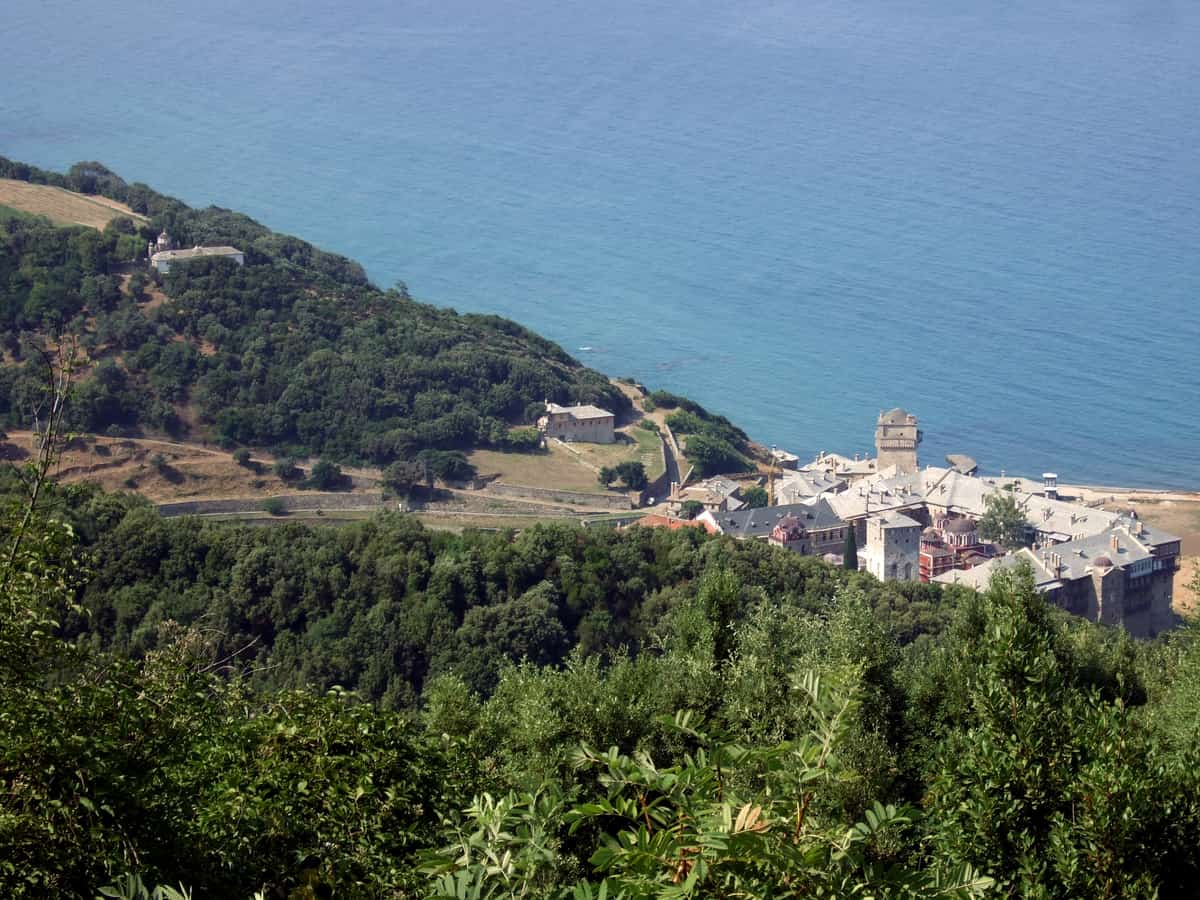
The ban on women has a name: the avaton. Under it, the monastic community bars women and female animals from its territory. The stated aim is to make celibacy easier for the men who have chosen it. A second reason is that the Virgin Mary alone represents her gender on Athos, a place dedicated to her glory. Female domestic animals such as cows and sheep are barred as well, and cats are the only exception, because they hunt mice. A Mount Athos cruise keeps clear of that territory.
Athonite tradition traces the rule to a sea voyage. The Virgin Mary was sailing with John the Evangelist from Joppa to Cyprus when the ship was blown off course to Athos, then a pagan land. The ship anchored near the port of Klement, close to the present monastery of Iviron. She blessed the mountain, and from then on it was her garden, out of bounds to all other women. The monks call the territory the Garden of Virgin Mary, and a Mount Athos cruise follows its coast.
Greek law and religious tradition both forbid women to enter the area governed by the monastic community. Emperor Constantine Monomachos was among the emperors who proclaimed the ban, in a chrysobull of 1046. When Greece joined the European Community, the special jurisdiction of the monastic institutions was confirmed, and only men are allowed to enter. A 2003 resolution of the European Parliament asked for the ban to end, yet the prohibition is unchanged. A Mount Athos cruise respects it by keeping at least 500 metres from the coast.
Men who plan to land need a special entrance permit, the diamonitirion, from the Mount Athos Pilgrims’ Bureau in Thessaloniki. The daily cap is 100 lay Eastern Orthodox pilgrims and 10 non-Orthodox pilgrims. Each pilgrim collects the permit in Thessaloniki and presents it at Ouranoupoli or Ierissos before boarding the ferry. Orthodox clergy also need written permission from the Ecumenical Patriarchate. A Mount Athos cruise works on a different basis: it is a sightseeing trip for tourists along the coast, not an entry into the territory.
- Avaton: The monastic community bars women and female animals from its land, with cats as the only exception.
- Legal basis: Greek law and religious tradition both keep women out of the area governed by the monks.
- Entry permit: Men who land need a diamonitirion from the Pilgrims’ Bureau in Thessaloniki.
- Daily cap: Entry is limited to 100 lay Orthodox and 10 non-Orthodox pilgrims each day.
- Sea distance: Mount Athos cruise boats are not allowed to pass within 500 metres of the coast.
The rules on land and the rules at sea work together. The avaton closes the monastic territory to women, the permit system limits the number of men, and the 500-metre line keeps sightseeing boats away from the shore. Within those limits, a Mount Athos cruise stays open to tourists of both sexes. Women and men on the same Mount Athos cruise see the coast that the land rules close to women.
Where does a Mount Athos cruise start?
A Mount Athos cruise starts at Ouranoupoli, a coastal village at the very beginning of the Athos peninsula in Halkidiki. It is the last settlement before the border of the monastic state, and its port serves as the main gateway to the monastic community.
Ouranoupoli lies on the coastline in the northwest part of the Athos peninsula, right at its start. The village belongs to the municipality of Aristotelis and is the last settlement before the border with the monastic state. A fence about 9 kilometres long marks the line between the monastic territory and Aristotelis. The city of Thessaloniki is about 140 kilometres away. The village name means Sky City, and the older form was Ouranopolis. A Mount Athos cruise leaves from the main port of this village.
The village takes its name from the ancient city of Uranopolis. Alexarchus, a brother of Cassander, founded that city in the late 4th century BC, and an earthquake later destroyed it. In the 1920s, Greek refugees from Asia Minor settled in Ouranoupoli and set up rug manufacturing. In 1956, a road reached the village along the old pilgrim route. A single asphalt road links Ouranoupoli with Thessaloniki, and regular daily buses run from the KTEL Chalkidiki station there to the departure point of the Mount Athos cruise.
The Byzantine Tower of Ouranoupoli, also known as Prosfori, or The Offering, and as the Tower of Prosforion, stands near the embarkation point, so Mount Athos cruise passengers board close to it. Emperor Andronikos II Palaiologos built the tower in the 13th century and placed it under Vatopedi Monastery. From 1928, Sydney Loch and his wife Joice NanKivell Loch lived in the tower and made it a meeting place for monks and laymen travelling to and from Athos.
Near the tower, an 18th-century building that served as the boat-house, or arsanas, of the Vatopedi monks holds the Christian Chalkidiki Exhibition. The 10th Ephorate of Byzantine Antiquities set it up, and its finds date from the Early Christian, Byzantine and post-Byzantine periods. A walk east along the coast leads to the ruins of Zygou Monastery, also called Frangokastro, close to the Athos border. From the main port, regular daily ferries carry male pilgrims to Dafni, and Mount Athos cruise boats take tourists along the coast.
- Village: Ouranoupoli is the last settlement before the border of the monastic state of Mount Athos.
- Tower: The Byzantine tower dates from the 13th century and stands near the embarkation point.
- Exhibition: The Christian Chalkidiki Exhibition occupies the old boat-house of the Vatopedi monks.
- Ferries: Regular daily ferries carry male pilgrims from the main port of Ouranoupoli to Dafni.
- Cruises: A Mount Athos cruise from Ouranoupoli takes tourists on a sightseeing tour of the coast.
Ouranoupoli handles two kinds of sea traffic to Athos from one harbour. Pilgrims with permits board ferries for Dafni, while a Mount Athos cruise takes tourists of both sexes along the coast. The Byzantine tower, the old monastic boat-house and the ruins of Zygou and of Agios Nikolaos Church near the border give the starting point of each Mount Athos cruise a record that reaches back to the Byzantine era.
Which monasteries does a Mount Athos cruise pass?
A Mount Athos cruise down the western coast passes Docheiariou, Xenophontos, St. Panteleimon, Osiou Grigoriou, Dionysiou and Agiou Pavlou, with Simonopetra among them. All seven belong to the twenty self-governing monasteries of Athos, and each holds a fixed rank in the Athonite hierarchy.
The houses passed on a Mount Athos cruise include Docheiariou, also spelled Dochiariou, which dates from the late 10th or early 11th century. It is dedicated to the Archangels Michael and Gabriel and holds tenth place in the Athonite hierarchy. The monks keep the icon of the Virgin known as Gorgoepikoos, “She Who is Quick to Hear”. In 1979 the house became cenobitic, or communal, when Elder Gregorios arrived from Missolonghi with ten monks. In 2011 it had 53 monks.
Xenophontos stands on the western shore of the peninsula, and a Mount Athos cruise passes a monastery with two main churches. The older one, from the late 10th century, sits low near the water. The newer Great Katholikon rose from 1817 to 1839 beside the main tower and carries 8 domes and a marble iconostasis carved by Antonios Litra of Tinos. A bell tower followed in 1864. The monastery has 11 chapels inside and 6 outside, and about 55 working monks.
St. Panteleimon, on the south-western side, stands out on a Mount Athos cruise as the largest monastery on Athos. Known as Rossikon, it serves as the Russian house of Athos, and its liturgy is in Russian. Monks from Kievan Rus’ founded it in the 11th century. The present buildings rose on a new site nearer the shore in the first two decades of the 19th century and resemble a small town crowned by domes. Its bells have the reputation of being the largest in Greece.
On a Mount Athos cruise, Osiou Grigoriou appears on a corner of land that juts into the sea, with steep rocks rising behind it. Saint Gregory of Sinai the Younger founded it in 1310 and dedicated it to Saint Nicholas. Dionysiou, its neighbour on a Mount Athos cruise, lies in the south-western part of the peninsula, ranks fifth and honours John the Baptist. Saint Dionysius of Korisos founded it in the 14th century. Its archives keep the chrysobull of its benefactor, Alexios III Komnenos, dated September 1374.
- Docheiariou: The library holds 545 manuscripts, 62 of them on parchment, and more than 5,000 printed books.
- Xenophontos: Over 500 manuscripts and about 10,000 printed books fill a library that also hosts a museum.
- St. Panteleimon: A separate library building in the court keeps 1,320 Greek and 600 Slavonic manuscripts, plus 25,000 printed books.
- Dionysiou: The library housed 804 manuscripts, the oldest from the 11th century, and more than 4,000 printed books.
- Agiou Pavlou: The collection counts 494 manuscripts and over 12,000 printed books.
Agiou Pavlou adds a Romanian link to a Mount Athos cruise. Saint Paul of Xeropotamou founded it in the late 10th or early 11th century, and it stands in the western part of the peninsula. Its main church honours the Presentation of Christ in the Temple. The house ranks fourteenth and has 31 working monks, plus two dependent sketes: the Romanian Lakkoskiti and the Greek Nea Skiti.
What is Simonopetra on a Mount Athos cruise?
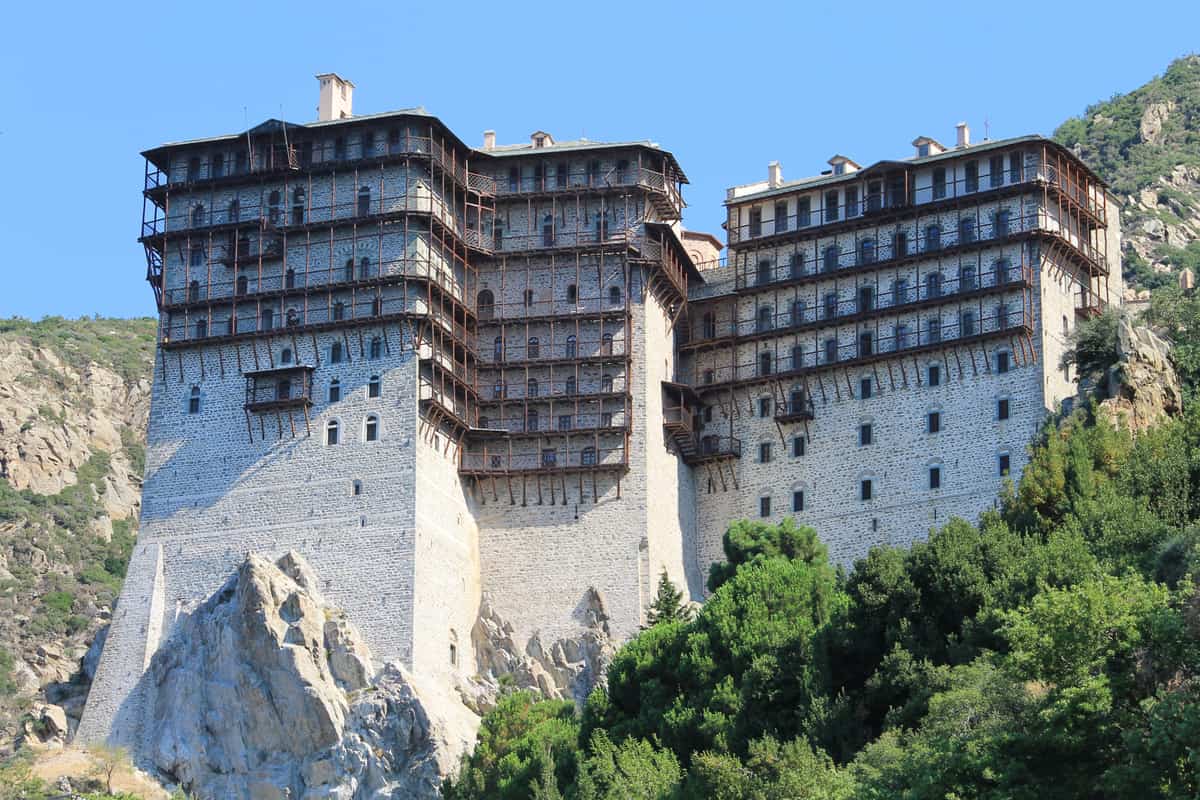
A Mount Athos cruise passes Simonopetra, the monastery perched on one great rock at the edge of a cliff 330 metres above the sea. Its name means “Simon’s Rock”, it ranks 13th among the Athonite monasteries, and its present form dates from 1902.
The monastery rises on the southern coast of Athos, with the Athonite port of Dafni on one side and Osiou Grigoriou on the other. That coast is rugged, yet this site is harsher still. The rock itself passes through the lower floors. On a Mount Athos cruise, the walls seem to grow straight out of the stone, with a sheer drop to the sea below. The house holds 54 monks, led by Archimandrite Eliseus.
Simon the Athonite founded the monastery in the 13th century, and he was later honoured as Saint Simon the Myrrh-bearer. Tradition says that he lived in a cave nearby and saw a vision of the Theotokos, the Virgin Mary. She asked him to raise a monastery on that rock and promised to protect and provide for it. Passengers on a Mount Athos cruise look up at the same rock. Simon gave his foundation the name New Bethlehem, and its dedication to the Nativity of Jesus remains.
Money from the Serbian despot Jovan Uglješa paid for rebuilding and enlarging the house in 1364, and in 1368 he issued a royal chrysobull in its favour. A Mount Athos cruise passes a house that has burned and risen again. A fire in 1581 ruined Simonopetra, and a large part of the brotherhood died in the flames. Abbot Evgenios travelled to the Danubian Principalities for funds, and Michael the Brave, Prince of Wallachia, became the chief donor, giving land and money. Fires came again in 1626 and 1891.
Simonopetra is a group of multi-storey buildings, and the main one stands on the site of Simon’s first structure. The buildings that face a Mount Athos cruise grew in stages, and almost every stage followed a great fire. Abbot Evgenios used the funds he raised to erect the western building. The eastern building came after the fire of 1891, paid for largely with money collected in Russia, and the work ended in 1902.
- Floors: The floors seen from a Mount Athos cruise are numbered from the top down, so the highest floor counts as the first and the lowest comes last.
- Port building: Simonopetra’s arsanas, or port building, was finished in 1567 with money from a Wallachian noble.
- Choir: The monastery has issued collections of Byzantine chant by its choir, and Agni Parthene brought the choir wide recognition.
- Saint: Ieronymos of Simonopetra, who died in 1957, is one of the 20th-century saints tied to the monastery.
The brotherhood behind the walls that a Mount Athos cruise passes came close to vanishing. In recent centuries its monks came from Ionia in Asia Minor, but in the mid-20th century the flow of new monks fell and the brotherhood shrank. In 1973 Emilianos (Vafidis), also known as Aimilianos of Simonopetra, moved in with his monks from the Great Meteoron monastery at Meteora and filled the almost abandoned house again. He led it as abbot from 1974 to 2000.
What is the history behind a Mount Athos cruise?
A Mount Athos cruise follows a coast shaped by monks since the Byzantine era. Organized monastic life began in 963, when Athanasius the Athonite founded Great Lavra, and the monasteries then lived through Byzantine patronage, Ottoman rule and incorporation into the modern Greek state.
The coast seen on a Mount Athos cruise held monks long before it held great monasteries. Monks were certainly present from the fourth century, and possibly from the third. In the seventh century, after Egypt fell to the Islamic conquest, monks from the Egyptian desert reached the peninsula looking for calm. They built wooden huts with straw roofs and ate fruit from wild trees. Hermits and ascetics seeking isolation arrived in the 9th century, and organized communities existed by the 10th.
The turning point came in 963, when Athanasius the Athonite began Great Lavra, the first monastery on Athos. His friend, the Byzantine Emperor Nikephoros II Phokas, paid for the work, which started with the protective wall and moved on to the church and the cells. Its foundation moved Athos from scattered hermitages to large cenobitic monasteries, and the houses on a Mount Athos cruise grew from that model. Imperial grants and new lands raised the brotherhood from 80 to 120 monks.
Great Lavra kept growing. In the 11th century it had 700 monks, and smaller monasteries had been placed under it. Support came from rulers across the Orthodox world: Byzantine emperors, the Kingdom of Georgia and Slavic states. Monasteries of different Orthodox traditions were founded, and a Mount Athos cruise still passes houses with Russian and Serbian pasts. The 14th century brought raids. Spaniards from the crown of Aragon and other pirates struck Great Lavra and the other monasteries, and in 1307 Catalan mercenaries set St. Panteleimon on fire.
After Constantinople fell in 1453 and the Ottoman Empire spread, the monasteries seen on a Mount Athos cruise kept working under Ottoman rule. Self-rule survived in part, as did the religious institutions, but the community went through economic hardship and political instability. By the end of the 15th century, the Russian pilgrim Isaiah described Great Lavra as Greek, Simonopetra as Bulgarian, St. Panteleimon as Russian and Dionysiou as Serbian. In the 19th century the number of monks rose, helped by donations from Russia, Serbia and Romania.
- Greek state: Athos passed to the Kingdom of Greece in 1912, so a Mount Athos cruise sails along Greek land that keeps a special autonomous status.
- Self-rule: The monastic community governs the mountain and the larger part of the peninsula as an autonomous region of Greece.
- Church authority: In church matters, the community answers directly to the Ecumenical Patriarch of Constantinople.
- Municipality: The rest of the peninsula belongs to the Aristotelis municipality.
- UNESCO: The monastic community joined the UNESCO World Heritage List in 1988.
Great Lavra stands on the south-eastern foot of the mountain, at 160 metres. Its library holds 2,116 Greek manuscripts and over 20,000 printed books, and the monastery keeps 2,500 icons. It has followed the cenobitic, communal rule since 1980. Its cross-shaped trapeza is the largest on Athos, and the church frescoes by Theophanis date from 1535. A Mount Athos cruise passes houses that copied the church plan Athanasius set at Great Lavra.
Which islands does a Mount Athos cruise visit?
A Mount Athos cruise sails in the Singitic Gulf, and the island in the northeastern part of that gulf, along the Athos peninsula, is Ammouliani, also called Amoliani. It is the only permanently inhabited island of Halkidiki and lies about 120 km from Thessaloniki.
The Singitic Gulf carries two other names: the Mount Athos Gulf and the Holy Mountain Gulf. It is a gulf of the Thracian Sea, the northern section of the Aegean Sea, in Halkidiki, and it lies between the Sithonia peninsula to the west and the Athos peninsula to the east. Monasteries of Athos stand along its eastern shores, the coast that a Mount Athos cruise follows. The gulf is known for its clear water, and small coastal settlements line the Sithonia shore on the opposite side of the gulf.
Ammouliani lies in the northern part of the Singitic Gulf, between the peninsulas of Sithonia and Athos. The island faces the small port of Trypiti on the Halkidiki mainland, and frequent transport runs between the two. Seen from a Mount Athos cruise along the monastic shore, Ammouliani sits to the west, toward the Sithonia peninsula. The island belongs to the Halkidiki regional unit of northern Greece, and its local administration is the municipal unit of Stagira-Akanthos. It has also grown into a tourist destination in its own right.
The island has a direct link with the monks of Athos. Until the early 1900s, Ammouliani was a dependency of Vatopedi Monastery, one of the monastic houses on the peninsula. In 1925, the island passed to refugee families from the islands of the Propontis, the Sea of Marmara, who had come after the Asia Minor Disaster. The population of the island grew fast, and today more than 500 residents live there. This history ties Ammouliani to the same monastic world that a Mount Athos cruise shows from the water.
Halkidiki has only a small number of islands. Besides Ammouliani, the Singitic Gulf holds Diaporos, which lies off the eastern coast of Sithonia, across the gulf from Athos. Diaporos covers about 4 km² and is the largest island in a small group of islets opposite the village of Agios Nikolaos; Peristeri and Elia are two of the smaller islets nearby. It has pine forests, rocky shores and small sheltered coves, but no permanent population. In the Toronean Gulf, west of Sithonia, lies the uninhabited island of Kelyfos.
- Ammouliani: The only permanently inhabited island of Halkidiki, opposite the mainland port of Trypiti.
- Diaporos: An island of about 4 km² off the eastern coast of Sithonia, reached by boat excursions from Sithonia.
- Peristeri and Elia: Smaller islets that lie near Diaporos in the Singitic Gulf.
- Kelyfos: An uninhabited island in the Toronean Gulf, between Kassandra and Sithonia.
- Singitic Gulf: The water of a Mount Athos cruise, also known as the Holy Mountain Gulf.
The islands give a Mount Athos cruise a second point of interest beside the monastic coast. Ammouliani, a former Vatopedi dependency settled by refugee families, is the inhabited island on the Athos side of the gulf. Diaporos lies across the water off Sithonia and draws its own boat excursions in the summer months, while Kelyfos stays apart in the Toronean Gulf. All three islands belong to Halkidiki, the regional unit that also holds Ouranoupoli, in the north of Greece.
When is the best season for a Mount Athos cruise?
The Mount Athos cruise season is summer, when cruises for tourists run along the coast of the Athos peninsula. Halkidiki has a Mediterranean climate with hot, relatively dry summers and cool, wet winters, and the region is a popular summer destination in Central Macedonia.
Halkidiki has a mainly Mediterranean climate, classed as Csa in the Köppen system. Winters are cool and wet, and summers are hot and relatively dry. Snow can fall in the winter months, but the snowfalls do not last long. Thunderstorms can still break out during the hot summer months. Climate also varies inside the region: Neos Marmaras, on the Sithonia peninsula, has a hot semi-arid climate, classed as BSh. This hot, dry summer pattern matches the season when a Mount Athos cruise runs along the coast of the peninsula.
The Aegean Sea follows the same broad pattern. Its climate is mainly Mediterranean, and the Köppen system places the bulk of the sea in the hot-summer Mediterranean class, with hotter, drier summers and milder, wetter winters. Summer heat over the water stays below the levels of arid and semi-arid climates, because the large body of water tempers it. The north of the Aegean is the exception, classed as cold semi-arid, with cooler summers than the hot-summer class. The Etesian winds are a dominant influence on weather across the Aegean Basin.
Water temperature changes sharply between the seasons. A study of the Aegean in 1991 and 1992 found a surface layer 40 to 50 metres thick, with summer temperatures of 19 to 24 °C. In winter, the same surface water ranged from 8 °C in the north to 13 °C in the very south. The Singitic Gulf belongs to the Thracian Sea in the northern Aegean, so its winter water sits near the cold end of that range. A Mount Athos cruise in summer meets the sea at its warmest.
The sea near Athos has a record of shipwrecks from ancient times. The waters around the peninsula can be dangerous, especially toward its far end. Herodotus recorded that a strong north wind wrecked a Persian fleet as it tried to round the coast near the mountain. Summer is boating season in the Singitic Gulf: across the water from Athos, visitors reach Diaporos by private boat and organized tour in the summer months to swim in its shallow water. A Mount Athos cruise belongs to the same summer boating season.
Halkidiki has a long record as a summer destination. The trend began in the late 1950s, when people from Thessaloniki started to spend their summer holidays in the coastal villages. By the 1960s, visitors from Austria and Germany came more frequently, and a big tourist boom followed in the 1970s. On Athos itself, the high season for pilgrim entry permits falls in July and August, and at Christmas, Great Lent and Easter. A Mount Athos cruise in July or August shares the Athos coast with that pilgrim peak.
- Summer: The Mount Athos cruise season, with hot and relatively dry weather across Halkidiki.
- Winter: Cool, wet months in Halkidiki, with snowfalls that do not last long.
- Sea surface: Summer water of 19 to 24 °C, against winter readings of 8 °C in the north of the Aegean.
- Wind: The Etesian winds rank as a dominant weather influence in the Aegean Basin.
- Pilgrim peak: July, August, Christmas, Great Lent and Easter form the high season for Athos entry permits.
Summer brings together the three conditions that favor a Mount Athos cruise: the sightseeing cruises run, the sea surface is at its warmest, and Halkidiki is at its driest. Winter turns cool and wet across Halkidiki, and the surface water in the north of the Aegean drops to 8 °C, far below the summer range. July and August also mark the high season for pilgrim permits, so the Athos coast sees both pilgrims and sightseers in those months.
What do travelers ask about a Mount Athos cruise?
A Mount Athos cruise raises four common questions: whether women can join, which region of Greece the peninsula belongs to, how high the mountain rises, and whether the trip fits with a Mount Olympus visit on another day.
Can women join a Mount Athos cruise?
Yes. Women can join a Mount Athos cruise, because the boats are not allowed within 500 metres of the Mount Athos coastline. On land, Greek law and religious tradition bar women from the whole area governed by the monastic community. This ban, known as the avaton, was proclaimed by emperors, including Constantine Monomachos in a chrysobull of 1046.
Which region of Greece does a Mount Athos cruise explore?
A Mount Athos cruise explores the Athos peninsula, the easternmost leg of Halkidiki in central Macedonia, in the north of Greece. Halkidiki is a peninsula and regional unit, with Polygyros as its capital and Nea Moudania as its largest town. The monastic community governs the mountain and the bulk of the peninsula, and the rest belongs to the Aristotelis municipality.
How high is the peak seen on a Mount Athos cruise?
The peak seen on a Mount Athos cruise rises to 2,033 metres. Its slopes are steep and densely forested, with black pine forests at higher elevations. Unlike Sithonia and Kassandra, the Athos peninsula is a geological continuation of the Rhodope Mountains. At least 35 plant species are endemic to Mount Athos, the bulk of them around the main summit.
Can a Mount Athos cruise pair with a Mount Olympus day trip?
Yes, a Mount Athos cruise and Olympus fit on separate days from Thessaloniki. Ouranoupoli lies about 140 km from the city, and Mount Olympus stands about 80 km to its southwest, on the border of Thessaly and Macedonia. A Mount Olympus day trip heads to the massif whose top, Mytikas, rises to 2,917 metres, the highest peak in Greece.
Featured photo: Akonstand, CC BY-SA 4.0, via Wikimedia Commons.