
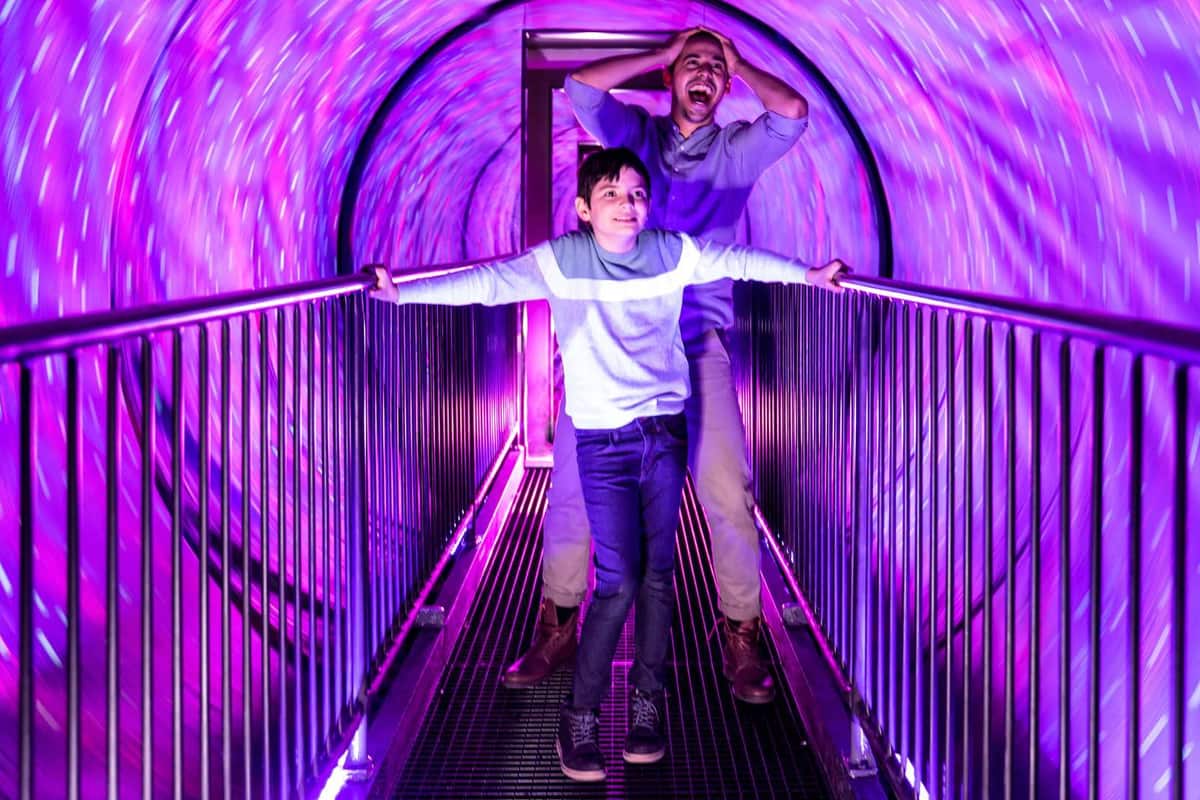
The Thessaloniki Museum of Illusions fills a listed building in Ladadika with rooms and exhibits that fool the eye and the brain. It features among the Greek tours listed on Greece VIP.
This post covers the museum, its location, rooms, installations, the science behind them, tickets, kids, facilities and reviews. Weather, the best time and common questions come last.
What is the Thessaloniki Museum of Illusions?
The Thessaloniki Museum of Illusions is a hands-on “edutainment” museum in Ladadika that joins play and learning. It counts more than 40 visual and educational exhibits, with holograms and immersive rooms.
Its exhibits use optical illusions, visual tricks and interactive displays that challenge perception. Visitors observe, touch, pose and step inside each one.
The collection falls into three groups: Illusion Rooms, Installations and Images. Its motto says that “nothing is ever quite as it seems”.
The museum belongs to a global chain that began in Zagreb, Croatia, in 2015. The chain now counts more than 70 locations on 5 continents.
More than 28.8 million visitors have passed through its museums worldwide. The chain develops new illusions every year.
- Exhibits: More than 40.
- Groups: Three sections.
- Chain: 70-plus museums.
The Thessaloniki Museum of Illusions runs as a private initiative, so its rules differ from state museums.


Where is the Thessaloniki Museum of Illusions?
The Thessaloniki Museum of Illusions stands at Doxis 5 in Ladadika, inside a listed historic building. It covers more than 400 square metres, a short walk from the port.
Aristotelous Square lies 0.8 km away by road, and the White Tower 1.6 km.
Ladadika lies on the east side of the port. It once hosted the Egyptian Market.
The quarter escaped the worst of the 1917 fire, so it keeps a traditional character. After its listing, new construction there was strictly forbidden.
Before the First World War, Ladadika was the city’s red-light district. Critics later called its regeneration a “fun park” of dubious taste.
- Address: Doxis 5, Ladadika.
- Size: Over 400 m².
- Port: About 90 m away.
The Thessaloniki Museum of Illusions sits about 90 m from the port gate.
Which rooms does the Thessaloniki Museum of Illusions have?
The Thessaloniki Museum of Illusions has rooms where visitors look into infinity, walk upside down and shrink. The big and small room and the giant chair top visitor requests.
The Reversed Room offers “a change of perspective”, with visitors who seem to walk on the ceiling.
The Vortex Tunnel spins around a bridge, and staff tell walkers to “hold on tight”. The dizzy feeling alone shows the power of the illusion.
A reseller calls the Infinity Room the favourite room: an endless-looking tunnel made for photos.
In the Ames Room, visitors appear to “shrink to miniature size”.
- Spin: Vortex Tunnel.
- Shrink: Ames Room.
- Flip: Reversed Room.
Visitors who want more of the city can compare the Thessaloniki walking tours.
What installations and images fill the Thessaloniki Museum of Illusions?
The Thessaloniki Museum of Illusions fills its halls with installations and images, from classic science to new art. Visitors meet their clones, swap noses and serve their heads on a platter.
The museum calls Head on a Platter its funniest exhibit. The photos show a head “ready for dinner”.
At the Cloning Table, the right viewing angle makes the clones appear. The Beuchet Chair shows how surroundings change a person’s size.
The Images section shows the gap between what the eye sees and what the brain thinks it sees.
Holograms vanish, reappear, change motif or pop out of their frames.
- Funniest: Head on a Platter.
- Popular: Cloning Table.
- Images: Holograms, 3D art.
The Thessaloniki Museum of Illusions mixes classic exhibits with newer illusions.
How do the illusions at the Thessaloniki Museum of Illusions work?
The Thessaloniki Museum of Illusions tricks the visual system into a picture that differs from reality. Each room works on a known rule of perception.
Adelbert Ames Jr. patented the Ames room in 1940. Its true shape is an irregular hexahedron, with one back corner much farther away.
From the fixed viewpoint, it looks like an ordinary rectangular room. A person in one corner looks like a giant, and in the other looks tiny.
In a vortex tunnel, the eyes report motion while the inner ear reports none. The brain gets conflicting signals, so walkers lose their balance.
An infinity mirror bounces light between parallel mirrors, and each reflection looks dimmer. Dennis Gabor invented holography in 1948.
- Ames room: 1940 patent.
- Vortex: Eyes against ears.
- Hologram: 1948 invention.
The Thessaloniki Museum of Illusions shows how much perception depends on context.
How do tickets work at the Thessaloniki Museum of Illusions?
Tickets for the Thessaloniki Museum of Illusions are best bought online, to secure the entry slot. The ticket office also sells them, but availability there is limited.
Phone bookings are not accepted. Visitors enter at the chosen time slot and then explore at their own pace.
Online tickets can move once, within 28 days of the original date. Tickets are non-refundable, and no-shows lose them.
Types cover adults (13+), children (4–12), infants, families, students, unemployed visitors and persons with disabilities.
The Family Package covers two adults and two children. Groups of 20 or more get a discount.
National free-admission days do not apply here, since the museum is private.
- Best: Buy online.
- Change: Once, within 28 days.
- Free: Ages 0–3.
Visitors who pair culture with food can compare the Thessaloniki food tours.
Is the Thessaloniki Museum of Illusions good for kids and groups?
The Thessaloniki Museum of Illusions suits kids, with nothing scary or dangerous inside. Every child up to 15 enters with at least one adult.
Groups can book an escorted tour or explore freely. School groups get special discounts.
School field trips explore physics, philosophy and art as students see how vision tricks the brain.
First-year psychology students from a Thessaloniki college visited to study perception. The college said the visit linked theory with real life.
Birthday parties include games among the exhibits for kids and adults. Corporate events, workshops and team-building sessions use the space too.
Spooky Weekends run every Saturday and Sunday from 10 October to 1 November, with Halloween crafts and tattoos. Each guest takes home a glow-in-the-dark bracelet.
- Kids: Safe exhibits.
- Schools: Special discounts.
- Halloween: Spooky Weekends.
The Thessaloniki Museum of Illusions shapes party content around the guests’ interests, from science to art.
What facilities does the Thessaloniki Museum of Illusions have?
The Thessaloniki Museum of Illusions is wheelchair accessible and air-conditioned, and prams can go through it. It has no waiting area, cloakroom or safety deposit boxes.
A small unguarded space at the ticket office takes bulky bags and suitcases, at the owner’s risk.
Pets of any size are not allowed, not even in bags. Food and drink stay outside.
The rooms are built for “the coveted, impossible photo”. Reviewers say staff took photos of them inside the illusions.
The shop next to the ticket office sells educational games, wooden puzzles and souvenirs. Visitors can enter it without a ticket.
- Access: Wheelchair friendly.
- Bags: Unguarded space.
- Shop: No ticket needed.
The Thessaloniki Museum of Illusions sets no photo limits in its FAQ, so cameras come along.
What do reviewers say about the Thessaloniki Museum of Illusions?
Reviewers of the Thessaloniki Museum of Illusions praise friendly staff, a clean space and fun for every age. A ticket listing rates it 4.3 out of 5 from 181 reviews.
Reviewers write that they laughed a lot. One family called the workers very friendly.
A German reviewer found it interesting to see what the brain does. A reviewer from Israel called it lovely for children and adults alike.
A British reviewer said not every exhibit worked. She advised bringing reading glasses, as there is a lot to read.
A local listings site reported more than 2,500 reviews rating it close to “excellent”.
- Rating: 4.3 from 181.
- Praise: Friendly staff.
- Tip: Reading glasses.
Travelers who want the bay at dusk can compare the Thessaloniki sunset cruises.
How does weather shape a visit to the Thessaloniki Museum of Illusions?
The Thessaloniki Museum of Illusions is indoors and air-conditioned, so it works in heat and rain. The Kalamaria weather station, about 6 km south-east, logged a 33.3 °C mean high this July and August.
Both months peaked at 36.7 °C, on 21 July and 23 August. August brought no rain at all.
Last July was hotter still: a 34.6 °C mean high and a 38.8 °C peak on 23 July.
April was the wettest month this year at Kalamaria, with 97.0 mm. February followed with 66.8 mm, and its gusts reached 88.5 km/h on 18 February.
Winter turns cold by the bay. Kalamaria dropped to −1.1 °C on 12 January this year.
- Hottest: 38.8 °C last July.
- Wettest: April, 97.0 mm.
- Coldest: −1.1 °C.
The Thessaloniki Museum of Illusions gives a cool break on the hottest afternoons by the port.
When is the best time to visit the Thessaloniki Museum of Illusions?
The Thessaloniki Museum of Illusions suits any season, and rainy or hot days suit it best. Last December brought 95.8 mm of rain at Kalamaria, the wettest month of last year.
Last November added 60.0 mm, and a gust of 78.9 km/h hit the station on 28 December.
Spooky Weekends run from 10 October to 1 November, so autumn visits add Halloween activities.
Online booking secures a time slot, while the ticket office can mean a wait.
October so far has averaged a 23.0 °C high at Kalamaria, mild for the walk from Aristotelous Square.
- Rain: Indoor refuge.
- Autumn: Spooky Weekends.
- Tip: Book online.
The Thessaloniki Museum of Illusions fits a wet afternoon in Ladadika as well as a hot one.
What do travelers ask about the Thessaloniki Museum of Illusions?
Travelers ask about buses, the metro, parking, the airport and nearby sights. The museum names no metro station of its own.
Which buses stop near the museum?
Lines 3, 12 and 33 stop at Plateia Emporiou. Lines 5, 6, 15, 16, 23, 24 and 39 stop at Plateia Eleftherias.
Which metro station is closest?
Venizelou station lies about 550 m in a straight line from Doxis 5. Dimokratias lies about 630 m away.
Is there parking?
The museum has no parking of its own. It suggests the municipal car parks at Plateia Eleftherias and the port.
How far is the airport?
Thessaloniki airport lies 16.8 km by road. The new railway station lies 1.7 km away.
What lies nearby?
Bensousan Han, an inn from 1810, stands in upper Ladadika. The Cinema Museum and the photography museum fill old warehouses on the harbour.
Travelers who add a mountain day can compare the Meteora day trips from Thessaloniki.