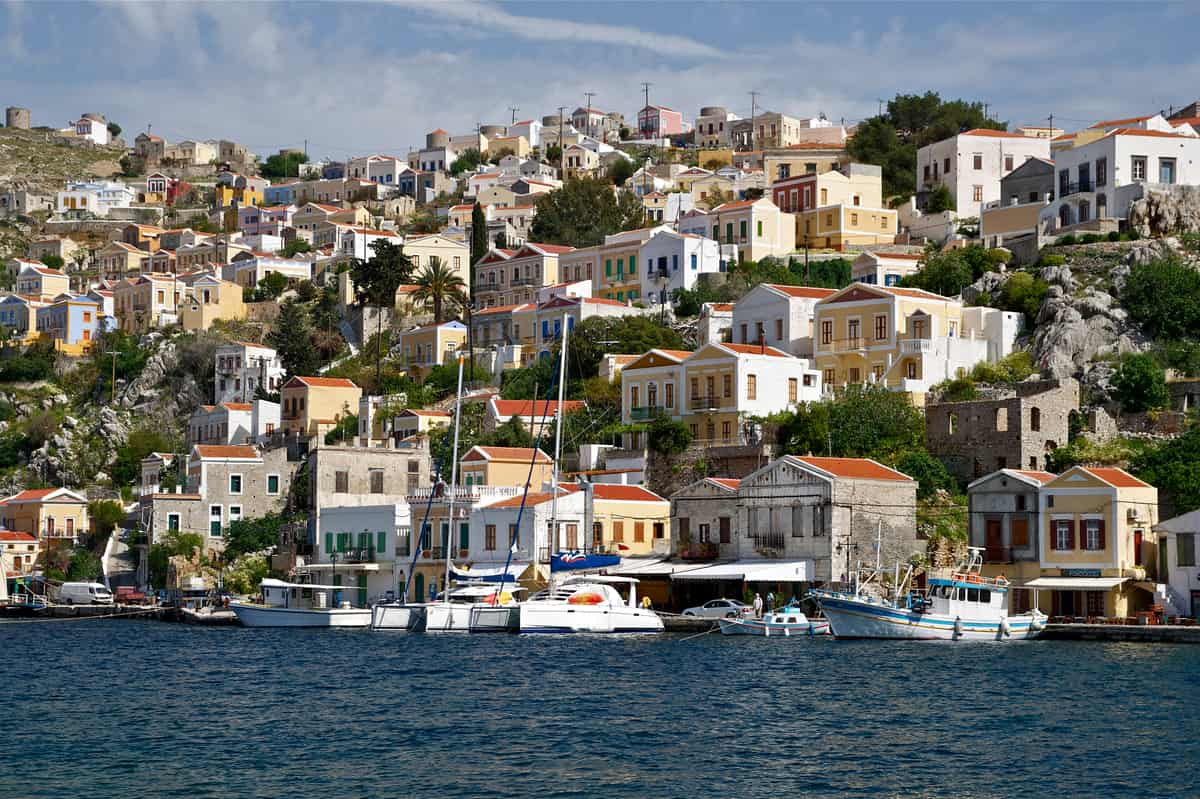
A Symi day trip from Rhodes crosses by boat from Rhodes town to the small island of Symi in the Dodecanese, with its harbour of neoclassical houses and the Monastery of Panormitis. This post covers what a Symi day trip from Rhodes includes, where the boats leave from, the crossing, Gialos and Ano Symi, the monastery, the history, the sponge divers, the bays and the best season. It is one of the best tours in Greece on Greece VIP.
Each section ends with a Symi day trip that can be booked online.
What does a Symi day trip from Rhodes include?
A Symi day trip from Rhodes includes a boat crossing from Mandraki to a mountainous Dodecanese island to the north, where the harbour of Gialos, the upper town of Ano Symi and the monastery at Panormitis form the main points of interest.
Symi belongs to the Dodecanese island chain and lies about 24 km (15 miles) north of Rhodes, the largest of the Dodecanese islands and their historical capital. Both islands are municipalities within the Rhodes regional unit, which in turn forms part of the South Aegean administrative region. In administrative terms, a Symi day trip from Rhodes moves between two municipalities of the same regional unit, from the largest island of the group to a far smaller neighbour.
The name also appears in English as Syme or Simi. The island covers 58.1 square kilometres (22.4 sq mi) of mountainous ground. Small valleys cut through the interior, while the coast switches between rocky cliffs, beaches and isolated coves. In the 19th century the population peaked at about 22,500. By 2021 the permanent population had fallen to 2,603, and the island holds a larger population during the summer.
The main town sits on the northeast coast and shares the island’s name. It has two parts. The lower town around the harbour is called Yialos, a name also written Gialos, and it serves as the port of the island. Above it rises the upper town, known as Horio or Ano Symi. Colourful neoclassical mansions cover the slopes near the main town, and a large share of them date from the mid-19th century, when Symi reached the height of its prosperity.
Outside the main town, Symi has smaller settlements at Pedi, Nimborio, Marathounda and Panormitis. Panormitis holds the island’s best-known monastery, which draws visitors from all over the world, and each year Greek pilgrims honour St Michael of Panormitis. The economy once rested on shipbuilding and the sponge trade. Today tourism leads, and the residents work mainly in tourism, fishing and trade. Visitors on a Symi day trip from Rhodes therefore support the island’s main industry.
- Island group: Symi forms part of the Dodecanese and of the Rhodes regional unit.
- Area: Mountainous terrain covers 58.1 square kilometres of the island.
- Population: The 2021 count recorded 2,603 permanent residents, down from a 19th-century peak of about 22,500.
- Main town: On a Symi day trip from Rhodes, boats reach Yialos, the harbour town, with Horio, or Ano Symi, above it.
Put together, these facts outline a Symi day trip from Rhodes: a crossing to the north, arrival at the port of Gialos, the upper town of Ano Symi above it, and the monastery at Panormitis in its own settlement. From Easter until Panormitis Day in early November, tourists and day-trippers raise the island’s head count to as much as 6,000.


Where does a Symi day trip from Rhodes depart?
A Symi day trip from Rhodes departs from Mandraki, the oldest port on the island, in the centre of Rhodes city. Cruise boats set out from here each day for Symi, along a waterfront with bronze deer, harbour windmills and the Fort of Saint Nicholas.
Rhodes city runs three major ports, each with its own role. Kolona handles traffic between the Dodecanese islands. The Central Port takes cruise ships and international traffic, including scheduled services to and from Turkey. Akandia, the new port of the island, deals with domestic and cargo traffic. Mandraki is the oldest port of the island and lies in the centre of the city. Daily cruise boats to Symi set out from its quays, which makes Mandraki the starting point for a Symi day trip from Rhodes.
The name itself is a Greek word for a small sheltered harbour set aside for small boats and fishing vessels. Under the Knights Hospitaller, Mandraki served as the military harbour. Grand Master Zacosta guarded it with a tower, built between 1464 and 1467 at the end of the natural mole. After the siege of 1480, Grand Master d’Aubusson wrapped a bastion around the tower and turned it into a guard fortress on the sea, known today as the Fort of Saint Nicholas.
The harbour entrance, which a Symi day trip from Rhodes passes, also links to the Colossus of Rhodes, the statue of the sun god Helios by Chares of Lindos and one of the Seven Wonders of the Ancient World. Local tradition places it where two pillars now stand at the Mandraki entrance, although its true site is still debated. The fort’s floor holds a circle of sandstone blocks of unknown purpose, and curved marble blocks built into its structure have been proposed as remains of the statue’s base.
Bronze deer stand at the harbour. Windmills form a second landmark: a natural mole at the commercial harbour once carried 13 of them, and the Gate of Saint Catherine is also known as the Windmills Gate because it led to the grain mills on the harbour mole. Along the Mandraki sea promenade, the architect Florestano Di Fausto built the Market, the Cathedral of Saint John of the Knights and the Palace of the governor during the Italian period.
- Starting point: A Symi day trip from Rhodes begins at Mandraki, in the heart of Rhodes city.
- Marina: The municipal marina of Rhodes city lies in downtown Mandraki, and a private one sits next to Akandia port.
- Fort: The Fort of Saint Nicholas grew from a tower built between 1464 and 1467 at the end of the natural mole.
- Deer: Rhodes has its own population of fallow deer, found in 2005 to be genetically distinct.
Mandraki is not the only sea gate of Rhodes. Ferries link the island each day with nearby Dodecanese islands, and routes also run to Turkish coast towns such as Marmaris and Fethiye. The Liberty Gate, opened by the Italians in 1924, connects the Kolona and Mandraki harbours. For a Symi day trip from Rhodes, though, the old harbour in the city centre is the place to board the cruise boats.
What does the sea crossing on a Symi day trip from Rhodes pass?
A Symi day trip from Rhodes crosses the sea to an island about 24 km north of Rhodes, with the Turkish coast close by. The Datça and Bozburun peninsulas are the nearest land to Symi, and uninhabited islets such as Nimos and Seskli lie around it.
Symi lies about 24 km (15 miles) north of Rhodes, and both islands belong to the Dodecanese group of the southern Aegean Sea, so a Symi day trip from Rhodes starts and ends inside one island group. The setting is closer to Turkey than to mainland Greece. Rhodes sits 363 km (226 mi) east-southeast of the Greek mainland, yet only 18 km (11 mi) from the southern shore of Turkey, and the Turkish coast is plainly visible from the island.
On the Turkish side, the nearest land to Symi is formed by the Datça and Bozburun peninsulas, both in Muğla Province. The Datça Peninsula is long and narrow. Its outline follows small bays and coves that face south or north along a length of close to 100 km (62 mi). Tekir, at its far western tip, is the location of the ancient city of Knidos. The district of Datça covers 436 square kilometres and had 25,029 residents in 2022.
The coves of the Datça Peninsula draw mariners, and they are promoted as part of the Blue Cruise along the southwest coast of Turkey, with gulets leaving from Bodrum, Marmaris or Datça. At the eastern end, where the peninsula joins the mainland, a narrow isthmus overlooks the Gulf of Gökova to the north and the Gulf of Hisarönü to the south. For centuries, the maze of shores and islets in this corner of the sea favoured pirates, and piracy stayed a serious problem until the early 20th century.
Closer to Symi, small uninhabited islands belong to its municipality: Gialesino, Diavates, Kouloundros, Marmaras, Nimos, Sesklio and Chondros. With them, the municipality reaches 65.754 square kilometres. Nimos lies off the northern coast of Symi, cut off from it by a small, shallow strait called Diapori. It covers 4.6 square kilometres (1.8 sq mi) and is the Ymos of the ancient Greeks. Seskli, also known as Sesklio, is a small islet close to Symi whose ancient name was Teutloussa.
- Gate to the Aegean: The island where a Symi day trip from Rhodes begins has long held a strong position on trade routes between West and East.
- Seskli finds: Archaeological finds on Seskli come from different periods and reach back to the late Neolithic.
- Ancient record: Pliny the Elder named the islet Scutlusa.
- Protection: Greece’s Central Archaeological Council has proclaimed Symi and its surrounding islets an archaeological site.
In short, a Symi day trip from Rhodes crosses between two Greek islands that both lie near Turkey. The Datça and Bozburun peninsulas sit closest to Symi, and Nimos, Seskli and five more islets surround the island. A Symi day trip from Rhodes therefore passes Greek islands, the Turkish coast and declared archaeological sites in one crossing.
What is Gialos harbour like on a Symi day trip from Rhodes?
A Symi day trip from Rhodes reaches Gialos, also written Yialos, the lower part of Symi town around the harbour. The port serves as a marina for sailors, and colourful neoclassical mansions from the mid-19th-century peak of Symi’s prosperity cover the slopes.
Symi town is the island’s main settlement and shares its name with the island, which also appears as Syme or Simi. It stands on the northeast coast and splits into two parts. The lower town around the harbour is Gialos, and the upper town is Horio, also called Chorio or Ano Symi. On a Symi day trip from Rhodes, Gialos is the arrival point in town. Tourists from other Dodecanese islands also come by ferry, and sailors use the port as a marina.
Colourful neoclassical mansions cover the slopes near the main town. Much of this housing dates from the mid-19th century, when Symi reached the height of its prosperity. Sponges supplied much of that wealth, and shipbuilding was the other traditional industry of the island. Symi counts, with Nafplio, Poros and Ermoupoli on Syros, as an important example of Neoclassical architecture in Greece. On a Symi day trip from Rhodes, these facades form the backdrop to the whole harbour.
The flow of tourists has led to the restoration of a great number of homes on Symi, including houses destroyed during World War II. By law, this work has to conform to rules set by the Archaeological Service of the Greek culture ministry. Greece’s Central Archaeological Council has also proclaimed Symi, like the islets around it, an archaeological site. On a Symi day trip from Rhodes, the whole harbour therefore lies inside a protected area, and every restored facade answers to state rules.
- Names: The lower town is Gialos, also written Yialos, and the upper town is Horio, Chorio or Ano Symi.
- Mansions: Colourful neoclassical mansions on the slopes date largely from the island’s mid-19th-century peak.
- Rules: By law, house restorations follow the rules of the Greek culture ministry’s Archaeological Service.
- Status: Greece’s Central Archaeological Council has proclaimed Symi and its surrounding islets an archaeological site.
- Marina: Sailors use the port of Gialos as a marina, and ferries bring visitors from other Dodecanese islands.
Tourism is now Symi’s main industry, and residents work mostly in tourism, fishing and trade. The harbour shows both sides of the island’s story: the mansions recall the shipbuilding and sponge economy, and the marina serves the sailors of today. For a Symi day trip from Rhodes, Gialos is also the gateway to Ano Symi, the adjacent upper town on the slope of the hills above the port.
What does Ano Symi show on a Symi day trip from Rhodes?
A Symi day trip from Rhodes shows Ano Symi, or Chorio, the upper part of Symi town. The Kali Strata, a stone stairway of 500 steps, leads up to it, and the quarter holds Byzantine-era churches, a museum and the Knights’ castle.
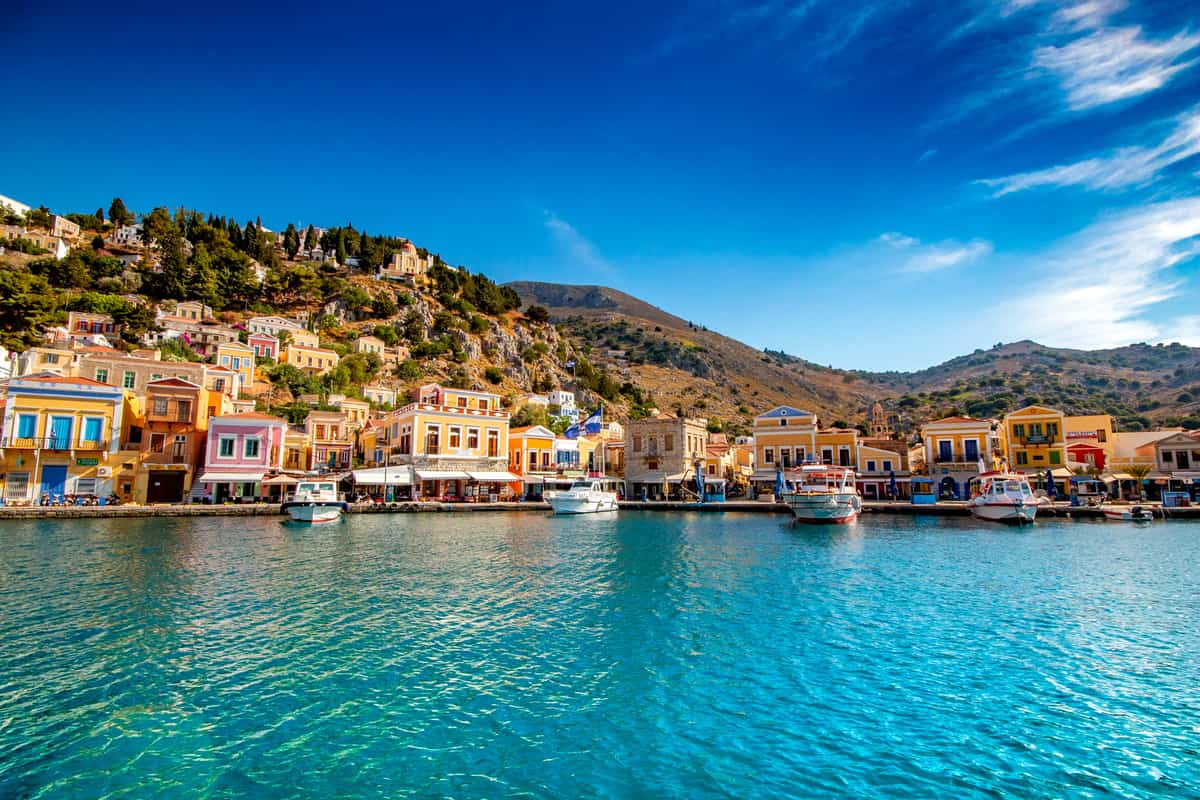
Ano Symi also goes by Epáno Sími, Greek for “Upper Symi”, but the more common names are Horio and Chorio. It is the upper part of the main town, which shares the island’s name, and lies north-west of Rhodes. The quarter sits on the slope of the hills. Its people largely abandoned it for years, but it has seen a resurgence in recent times. For a Symi day trip from Rhodes, Ano Symi is the upper half of the town, paired with Gialos below.
The Kali Strata is the stairway into the quarter. It is built of stone, counts 500 steps, and its Greek name means “Good way”. On a Symi day trip from Rhodes, these steps connect Ano Symi with the town below. The upper town also holds a large number of churches. Aghios Georgios and Metamorfosis are two of them, and both date from the Byzantine era, when Symi belonged to the Byzantine Empire before the Knights of St. John took it in 1309.
The upper town is also home to the Archaeological Museum of Symi, in the Agios Athanasios neighbourhood of Chorio. According to the Ministry of Culture, the museum spreads over three levels and takes in mansions of the 18th and 19th centuries, the Farmakidis House and the Chatziagapitos Hall, with their courtyards and gardens. Its exhibits run from Prehistory to the 19th century, so the displays follow the island from its distant past into its modern history, in the same quarter as the castle.
The quarter also contains the Kastro, the Castle of the Knights of St. John. The Knights held Symi from 1309 to 1522, while Rhodes served as their stronghold. After 1309 they built castles and fortresses on the other islands of the group over the following decades. The Symi castle stands just above the harbour. A Symi day trip from Rhodes therefore links two strongholds of the same order: the fortified city on Rhodes and the castle above Gialos.
- Names: Ano Symi is also called Horio, Chorio or Epáno Sími, the Greek for “Upper Symi”.
- Stairway: The Kali Strata, meaning “Good way”, is a stone stairway of 500 steps.
- Churches: Aghios Georgios and Metamorfosis are among the churches of the quarter that date from the Byzantine era.
- Museum: The Archaeological Museum of Symi spreads over three levels in the Agios Athanasios neighbourhood.
- Castle: The Kastro is the Castle of the Knights of St. John, who held Symi from 1309 to 1522.
Ano Symi adds the older layers of the town to the 19th-century harbour front. The upper quarter holds Byzantine-era churches, a museum with objects from Prehistory to the 19th century, and the castle of the Knights. The same archaeological-site status and restoration rules that cover Gialos apply here too. A Symi day trip from Rhodes that climbs the Kali Strata moves from the mansions of Gialos to these older sites on foot.
Why does a Symi day trip from Rhodes stop at Panormitis Monastery?
A Symi day trip from Rhodes stops at Panormitis because the island’s famous monastery stands there, visited by people from all over the world. The Ministry of Culture lists it as the Monastery of St. Michael (Taxiarches Michael) Panormitis, with access by boat from Rhodes.
Panormitis is one of the townships of Symi, alongside Pedi, Nimborio and Marathounda, outside the main town. It is the location of the monastery, and Greeks in large numbers pay homage to St Michael of Panormitis each year. The Ministry of Culture gives two ways in: by car from Chorio, or by boat from Rhodes. That sea route explains the stop, since a Symi day trip from Rhodes can call at the monastery directly from the water.
The monastery is dedicated to Michael, also called Archangel Michael or Michael the Taxiarch, which explains the form Taxiarches Michael in the Ministry’s title. Orthodox tradition names three icons of the archangel in whose making he is said to have taken a personal hand: Archangel Michael of Mantamados on Lesbos, Archangel Michael of Panormitis and Archangel Michael of Nenita. Each of the three is different. For pilgrims on a Symi day trip from Rhodes, the Panormitis icon is one of these three.
In the Eastern Orthodox Church, the principal feast of the archangel falls on 8 November. Churches on the Julian calendar keep it on what is now 21 November in the Gregorian calendar. The Orthodox calendar for 8 November lists a Synaxis of the Archangel Michael “Panormitis”, on Symi, and the island’s tourist season runs from Easter until Panormitis Day in early November. The calendar for 6 September adds two more Symi feasts of Michael, one at Nimborio and one for Michael of Perimpliotis.
The monastery also lies on Saint Michael’s line, a claimed alignment of monasteries and churches across Europe and the Holy Land, eight of them dedicated to the archangel. The line runs 4,190 km from Skellig Michael to the Stella Maris Monastery on Mount Carmel and passes Mont Saint-Michel. With a great number of churches devoted to Michael across Europe, the odds that an arbitrary line crosses more than one lesser site are high. A Symi day trip from Rhodes visits one of the named points on the line.
- Name: The Ministry of Culture lists the site as the Monastery of St. Michael (Taxiarches Michael) Panormitis.
- Access: The Ministry’s record gives two routes, by car from Chorio or by boat from Rhodes.
- Icon: Orthodox tradition counts the Panormitis icon among three icons whose making the archangel is said to have shaped.
- Feast: The Orthodox calendar lists a Synaxis of the Archangel Michael “Panormitis” on 8 November.
- Shop: The monastery shop sells postcards, religious souvenirs and publications.
Panormitis gives a Symi day trip from Rhodes a second destination on the island, apart from Gialos and Ano Symi. A ferry company based in Rhodes lists “Panormitis Symi” as a destination of its own, next to Symi. Pilgrims come for St Michael of Panormitis. Since April 2004, Symi, Chalki, Tilos and Kastellorizo have formed the Metropolis of Symi, a church province split off from the Metropolis of Rhodes.
What is the history behind a Symi day trip from Rhodes?
A Symi day trip from Rhodes reaches an island with a long recorded past. Homer’s Iliad names it as the domain of King Nireus, the Knights of St. John took it in 1309, and the Ottoman Empire conquered it in 1522, together with Rhodes.
Greek mythology names Symi as the birthplace of the Charites and traces its name to the nymph Syme. Another account, credited to Mnaseas in the Deipnosophistae of Athenaeus, says that Glaucus named the island after his wife Syme when the two settled there. Ancient names for the island include Aigli and Metapontis, and Pliny the Elder claimed that the name came from simia, a word meaning a monkey. The name itself links a Symi day trip from Rhodes to Greek myth.
Homer’s Iliad presents Symi as the domain of King Nireus, who fought on the Greek side in the Trojan War. The poem calls him the handsomest man in the Achaean forces after Achilles, yet he lacked physical strength. Myth makes him the son of King Charopus and the nymph Aglaia and one of the suitors of Helen. Sources give him 3, 16 or 53 ships. Accounts name Eurypylus, son of Telephus, or Aeneas as his killer, though John Tzetzes has him survive the war.
Thucydides records a Battle of Syme near the island in January 411 BC, when Spartan ships defeated an Athenian squadron. The record of Symi then stays thin until the 14th century, though archaeology shows continuous settlement and ruined citadels point to an important site. Symi formed part of the Roman Empire and then the Byzantine Empire. In 1309 the Knights of St. John, also known as the Knights Hospitaller, conquered it. The same order made Rhodes its stronghold, so a Symi day trip from Rhodes joins two of its possessions.
The Knights took Symi out of interest in shipping and commerce, and their conquest opened centuries of prosperity. The island’s position among the Dodecanese made it a trade waypoint until steam-powered shipping arrived in the 19th century. In 1522 the Ottoman Empire conquered Symi and nearby Rhodes, so both ends of a Symi day trip from Rhodes share that date. Symi kept extensive privileges in taxation and self-government, and its prosperity went on almost uninterrupted.
- Ottoman name: Under Ottoman rule the island carried the name Sömbeki.
- Special status: Under an edict of Suleiman, the islanders paid a special tax for an autonomous status that barred Ottoman generals from their civil affairs.
- Loss of privileges: Efforts to abolish these rights began after 1869, and the last of them ended after the Young Turks took power in 1908.
- War of Independence: Symiots took part in the Greek War of Independence of 1821–1829, yet Symi stayed outside the new Greek state and under Ottoman rule.
The story behind a Symi day trip from Rhodes runs from myth to the Ottoman centuries. The island’s name points back to the nymph Syme, its Homeric king fought in the Trojan War, and Spartan ships won a sea battle near its shores in 411 BC. Trade under the Knights brought wealth, and the Ottoman conquest of 1522 did not halt that prosperity.
Which modern events does a Symi day trip from Rhodes recall?
A Symi day trip from Rhodes recalls Italian occupation from 1912, German occupation from 12 October 1943, the surrender of German forces in the region on Symi at the end of the Second World War, and the island’s union with Greece in 1948.
In 1912 the Dodecanese declared independence from the Ottomans as the Federation of the Dodecanese Islands, but Italy occupied the islands almost at once. The occupation followed the outbreak of the Italian-Turkish war over Libya in early 1912, and Italy used it to put pressure on the Ottoman government nearer to Italy’s own territory. After the Treaty of Ouchy, Italy kept the islands as a guarantee for carrying out the treaty. Symi was formally ceded to Italy in 1923.
Italy formally annexed the Dodecanese under the Treaty of Lausanne and named them the Possedimenti Italiani dell’Egeo. From 1924 the Fascist regime of Mussolini tried to replace the name Dodecanese with Italian Islands of the Aegean, a term that never spread beyond Italian official use. Cesare Maria De Vecchi, governor from 1936 to 1940, promoted the official use of the Italian language until the Second World War interrupted the policy. Each Symi day trip from Rhodes crosses between two islands that Italy held in those years.
In the Second World War, Italy joined the Axis powers, which used the Dodecanese as a naval staging area for the invasion of Crete in 1941. After Italy surrendered in September 1943, the islands became a battleground between German and Allied forces, the Italians among them. The Germans won the Dodecanese campaign, and the larger part of the island chain fell within two months, one of the last German victories of the war. German forces occupied Symi on 12 October 1943.
In 1944, a Greek and British raiding force defeated the German garrison on Symi and evacuated the local population. The German occupation of the Dodecanese still held until the end of the war in 1945, when the German forces surrendered to the British. That surrender of German forces in the region took place on Symi itself, and the island then spent three years under British occupation. A Symi day trip from Rhodes thus stops at the site of that surrender.
- British protectorate: After the war the Dodecanese became a British military protectorate and soon ran their own civil affairs.
- Peace treaty: The 1947 Peace Treaty with Italy formally united the islands with Greece, over objections from Turkey.
- Union: Symi became part of Greece in 1948 and now belongs to the Rhodes regional unit, which keeps a Symi day trip from Rhodes inside one administrative area.
- Rebuilt homes: Tourism led to the restoration of a great number of homes, a large share of them destroyed in the Second World War.
Rhodes went through the same stages. Italian rule reached both islands in 1912, and German troops forced the 40,000-strong Italian garrison on Rhodes to surrender by 11 September 1943, a month before Symi fell. Both islands then came under British military control before union with Greece. A Symi day trip from Rhodes connects two islands with the same 20th-century record of Italian, German and British rule.
Why is sponge diving part of a Symi day trip from Rhodes?
A Symi day trip from Rhodes visits an island whose economy rested on shipbuilding and sponges. Symi once had the largest sponge fishing fleet in the world, its population peaked at about 22,500 in the 19th century, and neoclassical mansions from that era line the slopes.
The economy of Symi rested on two trades: shipbuilding and sponges. Under Ottoman rule the island grew known for its sponges, which supplied a large share of its wealth, and at one stage its sponge fishing fleet was the largest in the world. Prosperity peaked in the mid 19th century. The trade also reached the United States: Tarpon Springs, on the Gulf Coast of Florida, drew Greek sponge fishermen in a sponge rush at the start of the 20th century and became a sister city of Symi in 2008.
Sponge divers go under water to gather soft natural sponges for human use. Spicules of calcium carbonate or silica make the bulk of sponges too rough for general use, but two genera, Hippospongia and Spongia, have soft and fully fibrous skeletons. Homer and Plato mention the sponge as an object for bathing. Europeans used soft sponges as padding for helmets, as portable drinking utensils and as town water filters. Until synthetic sponges arrived, they also served as cleaning tools and as applicators for paints and ceramic glazes.
The original freediving method needed a small boat, a crew and a cylindrical box with a glass bottom to scan the sea floor. Once the crew spotted a sponge, a diver went overboard holding a skandalopetra, a rounded stone of 15 kilograms tied to the boat by a rope, which pulled him down fast. He cut the sponge loose and placed it in a net bag. Divers regularly went down to about 30 metres for up to 5 minutes, and lung capacity set the depth and bottom time.
Diving suits brought new dangers. Greek sponge divers adopted surface-supplied standard diving suits, known locally as scaphandro, in 1865, when safe decompression procedures were still unknown. Deaths and injuries from decompression sickness ran extremely high, and estimates put the toll at around 10,000 Mediterranean divers in the first 50 years of surface-supplied diving. By the mid-20th century, over-fishing had pushed both the sponges and the industry close to extinction.
- Mansions: The neoclassical mansions seen on a Symi day trip from Rhodes date from the mid-19th-century height of the island’s prosperity.
- Population: Symi had about 22,500 people at its 19th-century peak and 2,603 permanent residents in 2021.
- Regional centre: Kalymnos, another Dodecanese island, was the main centre of sponge production in the Aegean and has three museums about the trade.
Sponge diving belongs on a Symi day trip from Rhodes because the sponge trade paid for the island’s peak years. The divers worked with a stone, a rope and a net bag, and later with dangerous suits. Tourism is now the main industry, and each Symi day trip from Rhodes brings visitors to an island whose old wealth came from the sea floor.
Which bays does a Symi day trip from Rhodes reach?
A Symi day trip from Rhodes reaches an island whose shore switches between rocky cliffs, beaches and isolated coves. Pedi, Nimborio, Marathounda and Panormitis are the townships beyond the main town on the northeast coast, and seven uninhabited islets lie offshore within the Municipality of Symi.
Symi is a mountainous island, and its interior breaks into small valleys. Where the high ground meets the sea, the shore switches from rocky cliffs to beaches and on to isolated coves. The cliffs split the coast into separate stretches, and the beaches and coves between them form the bays of the island. Besides the harbour town and Ano Symi above it, Symi has smaller population centres and beaches. A Symi day trip from Rhodes therefore meets a coast of cliffs and coves rather than one long strand.
Away from the main town, Symi has four other townships: Pedi, Nimborio, Marathounda and Panormitis. Panormitis is the site of the island’s monastery. Nimborio is the commercial port of Symi, and the Orthodox calendar marks a Synaxis of the Archangel Michael there on 6 September. On the same date, the island also keeps a feast of the Archangel Michael of Perimpliotis. Islanders work mainly in tourism, fishing and trade. These four townships are the named places beyond the harbour on a Symi day trip from Rhodes.
Offshore, the Municipality of Symi also takes in seven uninhabited islets: Gialesino, Diavates, Kouloundros, Marmaras, Nimos, Sesklio and Chondros. Symi itself covers 58.1 square kilometres of mountainous ground, while the whole municipality, islets included, covers 65.754 square kilometres. No one lives on any of the seven, so every township of the municipality stands on Symi, and the islets remain empty ground around it. Beyond its own islets, the nearest land to Symi lies on the Datça and Bozburun peninsulas of Muğla Province in Turkey.
Nimos lies off the northern coast of Symi and covers 4.6 square kilometres. The small and shallow Diapori strait separates the two islands, so only a narrow band of water divides them. Like Symi, Nimos belongs to the Dodecanese group in the southern Aegean, and the ancient Greeks knew it as Ymos. Nimos has no residents, yet Greece’s Central Archaeological Council has proclaimed it an archaeological site, together with Symi and the other surrounding islets. The status therefore takes in the bays of Symi as well.
- Shore: Rocky cliffs, beaches and isolated coves take turns along the coast of Symi.
- Townships: Pedi, Nimborio, Marathounda and Panormitis stand outside the main town of the island.
- Nimborio: This township is the commercial port of Symi and marks a feast of the Archangel Michael on 6 September.
- Islets: Gialesino, Diavates, Kouloundros, Marmaras, Nimos, Sesklio and Chondros have no residents.
- Diapori: This small, shallow strait divides Symi from Nimos on the northern side of the island.
On a Symi day trip from Rhodes, the bays follow a clear outline. Cliffs, beaches and coves alternate around a mountainous island. Pedi, Nimborio, Marathounda and Panormitis carry the township names, and Nimborio doubles as the commercial port. Seven empty islets lie offshore, with Nimos across the Diapori strait to the north, and the whole group stands under archaeological protection. Beyond them, the Datça and Bozburun peninsulas form the nearest neighbouring land, in the Muğla Province of Turkey.
When is the best season for a Symi day trip from Rhodes?
A Symi day trip from Rhodes works best inside the tourist season, which runs from Easter until Panormitis Day in early November. July and August are the hottest and driest months at Rhodes airport, while the summer meltemi wind can keep inter-island ferries in port.
Symi’s visitor season opens at Easter and closes with Panormitis Day in early November. Inside that span, the Symi Festival takes place from July to September, as it has since 1995. The Greek political journalist Yannis Diakogiannis founded the event. A Symi day trip from Rhodes in July, August or September therefore falls within festival months. A trip between Easter and the end of June, or in October and early November, still sits inside the tourist season but outside the festival dates.
The climate of Rhodes is hot-summer Mediterranean, coded Csa in the Köppen system: winters are mild and summers hot. At Rhodes International Airport in Paradeisi, average highs reach 28.0 °C in June, 30.6 °C in July and 30.7 °C in August. September follows at 28.2 °C and October at 24.6 °C, while January drops to 15.4 °C. Symi lies about 24 kilometres north of Rhodes, so these Rhodes figures frame the weather on the island for a Symi day trip from Rhodes.
The same station logs 0.7 mm of rain in July, 1.3 mm in August and 2.0 mm in June, the three driest months of the year. September stays low at 7.9 mm, but October rises to 41.4 mm and December reaches 137.8 mm. Sunshine peaks in the same months, with 391.8 hours in July, 371.4 in June and 362.8 in August. A Symi day trip from Rhodes between June and August therefore meets the three driest and sunniest months.
The meltemi, also called the etesian wind, is a dry and strong northerly wind over the Aegean that blows from late spring until about mid-September. It peaks in the afternoon and tends to drop at night, yet a spell can keep blowing for days on end. In the southern Aegean it comes from the northwest. It rises without warning under clear skies and can reach force 7 to 8 on the Beaufort scale, when certain yachts and the majority of inter-island ferries cannot sail. It also tempers the summer heat.
- Season: The tourist months on Symi run from Easter to Panormitis Day in early November.
- Festival: Symi hosts its festival in July, August and September.
- Heat: August has the highest average maximum at Rhodes airport, at 30.7 °C.
- Rain: December is the wettest month at the airport, with 137.8 mm of rain.
- Wind: The meltemi can reach force 7 to 8 on the Beaufort scale and halt ferry crossings.
Taken together, the figures mark out two windows. July and August bring the hottest and driest weather but fall in the meltemi months. The second half of September and all of October come after the meltemi period yet stay inside the tourist season, with lower average highs than high summer. A Symi day trip from Rhodes fits either window, depending on how much heat and wind a traveler accepts on the crossing and ashore on Symi.
What do travelers ask about a Symi day trip from Rhodes?
A Symi day trip from Rhodes raises four practical questions. Symi draws tourists who stay as well as day-trippers, both islands belong to the Dodecanese, Lindos suits a separate day on Rhodes, and the Historical Museum of Symi holds finds from two local antiquarians.
Can travelers stay overnight after a Symi day trip from Rhodes?
Yes. Symi’s visitors include tourists as well as day-trippers, and together the two groups raise the island’s total to a peak of 6,000 people. The permanent population stood at 2,603 in 2021, and the island holds a larger population in summer. So visitors do stay overnight on Symi, not only for the day.
Which island group does a Symi day trip from Rhodes stay within?
Both islands belong to the Dodecanese, which counts 15 larger and 150 smaller Greek islands in the southeastern Aegean, with 26 of them inhabited. Rhodes has been the leading island of the group since antiquity, and Symi sits inside the Rhodes regional unit. The Dodecanese, in turn, sit inside the larger Southern Sporades island group.
Can a Symi day trip from Rhodes pair with a Lindos tour on another day?
Yes. Lindos stands in the southeast of Rhodes, and Greek National Road 95 links it with Rhodes City, so that outing stays on land while Symi needs a sea crossing. The Acropolis of Lindos is one of the island’s historical sites. A Lindos tour on a different day leaves each outing a day of its own.
Is there a museum to visit on a Symi day trip from Rhodes?
Yes. The Historical Museum of Symi reopened after renovation in late 2020. Its collections hold finds made by Michael and Niketas Chaviaras, two Symian antiquarians of the early 20th century. Their father, Demosthenes Chaviaras, who lived from 1849 to 1922, was a leading name in research on local history, and the family archive went to the museum in the 1980s.