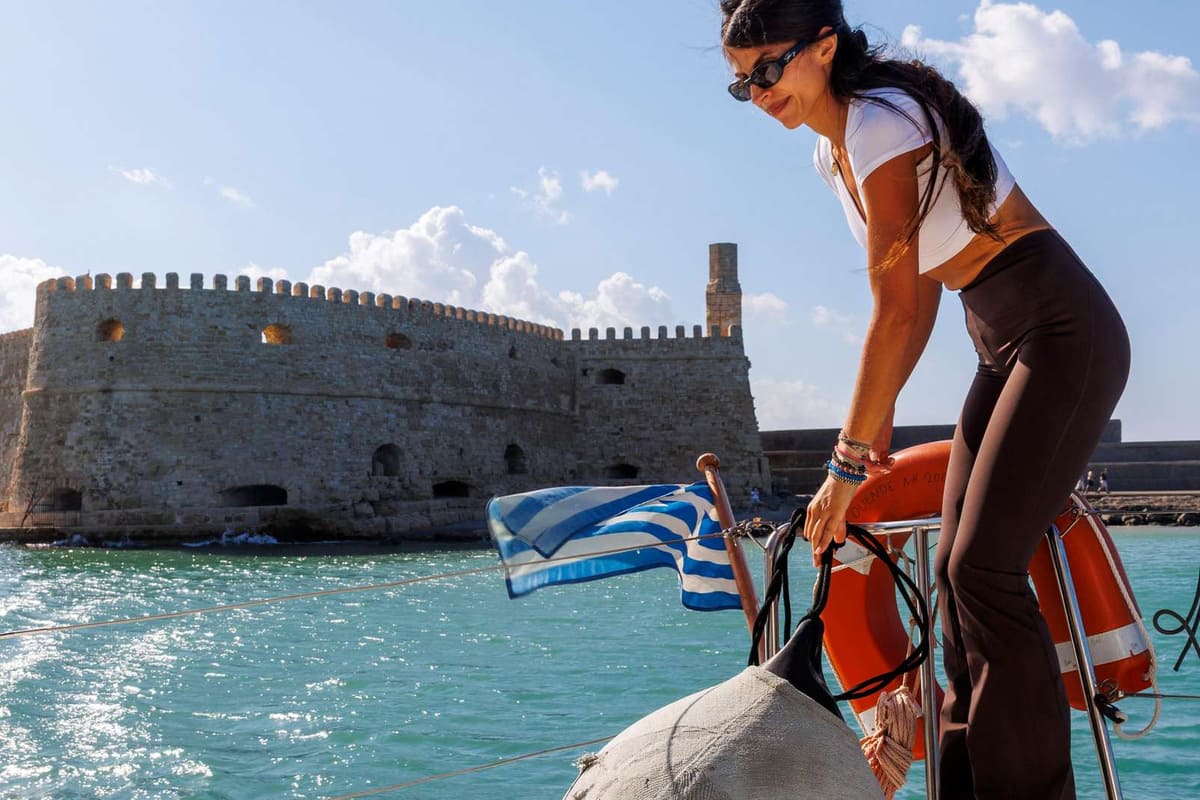
A Heraklion sailing tour takes a sailing yacht or catamaran out of the old harbour of Heraklion into the Cretan Sea. It is one of the Greek tours on Greece VIP.
This post covers what a Heraklion sailing tour includes, where it starts and the lighthouses on the way. It also covers the routes, the winds and the mountains seen from the sea. Sailing clubs and races, the best season and common questions come last.
Each section ends with a Heraklion sailing tour or a nearby cruise that can be booked online.
What does a Heraklion sailing tour include?
A Heraklion sailing tour includes a yacht that follows Greek tax, registry and crew rules. Boats over 7 m long pay the TEPAI fee. The skipper holds a recognised licence. Greek Navy charts cover the whole coast of Crete.
TEPAI is the Greek fee on recreational and day-tour boats. The independent tax authority, AADE, has collected it under Article 13 of Law 4211/2013 since 2019.
Private yachts, charter yachts and day-tour boats pay once they measure over 7 m. Flag, hull material and engine power change nothing for a Heraklion sailing tour.
A boat on land owes nothing, because the fee covers only Greek territorial waters. Arrested, decommissioned and immobilised boats are exempt, as are classified traditional boats.
An electronic register at AADE lists Greek-flag private yachts and all charter yachts, whatever their flag. Greek and EU private yachts carry a DEKPA movement card. It never expires but needs a yearly endorsement.
Law 2743/1999 bans skippering a private yacht without a skipper’s licence. Greek speedboat licence applicants must be at least 18 and pass theory and practical tests.
The Hellenic Navy Hydrographic Service, founded in 1919, publishes the official Greek charts. Its chart 443, East Central Crete, covers Heraklion sailing tour waters at 1:100,000.
- Harbour chart: Chart 443/1 maps Heraklion harbour at 1:5,000.
- Written test: Speedboat candidates need 18 of 20 answers right.
- Licence threshold: Motorboats above 30 hp require a licence.
The same fee and licence rules cover catamaran cruises on Crete. Proof of TEPAI payment stays on board a Heraklion sailing tour yacht for checks. Non-EU private yachts can pay at customs with their Transit Log.


Where does a Heraklion sailing tour start?
A Heraklion sailing tour starts in the old Venetian harbour, a short walk from the city centre. Larger yachts use its fortified quay. Gouves marina lies east of the city. Agia Pelagia’s bay to the west forms a calm harbour.
The old port, a Heraklion sailing tour base, has quays 700 m long in total. Depths along them run from 1.80 m to 3.66 m.
The basin takes vessels of up to 300 tons displacement. Larger private yachts berth on the eastern side of the fortified entrance quay.
Services for a Heraklion sailing tour include water, electricity, fuel, a slipway, parking and a cafe. The marina also houses the city’s sailing and yacht clubs.
East of the city, Gouves marina keeps dry storage on land for 15 boats. It sits beside the yacht berths of Kato Gouves.
Smaller yachts also berth along the southern pier and the western side of the fortified quay. Three more Greek Navy charts, 432, 433 and 444, cover the rest of Crete.
- Quay V: A yacht repair facility works at this quay of the port.
- Venetian port: Agia Pelagia was a key regional port under Venice.
- Agia Pelagia shelter: Cape Souda shields its main beach from north winds.
During the Cretan Revolution, the ship Arkadi anchored at Agia Pelagia. A Heraklion sailing tour passes the bay where it landed ammunition for the rebels.
Which lighthouses mark a Heraklion sailing tour?
A Heraklion sailing tour meets a green breakwater light and a red pier light in port. A white light flashes every 6 seconds on Dia’s southern cape. Hersonissos harbour shows one light. Cape Sideros lighthouse marks Crete’s northeastern tip.
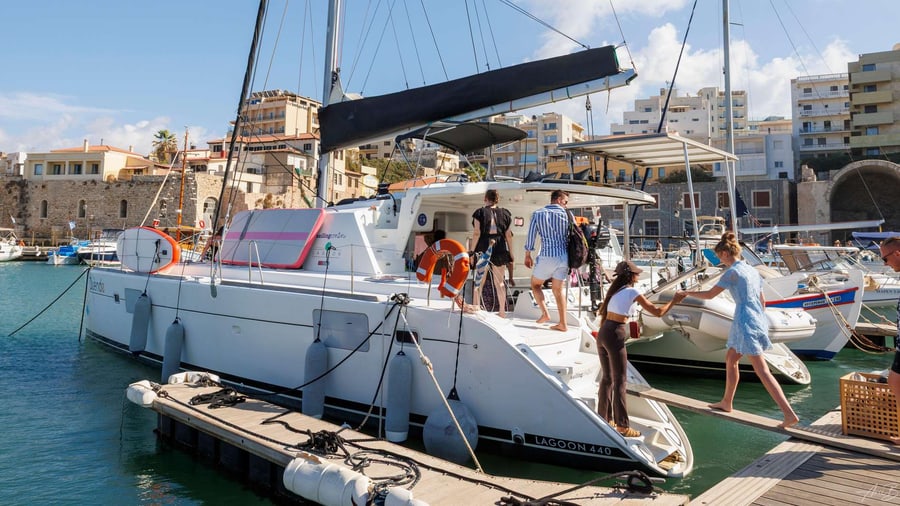
For a Heraklion sailing tour, the outer breakwater light shows green, on for 2 seconds, off for 4. Its 12 m post stands at the breakwater end.
Pier 6, the eastern pier, shows a red light every 6 seconds. It sits 13 m above the sea on a mast and reaches 9 nautical miles.
Dia’s southern cape carries a light 129 m above sea level. It shows its white flash from a 4 m white lantern that only boats can reach.
Hersonissos, 28 km east of Heraklion, grew from a small fishermen’s harbour. Pilot notes warn a Heraklion sailing tour against night approaches near its submerged reefs.
The harbour is open to the east but shelters a Heraklion sailing tour from north and northwest winds. A white church on a hill marks its west side.
Cape Sideros lighthouse, at Crete’s northeastern tip, dates from 1880. German forces destroyed it in 1941, and the present 15 m tower followed in 1948.
- Sideros signal: A white flash every 10 seconds reaches 23 nautical miles.
- Agios Ioannis: A French company built its lighthouse in 1864.
- Breakwater height: The green light’s focal height is 14 m.
Cape Agios Ioannis lighthouse stands 27 km north of Agios Nikolaos. It joined the Greek lighthouse network in 1912, but a large part has collapsed.
Which routes does a Heraklion sailing tour follow?
A Heraklion sailing tour heads for Dia or follows the north coast past capes and bays. Dia lies about 7 nautical miles from Heraklion. Published sea distances also link the city with Rethymno, Santorini and the island of Milos.
Published routes also run 97 nautical miles to Naxos and 125 to Karpathos. Evening yachts stop in a bay on Dia and return at sunset, like sunset cruises around Crete.
A Heraklion sailing tour sees the chapel of Agios Sozon on Cape Stavros from the water. Behind the cape, the Bobias hills reach 423 m above the sea.
A Heraklion sailing tour passes Hersonissos, named after the Greek word for peninsula. The place known by that name is in fact its peninsula and harbour.
Malia, 34 km east of Heraklion, has a 6 km coastline of sandy beach. A Heraklion sailing tour sees that long beach from the water.
For a Heraklion sailing tour, Spinalonga lies about 70 km east, at the entrance of Elounda Bay. The Venetians laid the foundation stone of its fort in 1579.
Agios Nikolaos and the ancient hilltop city of Lato overlook Mirabello Bay. Around 3000 BC, its coast played a part in the early working of copper.
- Rethymno: A Heraklion sailing tour to Rethymno covers about 40 nautical miles.
- Santorini: Athinios port lies 63 nautical miles away.
- Milos: Adamas port lies around 89 nautical miles away.
A Heraklion sailing tour passes a saint’s chapel at Cape Stavros and a Venetian fort at Spinalonga.
How do the winds shape a Heraklion sailing tour?
Crete’s high mountains slow northern winds before they reach the north coast, where a Heraklion sailing tour sails. The strongest winds blow over the island’s eastern and western edges. At night, a land breeze can blow off the north coast.
Crete is long and narrow, with a west-east axis across the prevailing northern flow. The mountains block it, and the air turns left as it approaches.
On 24 August 2007, satellite winds showed the slower zone reaching about 110 km north of Crete. A Heraklion sailing tour starts on this upwind side.
A model of that day put winds at 12.5 m/s offshore, falling to 2.5 m/s just off Rethymno. The strongest upwind winds sat north of western Crete.
That day, gusts reached 25 m/s at the southern exit of the gap between Lefka Ori and Idi. The study ruled out the Venturi effect as the main cause.
A coastal station at Rethymno logged southerly winds in 16% of records on northern wind days. They blew overnight, a strong sign of a land breeze.
At Heraklion airport, records since 2000 show a dominant northwest wind averaging 10 knots. In one winter storm, the Heraklion port station logged a 100 km/h gust.
- Kasos Strait: Strong summer wind jets blow through this strait.
- Upper air: Heraklion soundings showed cool sea air trapped below the summit of Idi.
- Open-sea buoy: E1-M3A lies 24 nautical miles north of Crete.
For a Heraklion sailing tour, wind depends on mountains, night breezes and gaps between peaks.
Which mountains does a Heraklion sailing tour see from the sea?
A Heraklion sailing tour sees Psiloritis, the mountain with the highest topographic prominence in Greece. Mount Juktas rises south of Heraklion city. The Dikti range lies on the east of the island, and the Talea range extends Psiloritis northward.
The summit of Psiloritis is Timios Stavros, crowned by a stone church of the Holy Cross. Five peaks of the Psiloritis range rise above 2,000 m.
Psiloritis holds dozens of caves. Snow on its upper slopes can be seen from the coast of the Heraklion region.
From the west, the ridge of Mount Juktas looks like the face of Zeus lying on his back. Local legend places the tomb of Zeus on this mountain.
Juktas is a limestone mountain formed in the Cretaceous period. Afentis Christos, a rare church with four aisles, stands on the southern height.
To the east, a Heraklion sailing tour faces the Dikti range on the eastern skyline. Dikti is the southernmost and easternmost Greek massif above 2,000 m.
A Heraklion sailing tour also sees the Talea range, which extends Psiloritis to the north. Its Strouboulas peak, 798 m high, looks like a pyramid from Heraklion.
- Anemospilia: This Minoan site lies at 440 m on the north slope of Juktas.
- Mylopotamos valley: This fertile valley divides Talea from Psiloritis.
- Strouboulas view: Its pyramid shape stands out from the Heraklion waterfront.
A Heraklion sailing tour keeps Juktas, Psiloritis, Dikti and the Talea range on its skyline.
Which sailing clubs and races does a Heraklion sailing tour recall?
A Heraklion sailing tour recalls the Heraklion Sailing Club, based in the old cold store of the port. The club has trained more than 2,000 adults and 700 children. It also recalls the Cretan Union Cup, a coastal regatta.
In October 2020, the deputy sports minister met the ten sailing clubs of Crete. Olympic medallists Pavlos Kagialis and Nikos Kaklamanakis also joined the meeting.
Every Heraklion sailing tour starts in a city whose sailing club trains sailors from age six. Its academies sail Optimist, Laser 4.7 and Radial dinghies.
The Laser 4.7 is now named ILCA 4, and the Radial is ILCA 6. The ILCA 7 has been the Olympic men’s dinghy since 1996.
Greece holds eight Olympic sailing medals: three gold, two silver and three bronze. The first gold came in the Dragon class at Rome in 1960.
A Heraklion sailing tour leaves a port that hosted the international Minoan Cup in 1993. Its club has run yearly J24 match racing championships since 1997.
The Cretan Union Cup marked 100 years of union with Greece in October 2013. Its 19 entries sailed from Chania via Rethymno and Heraklion to Agios Nikolaos.
- Finn: Ilias Hatzipavlis won silver in 1972.
- Women’s 470: Sofia Bekatorou and Emilia Tsoulfa won gold in 2004.
- Men’s 470: Pavlos Kagialis and Panagiotis Mantis won bronze in 2016.
The Hellenic Sailing Federation counts about 160 member clubs.
When is the best season for a Heraklion sailing tour?
For a Heraklion sailing tour, September is the best month, rated top for sailing comfort on Crete. The Crete charter season runs until October. A Mediterranean wave study places the largest summer waves southeast of Crete, away from Heraklion.
The Hellenic Centre for Marine Research (HCMR) modelled waves from 1960 to 2001. It found the highest mean wave heights east and west of Crete.
The model found the biggest extreme waves south of Crete, far from a Heraklion sailing tour. The southern Ionian Sea also ranked among the highest.
Large waves also build near the Aegean exits and north-northeast of the Cyclades. In summer, the extremes peak at the exits toward the Levantine basin.
The Mediterranean study, covering 1980 to 2019, finds the largest summer waves in Aegean and Levantine waters. That covers the routes of sailing tours on Santorini.
HCMR’s open-sea station north of Crete was first deployed in January 2000. A Heraklion sailing tour can check POSEIDON forecasts of wave height and direction.
Copernicus data put the Cretan area 0.46 °C below normal from January to March 2022. That March, the mixed layer reached 700 m or deeper.
- Wave trend: Greek waves rose until about 1981, then weakened.
- Model team: Zacharioudaki, Korres and Perivoliotis led the HCMR wave model.
- Plankton: A bloom southeast of Crete ran 50% above usual.
September stays the pick of the season for a Heraklion sailing tour, with October closing the charter year.
What do travelers ask about a Heraklion sailing tour?
A Heraklion sailing tour raises questions on lessons, shoes, toilets, Dia, squalls and adapted sailing. EU law sets a standard shore connection for waste tanks. A refuge on Dia takes overnight stays by arrangement.
Can a guest learn to sail after a Heraklion sailing tour?
The Heraklion Sailing Club runs an open-sea school for adults. It has beginner, advanced and racing sections. The beginner course leads to an open-sea diploma recognised by the Hellenic Sailing Federation. Two training series run each year, in spring and autumn.
Which shoes suit a Heraklion sailing tour?
A sailing clothing maker calls non-slip rubber soles a basic need for sailing shoes. They lower the chance of a fall on wet decks. Non-marking soles also protect the deck from marks and scratches. Dedicated sailing shoes meet both these needs.
How does a Heraklion sailing tour yacht handle toilet waste?
EU law requires a standard discharge connection for shore pipes on craft with holding tanks. Any pipe that carries toilet waste through the hull must have a valve that can be locked shut. Builders must also stop oil and fuel from leaking overboard.
Can a Heraklion sailing tour stay overnight at Dia?
Dia is a protected hunting ground. Agios Georgios is its only harbour, and yachts tie up there. An island refuge takes overnight stays by arrangement with the Heraklion Port Authority, which handles each request.
How can a crew spot a squall on a Heraklion sailing tour?
The American National Weather Service defines a squall as a sudden wind rise of at least 16 knots. It then holds 22 knots or more for at least a minute. Low shelf and roll clouds signal a squall arriving in under 15 minutes.
Does the port of a Heraklion sailing tour offer adapted sailing?
The Heraklion Sailing Club runs sailing for people with motor disabilities, acquired or from birth, from age six. It began with a gift of three new boats built for disabled sailors. A special crane lifts each sailor safely into the boat.