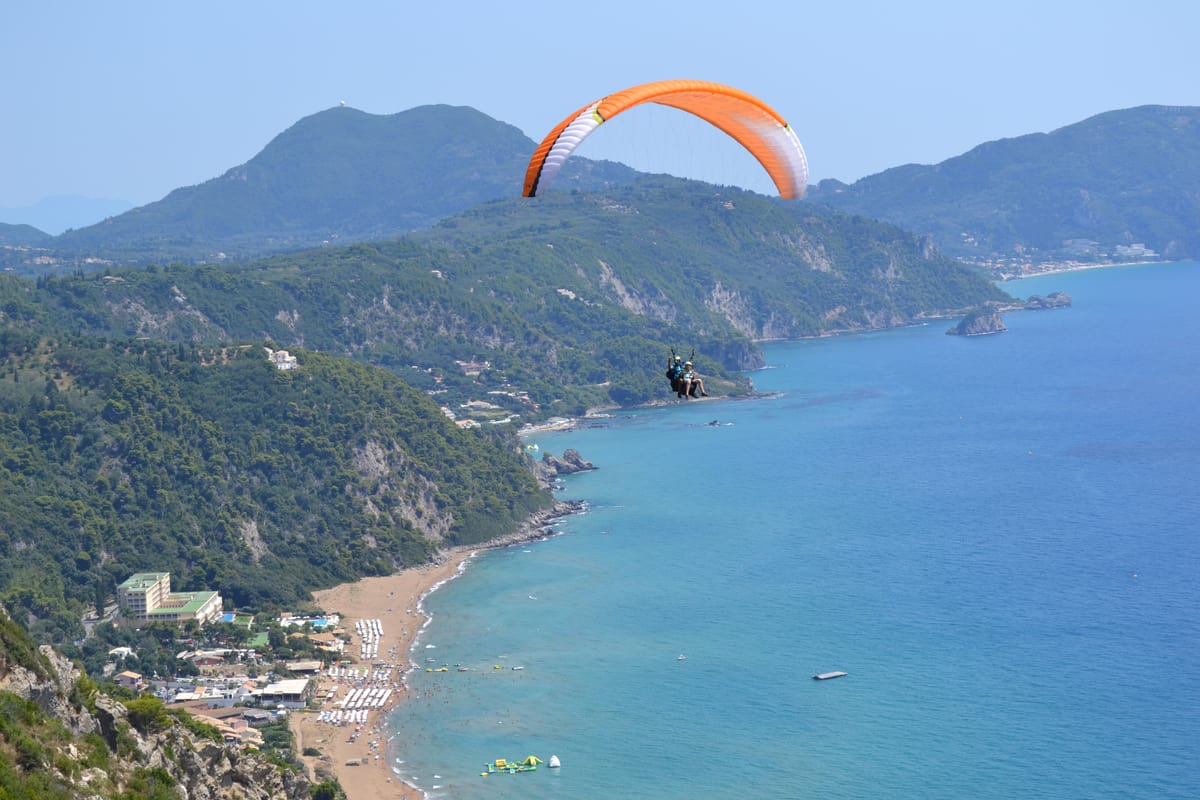
Corfu paragliding lifts a passenger and a trained pilot off a hillside under a fabric wing, high above the coast of Corfu. Tandem flights carry two people under one wing. It is one of the air sports in Greece on Greece VIP.
This post covers what Corfu paragliding includes, where flights take off and where they land. It also covers the views, the mountains and the coasts below. Winds, Greek rules, the difference from parasailing, what to bring, the best season and common questions come last.
Each section ends with a Corfu paragliding flight or a nearby outdoor tour that can be booked online.
What does Corfu paragliding include?
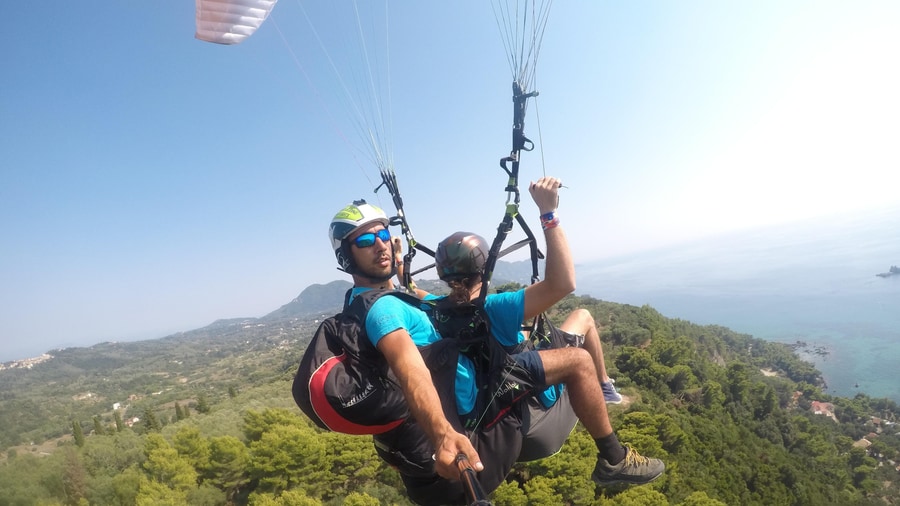
Corfu paragliding includes a tandem flight with a licensed pilot behind the passenger. The passenger sits in a harness linked to the pilot and the wing. A short briefing and a practice take-off come first. Greek rules and FAI standards set who flies.
The official Visit Corfu page describes the Corfu paragliding harness. It connects the passenger to both the pilot and the glider. The flying seat position is as comfortable as a recliner chair, the page says.
A Corfu paragliding tandem glider is built to carry two people. It is nearly twice the size of a regular solo paraglider. Tandem wings fly faster than solo wings and sink a little faster.
Each Corfu paragliding flight starts with a short briefing. It covers the take-off and the seated position in the air. Passengers then practise the take-off before the real flight begins.
Greek rules decide who flies a passenger, here and for paragliding on Crete alike. The Hellenic Paragliding Commission allows tandem flights only with a valid Greek Tandem-License. A Hellenic Airsports Federation permit also counts.
The FAI, the world air sports federation, sets the SafePro Para standard. Its stage 6 covers flying a passenger under a tandem wing. It needs IPPI Card Level 5, the senior pilot stage. That card dates from 1992 and counts only with a current national licence.
Stage 6 also needs 100 flights on 10 different sites. A logbook of flights or reliable witnesses must prove them. The pilot checks that the passenger understands the instructions in a common language.
- Weight: The Visit Corfu page sets a top passenger weight of 120 kg.
- Weather: Corfu paragliding depends on the weather, so flyers confirm 2 days before.
- Rescue parachute: Greek rules make every pilot carry one.
- Shoes: The Visit Corfu page lists trekking or sports shoes among the items to bring.
Corfu paragliding joins a simple passenger role to strict pilot rules. Greek rules give tandem gliders priority in the air. SafePro also asks each tandem pilot to agree to give up a flight.


Where does Corfu paragliding take off?
Corfu paragliding takes off from small launches above west-coast beaches, at Troumpetas and on Mount Pantokrator. A flying-site database lists them with their heights. Each rated launch suits only certain winds. Greek rules also keep flights away from airports.
The Hellenic Paragliding Commission counts about 300 flying sites for paragliding in Greece. For Corfu paragliding, the ParaglidingEarth database lists ten entries. Six of them rate the winds that suit each launch.
The Kontogialos take-off sits at 165 m and is small. A west wind rates best there, and a south-west wind rates lower. Kontogialos itself is a small village in the Sinarades community.
The Mirtiotisa take-off for Corfu paragliding sits at 231 m. The launch is small and covered with a green carpet. A south wind rates best, while south-east and south-west winds rate lower.
Agios Gordis has a take-off at 360 m. It is small and sits just under a power line. North, south-west, west and north-west winds all rate best. No other Corfu paragliding entry rates four winds best.
Troumpetas has two launches. One sits at 512 m, is small and has bushes in front. South and south-west winds rate best. Troumpetas North, at 445 m, is small and difficult, with north rated best.
The highest Corfu paragliding launch is Pantokratoras, at 887 m on Mount Pantokrator. Pilots reach it by car. The take-off is small and hard, with south-east and south winds rated best.
- Filakio: This entry sits at 236 m and came from the International Leonardo database.
- Vigla: This low entry sits at 102 m, with no wind ratings.
- Airports: Greek rules ban paragliding within 10 nautical miles of airports without special permission.
Corfu paragliding launches differ in height and in the winds they need. The Hellenic Paragliding Commission asks visiting pilots to contact local clubs and the site manager first. Their advice must be followed.
Where does Corfu paragliding land?
Corfu paragliding lands mainly on beaches below the launches, such as Glyfada and Barbati. One landing lies inland near Doukades. Official profiles describe the landing beaches. Greek rules set who lands first and how close flights come to people.
Under Greek rules, the glider with the lower height has priority during landing. Flights must stay at least 25 m from any person, grazing livestock, building, vehicle or public road. Pilots use radio to report where and when they plan to land.
Glyfada beach is the Corfu paragliding landing for the Mirtiotisa launch, at 5 m. The bathing beach is 950 m long and 30 m wide on average. Sand covers both the shore and the sea floor.
Kontogialos flights land on the beach, and landing on top is demanding. That beach is 450 m long and 30 m wide on average. Its sea floor slopes gently, reaching 5 m deep about 90 m out.
Corfu paragliding flights from Agios Gordis land on the beach, where space is short. The beach is 1,100 m long and 20 m wide on average. Sand covers it, with gravel toward the north end and big boulders in the south.
Flights from Pantokratoras land at Barbati beach, at 5 m. The beach sits on the north-east coast, in an open bay about 4,000 m long. It is 950 m long, with gravel on shore and sea floor.
Corfu paragliding flights from Troumpetas land near the village of Doukades, at 110 m. Doukades is a community of 487 people, and hills dominate the area. The Troumpetas North landing sits higher, at 216 m.
- Water tests: Glyfada, Kontogialos, Agios Gordios and Barbati rated excellent from 2019 to 2022.
- Crowds: Profiles estimate up to 2,000 bathers at Glyfada and 900 at Kontogialos.
- Test season: Samples run each year from 1 June to 31 October.
Corfu paragliding ends on sand or gravel near sea level, or near an inland village. The same database lists launches and landings alike. Official profiles add the size and water quality of each landing beach.
What views does Corfu paragliding give?
Corfu paragliding gives wide views of the Albanian mountains, the small Diapontia islands and Paxos. Each island has its own shape, from round to long and narrow. Farmland and a reed-lined lake lie below. Every direction shows a different coast.
To the east, the Ceraunian Mountains rise along the Albanian Riviera near Sarandë. The limestone range runs for about 100 km from south-east to north-west. Corfu paragliding views frame it across the water.
A mountain pass called Llogara crosses the range at 1027 m. It separates the Karaburun Peninsula from the rest of the mountains. That peninsula forms the western part of the range.
Corfu paragliding looks north-west to Othonoi, which rises to 393 m at Imerovigli. The island is about 5.6 km long and 3.6 km wide, with 30 km of coastline. Italy’s Cape Santa Maria di Leuca lies 47.5 nautical miles away.
Ereikoussa is the northernmost point of the Ionian Islands. Its name comes from the heather bush, which blooms there in October. The highest point, Santardo, reaches about 130 m. Its round shape stands out in Corfu paragliding views.
Mathraki is the southernmost of the Diapontia Islands. It lies 4 nautical miles from Cape Arilas. Corfu paragliding views show a long, narrow, green island. Its highest point reaches no more than 152 m.
To the south, Paxos and Antipaxos have a long, narrow, lizard-like shape. Paxos stretches from north-west to south-east. Both sit in the Pre-Apulian rock zone. Pelagic limestone, formed in the open sea, covers much of Paxos.
- Lefkimmi: This southern district covers 50.819 square kilometres of land.
- Olive country: Olive groves cover the larger part of Sidari’s farmland.
- Lake Antiniotissa: Reed and bamboo ring the lake, with sand dunes toward the sea.
Corfu paragliding shows why the island is called green. Plant cover turns drier on the southern Ionian islands of Zakynthos and the Strofades. Corfu sits at the green end of that change.
Which mountains shape Corfu paragliding?
Corfu paragliding takes shape over folded limestone mountains in the north-east, crowned by Pantokrator. A deep fault pushed this rock upward. Old sea rocks form these heights. Mainland mountains also shield the islands from cold north winds in winter.
Corfu sits on the north-western edge of the Hellenic Fold and Thrust Belt, a band of bent rock. The African and Eurasian plates pushing together made its rocks complex. The island holds the Ionian and pre-Apulian zones.
A huge fault called the Ionian Thrust pushes the Ionian Zone over the pre-Apulian Zone. In the Middle Miocene, it lifted old limestone in north-eastern Corfu. Corfu paragliding over the north rides above that rock.
In the east, Corfu paragliding passes over Jurassic rock called Pantokratoras Limestone. With the Vigla limestone, it forms a large anticline. An anticline is a fold of rock layers that arches upward.
The Pantokrator Limestone formed in a shallow sea early in the Jurassic. Across the Ionian zone, it lies above evaporites more than 2000 m thick. Evaporites are rocks left when salty water dries up.
Near the summit stands the Holy Monastery of Ypsilos Pantokrator. Ypsilos means high. The largest tower of the telecom station stands right over a well. Its transmitters have been picked up in Lecce, Italy, in summer.
In central Corfu, the village of Agioi Deka sits at 150 m. It lies on the north-eastern edge of Mount Galikio. The village stands about 11 km south of Corfu town.
- Coastal belt: Wild olive and carob mark the coastal zone of the Ionian Islands.
- Higher belt: Evergreen kermes oak marks the next zone up the slopes.
- Island record: Mt Aenos on Cephalonia, at 1628 m, tops the Ionian Islands.
Corfu paragliding also takes in Stravoskiadi, the second-highest point on the island. Below these summits, the rock records plates, faults and folds. Each ridge below marks one step in that long story.
Which coasts does Corfu paragliding fly over?
Corfu paragliding flies over a west coast of cliffs, wide bays and sandy beaches. In the north-west, clay heights and coves frame the shore near Cape Drastis. Farther south, Glyfada, Myrtiotissa and Agios Gordios sit below steep cliffs and crags.
Cape Drastis marks the north-west tip of Corfu. Peroulades sits east of the cape, 20 m above the sea. Its coves include Logas, also called Sunset Beach, and Apotripiti, beside dramatic coastal cliffs.
Near Sidari, clay heights push into the sea and form small coves, with underwater caves. The Canal d’Amour beach fills a closed cove facing north-east. It is 180 m long and under 5 m wide.
Corfu paragliding above Arillas meets a bay that faces south-west and stretches 6,500 m. Its shore shows siltstone, a rock of fine mud, and loose sandstone. Rocks cut off the north-west end, which only boats reach.
Corfu paragliding reaches Glyfada, which fills an open bay facing south-west. Its fine sand gives the water a blue-green colour. Pine-covered vertical cliffs rise straight above the beach.
Corfu paragliding also passes Myrtiotissa, 16 km from Corfu Town. Sheer, high cliffs ring the beach, kept green by small streams. Large rocks sit on its sandy sea floor. Both Myrtiotissa and Ermones belong to Vatos village.
Agios Gordios lies north of Cape Faskia, in a west-facing open bay 2,700 m long. Sheer crags rise behind the sand. Ermones forms a closed bay facing south-west. Dense, tall tamarisks line its 230 m beach.
- Afionas: The village stands on a high headland 37 km from Corfu Town.
- Pelekas: This village lies close to Glyfada and Kontogialos beaches.
- Agios Georgios Pagon: Its 2,400 m beach sits inside a bay 7,800 m long.
Corfu paragliding links clay coves in the north with sandy bays in the west. At Agios Stefanos cape, two pebble-rock beds, each about 10 m thick, mark a change in rock age.
What winds shape Corfu paragliding?
Corfu paragliding depends on three Mediterranean winds and on local sea breezes. The maestro brings fine summer weather from the north-west. The sirocco blows warm from the south. The cold bora comes from the north-east and arrives in gusts.
The maestro is a north-westerly wind that brings fine weather. It blows mainly in summer over the Adriatic Sea, above all on its western shore. It also reaches the coasts of Corsica and Sardinia.
The maestro equals the etesians, the summer winds of the eastern Mediterranean. Similar winds cross the Ionian region, home of Corfu paragliding. Ancient Greeks said the etesians blow for 40 days from the rising of Sirius. Greeks nickname the etesian wind the sleeper.
For Corfu paragliding, the sirocco is a warm wind from the south or south-east. Its Saharan air starts dry and dusty. Farther north, it brings fog and rain. It blows ahead of storms that cross the southern Mediterranean or North Africa.
The bora, or mpóra in Greek, blows from the north or north-east near the Adriatic. It is a katabatic wind that weakens over the open sea. For Corfu paragliding, it is mainly a gusty winter wind. A weak bora is a borino, and a strong one a boraccia.
Gusts are brief jumps in wind speed, lasting under 20 seconds as a rule. Behind a ridge, wind can form a rotor, a spinning roll of air. Its turbulence can harm a Corfu paragliding wing.
American practice sets limits for gust reports. Peak speed must reach 16 knots, with a 9-knot swing between peak and lull. Gusts stay weakest over open water and strongest over rough land.
- Lee waves: German glider pilots Hans Deutschmann and Wolf Hirth found them in 1933.
- Rotor clouds: These clouds mark dangerously turbulent air behind a ridge.
- Bora spells: A single bora event can end within a day.
A gap between two mountains squeezes and speeds up wind. The flow can then beat a paraglider’s top speed and halt its progress. Such local effects join the named winds in shaping Corfu paragliding.
What rules govern Corfu paragliding in Greece?
Corfu paragliding falls under a Greek aviation rulebook for hang gliding and paragliding. A national federation drafts the rules for air-sport clubs. A control zone around an airport needs clearance to enter. EU insurance law skips foot-launched flying machines.
Corfu paragliding follows a 2006 decision by the head of the Hellenic Civil Aviation Authority. It covers hang gliding, paragliding and similar air sports. Investigators class a paraglider as a flying air-sport device.
The same investigators found the rulebook silent on pilot licences. It set no way to earn one or match foreign ones. It also said paragliding pilots need no medical certificate.
The Greek aviation authority handed rule-making for air-sport clubs to this federation, known as ELAO. Its paragliding committee issued a Paragliding Regulation in October 2011. It binds members and competitors.
ELAO also wrote exam rules for paragliding pilot licences, with a ninth edition in 2018. These rules set the types of pilot licence. Yet the aviation authority had not approved them.
In 2019, investigators found no rulebook conditions for visiting foreign pilots. The gap covers Corfu paragliding too. They asked the authority and ELAO to fix it. The authority said a new rulebook needs time.
EU insurance law for aircraft operators skips foot-launched flying machines. That gap covers paragliders and hang gliders alike. Kites and parascending parachutes fall outside it as well.
- 2006 basis: The rulebook appeared in Government Gazette B/309 on 15 March 2006.
- FAI: The World Air Sports Federation, founded on 14 October 1905, governs air sports.
- CIVL: This FAI commission governs hang gliding and paragliding.
- Greek member: Greece’s member federation dates its FAI affiliation to 1931.
EU aviation safety law skips manned aircraft weighing 70 kg or less empty, fuel included. Corfu’s airport uses the code LGKR. Inside any control zone, Corfu paragliding also needs constant radio contact.
How does Corfu paragliding differ from parasailing?
Corfu paragliding belongs to open fields and mountain ranges. Parasailing, or parascending, pulls a canopy behind a moving vehicle, such as a powerboat. Parasail riders cannot steer or deflate the canopy. The boat crew sets their height and speed.
The contrast with Corfu paragliding starts with lift. A parasail rises on apparent wind, the airflow from the boat’s motion, which strikes the canopy. Towed upward, a parasail stays steadier than a parachute.
Pierre-Marcel Lemoigne developed the first ascending-gliding parachute in 1962. The same year he opened an Aeronautical Training Center. It towed parachutists aloft and released them to practise landings, cheaper than an airplane.
Modern parasailing began in 1974, when a Florida inventor tested the first working winch boat. Riders take off from its deck and land back on it. The first recorded parasailing accident came in 1977.
The parasail canopy also differs from a Corfu paragliding wing. A typical one has 72 panels. Its 16 main panels, called gores, are shaped like pie slices. Slots at the back push air down for lift.
A flight bar carries one to three riders, the design limit. The winch, a powered reel, sets the towline length. With wind and boat speed, that length controls the canopy’s height.
An American safety board estimates 3 to 5 million Americans parasail yearly. No federal rule there sets operator training, gear checks or bad-weather stops. Accidents end in serious injury or death as a rule.
- Towline failure: The board names it the leading cause of injury and death.
- Knots: A knot can cut towline strength by up to 70 percent, even in new rope.
- Abroad: Parasailing is largely unregulated worldwide, except in Queensland, Australia, since 2000.
- Stabilizers: Two stabilizer panels sit on the canopy, one on each side.
In Europe, parasailing also runs on land, with a car towing the canopy. This version is a competitive sport, with international contests since the mid-1980s. Both forms stay distinct from Corfu paragliding.
What do flyers bring for Corfu paragliding?
Corfu paragliding passengers bring sturdy boots, long trousers, a wind layer and strapped sunglasses. Each item answers a known risk. Landings strain legs, wind chills skin and pressure shifts reach the ears. Standards also test each wing against its top weight.
A study from Germany, Austria and Switzerland counted 283 injuries among 218 paragliders from 1987 to 1989. Landing caused 181 of them. Lower limb injuries made up 41.3% of the total.
The authors called for sturdy footwear above all, a lesson for Corfu paragliding. A Turkish review of 242,355 flights near Fethiye counted 108 fractures. Breaks around the foot and ankle made up 19, or 17.6%.
Long trousers guard the legs against scrapes on Corfu paragliding days. Abrasions mainly happen when bare skin slides across a rough surface. Mild grazes leave no scar, but deep ones can.
Wind chill indexes apply only at 10 °C or below, with wind above 4.8 km/h. At minus 20 °C, a 30 km/h wind rates minus 33.
A wind layer suits Corfu paragliding, since the flyer sits in moving air. A 2012 study tested windbreaker trousers and jackets in sudden cold. They delayed hypothermia, a dangerous drop in body heat.
Air pressure falls about 1.2 kPa per 100 m near sea level. Ear barotrauma is discomfort from a pressure gap across the eardrum. The eustachian tube links the middle ear to the back of the nose. Hearing loss from barotrauma is almost always temporary.
- Ear relief: Chewing gum or sucking a sweet helps open the tube.
- Sunglasses: Sports pairs use impact-resistant lenses and a strap or other fixing.
- Weight: The LTF standard loads a wing with 8 times its top take-off weight for 3 seconds.
In two-seat LTF tests, extra test weight tops out at 30 kg or 20% of pilot plus passenger. American rules cap an unpowered one-person ultralight at under 155 pounds. Such limits shape Corfu paragliding.
When is the best season for Corfu paragliding?
Corfu paragliding fits the dry summer best, when rain stays away for long spells. Lightning peaks in June, largely in the afternoon. Medicanes, rare sea storms, peak in January. Easter, Saint Spyridon days and cruise calls also shape the calendar.
The Köppen system sets tests for a dry summer. A dry summer month gets under 30 mm of rain. It falls between April and September, with a third or less of the wettest winter month’s rain.
The letter a marks a warmest month above 22 °C on average. Mediterranean climates can pass four to six summer and early autumn months without real rain. That dry spell suits Corfu paragliding.
Medicanes are Mediterranean sea storms that look like hurricanes. Their main danger is very heavy rain and flash floods, more than wind. On average, 1.57 form each year. They rarely form in summer, the main Corfu paragliding season.
Medicane activity rises in autumn and drops from February. HNMS, the Greek weather service, covers the whole Mediterranean. The 12th Plinius Conference on Mediterranean storms met on Corfu in September 2010.
The National Observatory of Athens tracks lightning with its ZEUS network. Strikes favour land and coasts in spring and summer, and the sea in the cold months. On stormy days, a jeep safari on Corfu keeps plans on the ground.
Lightning over the eastern Mediterranean peaks in June, largely in the afternoon. Corfu paragliding pilots plan around that window. At Easter, the Capodistria band plays the Funeral March from Beethoven’s Eroica on Holy Saturday.
- Saint Spyridon: His 12 December feast on the Julian calendar matches 25 December on the Gregorian.
- Early cruise: A steamship cruise from Naples called at Corfu in June 1833 and lasted three months.
- Cruise traffic: The Hellenic Ports Association lists 748,916 cruise passengers a year at Corfu.
Ships reach Corfu port through a channel 450 m wide that faces east. Summer gives Corfu paragliding its driest skies. Winter brings sea storms, and Easter brings band music.
What do travelers ask about Corfu paragliding?
Corfu paragliding questions cover pilot licences, age rules, health, phones, flight height and paperwork. A Greek safety report pushes for clearer tandem rules. Health agencies advise early medical checks. Air rules limit dropped objects and set minimum heights.
Who sets licence rules for Corfu paragliding pilots in Greece?
For Corfu paragliding, ELAO, the Hellenic Aeronautical and Air Sports Federation, sets tandem licence rules. Pilots hold Parapro 4 or Parapro 5, and instructors hold Parapro 5. A Greek safety report asked the HCAA, the civil aviation authority, to weigh a new regulation.
Is there an age limit for Corfu paragliding pilots?
That report covered a tandem flight at Exanthia, on Lefkada, on 16 July 2020. It asked ELAO to unify the maximum permitted age for tandem licences. It also asked for tandem pilots and instructors to be checked again at set intervals.
Can people with heart conditions try Corfu paragliding?
The CDC, the American health agency, says long-term illness does not, as a rule, mean staying home. It advises a health visit at least 4 to 6 weeks before departure. Heart patients get clearance from a cardiologist and carry a current EKG, a heart tracing.
Can flyers carry a camera phone on Corfu paragliding flights?
EU rules of the air limit dropping things from an aircraft in flight. Any drop must follow the law and air traffic advice. American rules ban letting an object fall from an ultralight if it endangers people or property. A secured phone meets both rules.
What height rules apply to Corfu paragliding?
EU rules set a visual flight minimum of 150 m above ground or water. Over towns, the floor is 300 m above the highest obstacle within 600 m. Take-off and landing are exceptions. The 1911 Encyclopaedia Britannica put Corfu’s northern San Salvador range at 3300 ft.
What paperwork comes with Corfu paragliding tandem flights?
American rules give one example. There, a tandem student joins USHPA, the national hang gliding and paragliding body, before flying. Options include a 10-day Temporary or 60-day Student membership. Each student signs a liability waiver and gets FAA study materials.