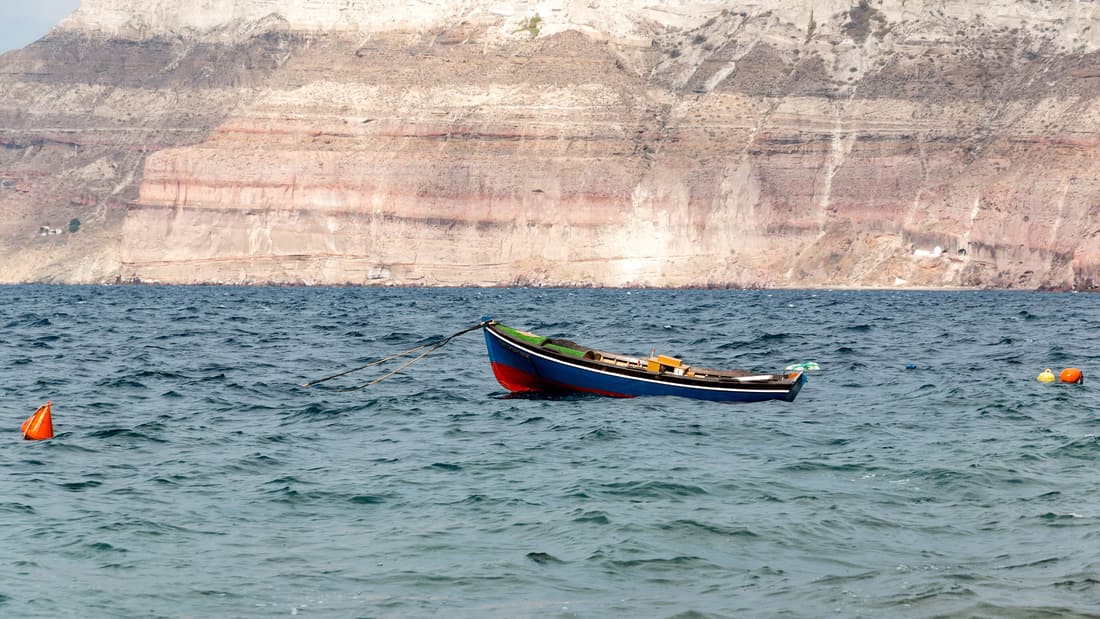
Santorini scuba diving takes beginners and certified divers below the water of a volcanic island, along the steep walls of the flooded caldera, around the lava of the Kameni islands and off the dark-sand beaches of the south and east coasts. This post covers what Santorini scuba diving includes, how the volcano shapes the dives, the dive sites, the wreck in the caldera, the marine life, the courses, safety and the best season. It is one of the water activities in Greece on Greece VIP.
Each section ends with a Santorini scuba diving or sea experience that can be booked online.
What does Santorini scuba diving include?
Santorini scuba diving includes try dives for beginners, certification courses and boat or shore dives for certified divers. The volcanic island of Thera, in the Cyclades, pairs a flooded caldera with quieter coasts, so beginners and certified divers find their own water.
The island group lies in the southern Aegean Sea, and the flooded caldera measures about 12 by 7 km. Steep cliffs stand roughly 300 m high on three sides, and the deepest point of the basin reaches 385 m. Santorini itself covers 75.8 km², Therasia 9.3 km² and the small Aspronisi 0.1 km². Those walls, built from layer upon layer of solidified lava, frame the water inside the bay.
A first taste of Santorini scuba diving begins in calm, shallow water with an instructor close by, and moves into open water once basic skills work. Certified divers step onto a boat for the inner caldera or walk in from the shore. The island sits on an active part of the South Aegean Volcanic Arc, a chain that also holds Methana, Milos and Nisyros.
- Try dives: An introductory session in shallow water, open to complete beginners.
- Certification courses: Full training that leads to an entry-level diver card.
- Boat dives: Trips into the caldera for certified divers.
- Shore dives: Entries from the outer beaches.
The mix of sheltered water, volcanic walls and open coast explains why Santorini scuba diving suits a wide range of visitors. An island born from eruptions offers a seabed unlike the flat, sandy floors of other holiday coasts, and a first dive or a fiftieth dive both find something worth watching.


How does the volcano shape Santorini scuba diving?
Santorini scuba diving follows the shape of a volcano. A Bronze Age eruption around 1600 BC collapsed the centre of the island, and the sea filled the hollow. Two small volcanic islands, Nea Kameni and Palea Kameni, sit in the middle of that water.
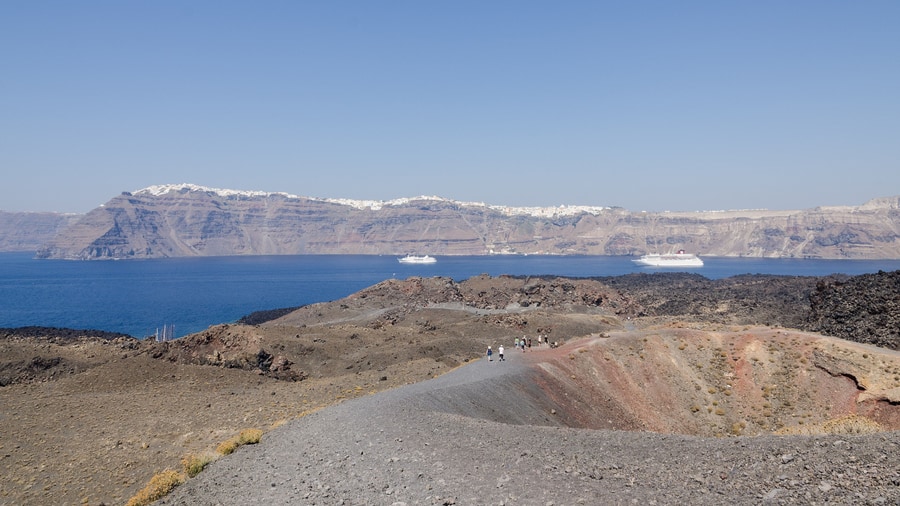
The Minoan eruption ranked 7 on the Volcanic Explosivity Index and released 28 to 41 km³ of dense rock. Ash fell up to 60 m thick on Thera, and the collapse opened two new channels in the ring of islands that had enclosed the bay. The caldera entered today formed about 3,600 years ago, and the buried town of Akrotiri has yielded no human remains.
Nea Kameni covers 3.4 km² and rises to 114 m beside a crater about 130 m high. Its last eruption happened in 1950, and the island stays uninhabited and protected as a scientific site. Palea Kameni covers 0.5 km² and holds a hot spring, where the thermal water runs warmer than the open sea. Santorini scuba diving around these cones crosses dark lava and pale ash.
- Kameni lava: Dacite flows and ash that built the central islands.
- Fumaroles: Vents that release steam and gases from the volcano.
- Volcanic sand: Shores made from material thrown out by eruptions.
The caldera is listed among the world’s sixteen Decade Volcanoes, a group watched because of its history and its closeness to people. That geology gives Santorini scuba diving its structure: vertical walls, boulder fields and a seabed that changes colour from black to grey inside a single swim. Layer by layer, the walls tell the story.
Which dive sites does Santorini scuba diving visit?
Santorini scuba diving visits the inner caldera walls, the lava shores of the Kameni islands and the south and east coasts. Dark beaches at Kamari and Perissa give easy shore entries, while the Akrotiri peninsula shelters quieter water and older volcanic rock.
Kamari stretches along a beach of black pebbles, about 8 km from Fira, below the Mesa Vouno ridge that rises to roughly 400 m. Perissa lies 13 km southeast of Fira near the same rock. Santorini scuba diving from either village reaches dark seabeds within a short swim, and the lava there absorbs heat, so the shallow water feels warmer in the sun.
The Akrotiri peninsula carries the oldest rocks of the group, formed by submarine eruptions between 650,000 and 550,000 years ago. Ash from the Bronze Age eruption preserved a settlement there that has been excavated since 1967. Colour marks the coast as well: the Red, Black and White beaches are built from solidified lava, and each one shows a different geological layer.
- Caldera walls: Layered lava and pumice in vertical sections.
- Kameni shores: Dark boulders and blocks around the central islands.
- Coastal beaches: Shore entries from black sand and pebble.
The variety matters because conditions differ inside and outside the ring of islands. Santorini scuba diving moves between those settings, and an unhurried stay allows time on the walls, the shallow lava and the long black beaches without repeating the same view. Each setting asks for its own plan.
Which wreck does Santorini scuba diving know in the caldera?
Santorini scuba diving knows one large wreck inside the caldera, a cruise ship that ran aground on a volcanic reef east of Nea Kameni in April 2007 and sank the next morning. Its bow rests about 62 m below the surface.
The ship struck the reef on 5 April 2007 and went down shortly before 7:00 on 6 April 2007, close to the shore. All 1,153 passengers left the vessel, and the stern now sits in water up to 180 m deep. About 450 tonnes of fuel were on board, and part was pumped off in June 2009. The hull is feared to slide deeper.
The owners, the operator and the captain were fined 1.17 million euro in June 2007 for marine pollution, and a Greek diver gathering evidence for a judicial investigation died in October 2007 from decompression sickness. The hull works as an artificial reef, and in 2017 the Merchant Marine Ministry of Greece announced a plan to raise it. Santorini scuba diving near the site concerns trained deep divers only.
- Position: Inside the caldera, east of Nea Kameni.
- Depth: From about 62 m at the bow to 180 m at the stern.
- Status: A reef with a raising plan announced in 2017.
The wreck is the strongest reminder that the caldera has a history beyond geology, and it shows why briefings matter on this island. Charts of the area have been questioned, and Santorini scuba diving beside a reef that lies close to a marked route leaves no room for guesswork on this coast.
Which marine life does Santorini scuba diving show?
Santorini scuba diving shows fish, octopus, sponges and seagrass meadows. The Mediterranean seagrass Posidonia oceanica grows on sandy patches between the rocks, and the common octopus hides in crevices along the shallow volcanic coast, where small life fills every gap.
Posidonia oceanica, known as Neptune grass, is endemic to the Mediterranean Sea and forms dense underwater meadows between 1 and 35 m of depth. Its ribbon leaves grow in tufts of six or seven, and its presence marks clean water, which makes Santorini scuba diving sites with seagrass a sign of a healthy coast for divers and for scientists who study this sea.
The common octopus prefers relatively shallow, rocky coastal floors and rarely descends beyond 200 m. Aegean catches include sardines, mackerel, grouper, grey mullet, sea bass and seabream, and natural sponges from these sea floors once supported a Greek industry centred on the island of Kalymnos. Greece holds Europe’s largest fishing fleet as well, and the same rocky ground carries sponges and urchins.
- Seagrass: Posidonia meadows spread over sand between rock.
- Octopus: Common octopus in crevices, rubble and old pottery.
- Fish: Aegean species such as grouper, seabream and mullet.
Volcanic ground changes what grows where. Santorini scuba diving over dark sand and lava meets a thinner cover of weed than a limestone coast, and the animals gather around rock, wreckage and seagrass instead. That pattern rewards slow swimming and a close look, and it keeps a single tank interesting from start to finish.
Which courses does Santorini scuba diving offer?
Santorini scuba diving offers an introductory trial, Open Water Diver training, Advanced Open Water training and specialty courses. Agencies such as PADI and SSI set these levels, and each one carries its own depth limit and minimum age.
A Discover Scuba Diving session is open from 10 years of age and reaches a maximum depth of 12 m under direct supervision. Open Water Diver training fits a diver to 18 m with a buddy, and Advanced Open Water training lifts that limit to 30 m. PADI issues full certification from 15 years, and both courses mix theory, confined water practice and open water dives.
Divers of 10 to 14 years hold a Junior Open Water rating: from 10 to 11 years the depth limit is 12 m with a professional or a parent at hand, and from 12 to 14 years it is 21 m with an adult. SSI asks for 24 logged dives before Advanced certification, while PADI requires five dives on the course. Specialties follow later, covering deep diving and navigation.
- Try dive: An introductory session from 10 years of age.
- Open Water: Entry certification with an 18 m limit.
- Advanced Open Water: Training to 30 m with deep and navigation dives.
Training on a volcanic island adds context that a pool cannot give. Steps, entries and exits from lava rock ask for care, and Santorini scuba diving in deep caldera water makes good buoyancy control valuable from the first open water dive onward. That grounding stays useful long after the course ends.
How does Santorini scuba diving stay safe?
Santorini scuba diving stays safe through depth limits, planned ascents, rest between dives and the buddy system. Courses teach the signals, the limits and the habits that keep a descent calm, and every certification level carries its own rules for open water.
Divers Alert Network advises a minimum surface interval of 18 hours before a commercial flight after days of no-decompression diving. Decompression sickness comes from gas bubbles that form in body tissue during an ascent, and its symptoms range from joint pain and skin rashes to paralysis in severe cases. Climbing to the surface slowly, inside the planned profile, lowers the risk.
Under the buddy system, divers work in pairs, watching each other during the entry, the dive and the exit, so either can help the other within moments. Divers Alert Network also documents hazardous marine life, including sea urchins, fire coral and stinging jellyfish, and it recommends full-body protection and steady buoyancy control. Santorini scuba diving also asks for care on the surface, where boats, steps and heat demand attention.
- Flying: A long surface interval before any flight home.
- Ascents: Slow, steady and inside the planned profile.
- Buddy system: Pairs that watch each other throughout.
The habits that keep a dive safe are simple and repeatable. Gas checks, a plan agreed in advance and a partner who stays close cover much of the risk, and Santorini scuba diving on a volcanic coast rewards them even more, because rock, depth and boat traffic all sit close together. That discipline costs nothing at all.
When is the best season for Santorini scuba diving?
Santorini scuba diving runs best from late spring through early autumn, when the Aegean is warmest and the weather is settled. Summer sea temperatures in the Aegean surface water sit between 19 and 24 °C, and the meltemi wind blows through the summer months.
Santorini has a hot semi-arid climate with dry summers and wetter winters. Rainfall averages about 270 mm a year, and the average annual temperature is about 19 °C. July brings an average daily maximum of 30.1 °C, August 30.2 °C, and January an average daily minimum of 10.1 °C. The island never turns truly cold, and the sea holds its warmth late into the year.
The meltemi is the strong, dry north wind of the Aegean, and it reaches force 7 to 8 on the Beaufort scale. It builds through the afternoon and dies away at night. A Santorini boat tour planned for the morning meets flatter water than one booked late in the day, and Santorini scuba diving planned around the wind meets calmer water still.
- Warmest water: Late summer, after months of strong sun.
- Calmest hours: Mornings, before the wind builds.
- Quieter island: Spring and autumn, away from the busiest weeks.
The season shapes the diving as much as the site does. Wind, light and water temperature move through the year, and Santorini scuba diving planned around the wind gives calmer days and clearer water than a date chosen from the calendar alone. Visitors who prefer space on the island travel outside the busiest weeks.
What do travelers ask about Santorini scuba diving?
Travelers ask Santorini scuba diving questions about experience, age, comparisons with Crete, snorkelling and beach days. A trial session needs no certification at all, children can start young, and the same clear water suits snorkellers and certified divers alike.
Does Santorini scuba diving need experience?
No certification is needed for an introductory session. A Discover Scuba Diving programme puts a complete beginner in confined water first and then in open water to a maximum of 12 m, with an instructor supervising directly the whole time. The skills taught are simple: breathing, equalising and clearing a mask.
What age is right for Santorini scuba diving?
PADI opens introductory dives at 10 years, and Junior Open Water training starts at the same age. Divers of 10 to 11 years stay at 12 m with a professional or a parent, and divers of 12 to 14 years reach 21 m with an adult. Full certification follows at 15 years of age.
How does Santorini scuba diving compare with diving on Crete?
The caldera lies about 120 km north of Crete, the Aegean island with the largest population. Santorini offers a flooded crater with vertical walls, warm springs and a known wreck, while Crete scuba diving spreads over a much longer coastline with a wider mix of sites.
Can snorkelers join Santorini scuba diving?
Snorkellers share the same coastline and the same clear water without any need for a tank or a card. Shallow lava shelves beside the beaches, the dark pebbles of Kamari and the seagrass patches all sit within a short swim, and a mask and fins are enough for Santorini scuba diving sites to be enjoyed from the surface.
Can Santorini scuba diving be combined with a beach day?
A beach day fits easily around a dive, because the shore entries and the beaches share the same coast. Kamari holds the longest beach on the island, and its black pebbles lie close to the water where boats moor. Santorini scuba diving in the morning and warm sand in the afternoon make one full day.
Featured photo: Dietmar Rabich, CC BY-SA 4.0, via Wikimedia Commons.