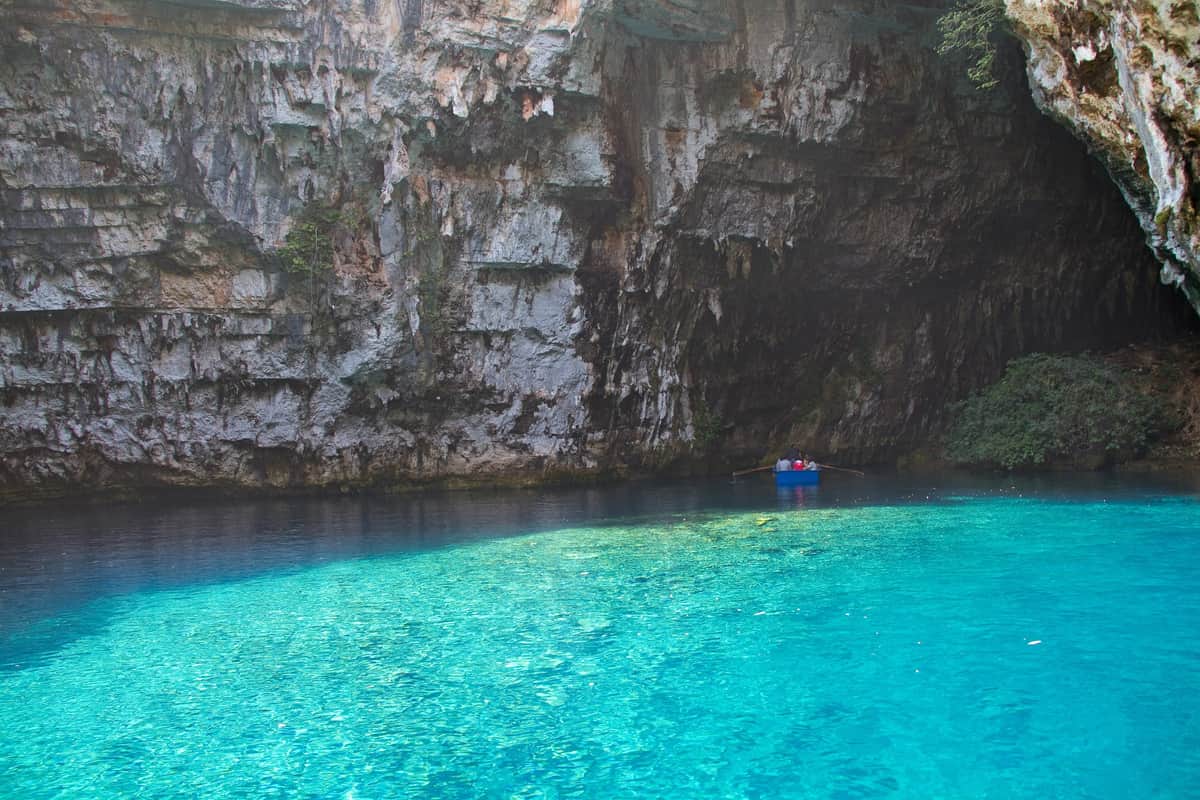
A Melissani cave tour takes a rowing boat across the underground lake of Melissani near Sami on Kefalonia, where sunlight falls through a collapsed roof onto clear blue water under walls of limestone. This post covers what a Melissani cave tour includes, how the cave formed, why the water glows blue, the myths and finds, the discovery of the cave, the sights nearby, how tours reach the cave and the best time to go. It is one of the nature tours in Greece on Greece VIP.
Each section ends with a Melissani cave tour that can be booked online.
What does a Melissani cave tour include?
A Melissani cave tour starts with a walk down a tunnelled entrance and steps to an underground lake. A small boat then crosses the water, passes two chambers, and glides below an open roof and past a small islet.
A Melissani cave tour begins on foot. Visitors follow an underground path, pass the tunnelled entrance and descend the steps. A vertical shaft descends to the water table, and the lake lies at its foot. Visitors then step into a small boat for a round trip. The cave stands just outside the town of Sami, on the east side of Kefalonia.
The cave is B-shaped, with two chambers separated by an island in the middle. Sunlight fills the first chamber. The second is dark, and electric lights show its stalactites, which carry algae and moss and look small beside the huge dome. A narrow passageway joins them, and the two chambers of a Melissani cave tour cover a distance of 160 m.
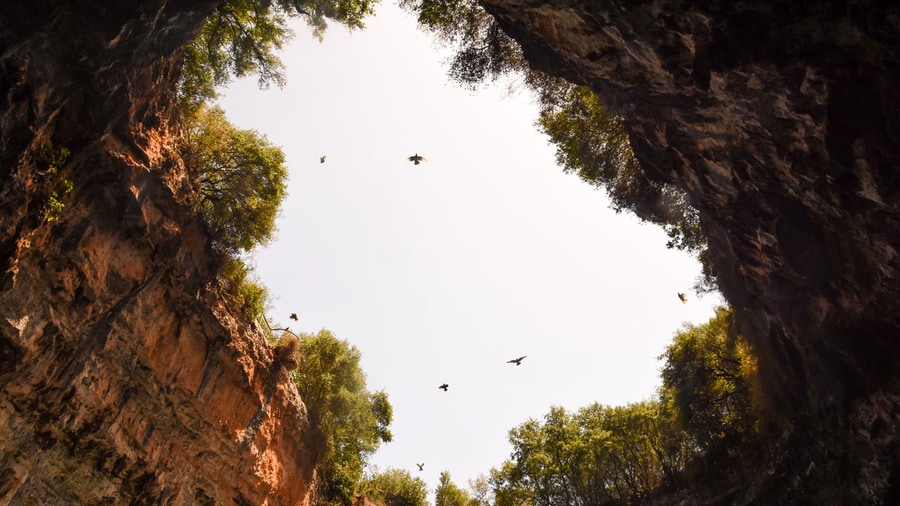
The roof of one hall caved in centuries ago, and daylight enters through an opening 36 m tall. A balcony above the cave looks down into it. The cave lies northwest of Sami. Karavomylos, south of the cave, lies 15 km northeast of Argostoli, the capital on the west side, so a Kefalonia island tour crosses the island to reach it.
- Setting: Forests surround the cave.
- Parking: Parking lots stand near the entry.
- Road: The Sami main road passes it.
The lake lies east of the mountains of Evmorfia and Agia Dynati, with the Ionian Sea and the Strait of Ithaca beyond. A Melissani cave tour runs through wooded ground between the ranges and the coast. Sami counts the cave as a major tourist attraction, and boat tours are offered there.


How was the cave of a Melissani cave tour formed?
A Melissani cave tour enters a karst cave, a space dissolved from limestone by weak carbonic acid. A collapse of the bedrock then opened the roof and made it a cenote, a sinkhole that exposes groundwater to the sky.
Karst is a landscape formed by the dissolution of limestone and similar rock. Rain picks up carbon dioxide, forms weak carbonic acid and dissolves calcium carbonate. Water enlarges fissures into openings, and the larger openings form conduits that drain the rock to springs. The lake of a Melissani cave tour is a typical karst feature of a coastal carbonate aquifer.
A cenote forms when limestone bedrock collapses and exposes groundwater. Melissani is a cenote of the kind described on the Yucatan peninsula in Mexico. A Melissani cave tour crosses the lake below the gap in the roof. In the dark chamber, stalactites carry algae and moss, and stalagmites are 20,000 years old.
No other Ionian island is larger than Kefalonia. It lies southeast of an active fault zone, where the Eurasian Plate meets the Aegean Plate, and thrust faults cause continuing uplift. Further cenotes with deep shafts lie in the bay of Sami, and huge karst conduits have been explored by speleo-divers.
- Depth: The lake is 20 to 30 meters deep.
- Opening: Plants grow at the cave mouth.
- Rock: Dolomite also dissolves into karst.
A Melissani cave tour crosses a lake shaped by two processes: the slow dissolution of limestone and a sudden fall of rock. The island sits in the heart of an earthquake zone, where dozens of minor tremors occur each year, and the thrust faults keep lifting the ground around the lake.
Why does the water glow blue on a Melissani cave tour?
A Melissani cave tour shows blue water because daylight pours through the opening in the roof and bounces off the clear lake. When the sun stands overhead at noon, the turquoise water makes the cave look lit with blue light.
On a Melissani cave tour, shafts of light stream in from above, bounce off the water and light up the first chamber. The water is clear enough that boats look as though they drift on air. Stones line the lake bottom, and the stone near the opening ranges from stucco to honey-like brown, which gives the pale light a warm backdrop.
The water is a mixture of fresh water and sea water. The lake lies about 500 m from the sea, and its surface stands 1 m above sea level. Brackish water enters at one end and flows out at the other, and springs below the surface replenish it. The groundwater leaves at Fridi beach, where it feeds coastal and submarine springs.
One source of the lake on a Melissani cave tour lies across the island. Near Argostoli, in the Vlikha area, sea water drains into sinkholes named katavothres. It travels under the island and re-emerges around fourteen days later at Karavomylos, after passing through Melissani lake. The distance filters the water, and the flow joins other sources of the brackish lake.
- Rays: Morning and evening light makes boats seem to hover.
- Sinkholes: They lie west of Argostoli.
- Mill: In 1835 the flow turned a mill.
A Melissani cave tour shows a colour that depends on light and water. Daylight and clear water make the blue, while the underground flow from the west coast is one source of the lake. The same water that sinks near Argostoli returns to the sea in the bay of Sami.
Which myths and finds does a Melissani cave tour recall?
A Melissani cave tour recalls the Cave of the Nymphs of Greek mythology. Myth ties the cave to the nymph Melissanthi and to the god Pan, and excavations there unearthed artifacts dating to the 3rd and 4th century BC.
Greek myth placed the Cave of the Nymphs at Melissani. Myth says the cave took its name from the nymph Melissanthi, who ended her life because the god Pan did not return her love. A Melissani cave tour therefore enters a place that carries the name of a nymph. Nymphs were spirits tied to one specific place, landform or tree.
Pan was the god of the wild, of shepherds and flocks and of rustic music, and kept company with the nymphs. Worshippers honoured him in natural settings such as caves and grottoes, not in temples. A cave lake east of the Evmorfia and Agia Dynati mountains fits that pattern. Pausanias found the shrines and sacred caves of Pan still frequented.
Excavations in the Melissani cave support the legend, because figures of nymphs came to light among the unearthed artifacts. The artifacts date to the 3rd and 4th century BC, so the tradition of nymphs in the cave is far older than modern tourism. Tourism is common there today, and a Melissani cave tour crosses the lake in a small boat.
- Dolphins: Stalactites resemble dolphins, companions of the nymphs.
- Ithaca: Vathy has another Cave of Nymphs.
- Museum: The Argostoli museum featured finds from Melissani Lake.
The Archaeological Museum of Argostoli, also known as the Kefalonia Museum, stands on R. Vergoti Street across from the Municipal Theater. The earthquake of 1953 destroyed the old building, and Patroklos Karantinos designed its successor of 1960. The earthquake of 2014 damaged that building, and construction of a new one started.
When was the cave on a Melissani cave tour discovered?
A Melissani cave tour visits a cave on Kefalonia that was rediscovered in 1951. Excavations followed in 1962 and unearthed artifacts, and speleo-divers have explored the vast karst channels of the cave, which lies in a coastal aquifer.
The cave was rediscovered in 1951. Two years later, on 12 August 1953, the Great Kefalonia earthquake struck the southern Ionian Islands. In mid-August the region between Kefalonia and Zakynthos recorded over 113 earthquakes, and the shock of 12 August caused the heaviest destruction. A Melissani cave tour therefore visits a site that was found again shortly before that sequence.
Archaeological work around Sami began long before the cave dig. Archived photographs at the museum in Argostoli show an excavation at Sami in 1899. The excavations at Melissani took place in 1962, eleven years after the rediscovery. In 1991 another dig uncovered a Mycenaean tomb near Poros. Their artifacts give credence to the legend that a Melissani cave tour recalls.
The channels belong to a karst environment on the coast of Kefalonia, and the bay of Sami holds more cenotes with impressive shafts. A GIS database lists them. The lake cave is a typical feature of that environment and a cenote of the kind described on the Yucatán peninsula in Mexico, and a Melissani cave tour reaches its water by boat.
- Path: An underground path leads to the boat.
- Balcony: A balcony overlooks the interior.
- Lights: Electric lights illuminate the dark chamber.
In 1953 the quake lifted Kefalonia by 60 cm, and the death toll across the islands stood between 445 and 800. Every building on Kefalonia fell except those in Fiskardo, and residents fled. The excavation of 1962 came nine years after that disaster, and a Melissani cave tour visits the cave.
What else does a Melissani cave tour visit nearby?
A Melissani cave tour sits near Drogarati Cave, the fishing village of Karavomylos, the port town of Sami and the village of Agia Efimia. Karavomylos stands 2 km west of Sami, and Agia Efimia lies north of the cave.
Chaliotata, one of six communities in the municipal unit of Sami, stands near Drogarati Cave. The two notable landmarks near Karavomylos are Drogarati and Melissani, and both draw tourists. Natural features that stand out on Kefalonia include the Koutavos Lagoon in Argostoli, the Drogarati caves and Melissani Lake. A Melissani cave tour and Drogarati share one corner of the island.
The fishing village of Karavomylos belongs to the municipal unit of Sami on Kefalonia. The village lies on the shore, 15 km northeast of Argostoli and 2 km west of Sami. The entrance to the lake cave lies almost midway along the main road that links Sami with Agia Efimia. A Melissani cave tour has Karavomylos as the nearest village.
Sami, a town and a municipality, occupies the middle of the east coast of Kefalonia. By the 6th century BC, Same was one of four cities on the island, and each minted its own coins. Boats from the major port of Sami reach Patras and Ithaca, so an Ithaca day trip can start on the coast that holds the cave.
- Harbour: Agia Efimia hosts flotilla sailing groups.
- Earthquake: Old buildings fell there in 1953.
- Caves: The Cave of Zervatis lies near Karavomylos.
Agia Efimia, which counted 638 residents in 2021, served as the seat of the former Pylaros municipality. Taverns, bars, shops and a wood-fired bakery serve tourism, now the main activity there. The cave lies 5 km southeast of Agia Efimia, so a Melissani cave tour sits between the village and Sami.
How does a Melissani cave tour reach the cave?
A Melissani cave tour reaches the cave by road through Sami, the east-coast town with the cave on its western side. Routes start in Argostoli, Lixouri, Fiskardo and Skala, and the tour runs as a small-group, private, bus or cruise excursion trip.
The Argostoli-Sami National Road, numbered EO50, begins in the capital. The Argostoli-Poros road serves the south, a separate road joins Poros to Sami, and the Argostoli-Fiskardo road serves the north with a link to Lixouri. Buses leave Argostoli for Poros, Sami, Skala and Fiskardo, though the service is infrequent.
Lixouri faces Argostoli over the water 4 km away, while a drive between the towns costs a 30 km detour, so a car ferry crosses the bay. Ferries from Sami sail to Patras and to Ithaca. Argostoli, the largest port, sends ferries to Zakynthos and Lixouri. A cruise excursion begins at a port and continues by road.
Kefalonia has one airport, named Anna Pollatou, in the southwest of the island and 8 km from Argostoli, where the Argostoli-Sami National Road begins. Athens is the main destination of scheduled flights. Upgrades after the 2015 privatisation added a new terminal building and extra car-hire companies.
- Small group: A limited party shares one vehicle.
- Private: One party books the whole vehicle.
- Bus: A coach carries a larger party.
- Cruise excursion: Ship passengers transfer by road.
The cave lies in the municipality of Sami, created in the 2019 reform. The 2021 census recorded 5,501 people in the municipality, which covers 291.2 km2 and has its seat in the town of Sami. Every road, ferry and flight arrival on Kefalonia therefore leads to the same municipality.
When is the best time for a Melissani cave tour?
A Melissani cave tour is best around midday, when the sun stands high over the opening in the roof and turns the lake blue. The cave season ends in October, and the months at both ends of the season suit visitors who want fewer crowds.
Daylight enters the cave through the opening in the roof. At noon the sun stands overhead, and its light strikes the turquoise water, so the chamber glows blue. The colours are strongest around midday. In the morning and evening, slanting rays cross the chamber, and the boats look as if they hover in the light.
The weather of Kefalonia follows the hot-summer Mediterranean pattern, coded Csa. Summers are sunny, and winters are mild and rainy. Summer brings little to no rain, afternoons close to 30 degrees Celsius and nights around 21 degrees. The cave is open for six months, closing after October, so a Melissani cave tour meets dry weather and a high sun.
- Winter days: Temperatures average 14 to 15 degrees Celsius.
- Winter nights: Temperatures fall to 8 to 9 degrees.
- Winter rain: Up to 156 mm falls, with high humidity.
The cave is popular, so the first two and the last two months of the season are the best choice to avoid the summer crowds. Summer is also the season of charter flights from across Europe and of the transit bus between the airport and Argostoli, so the island fills in the same months that the sun is highest.
Kefalonia is a popular holiday destination for Italians because of its closeness to Italy. Visitors first came in the early 19th century, yet the island stayed off the wider tourist map until the 1980s. The 2001 film Captain Corelli’s Mandolin made it better known, with filming centred on Antisamos Beach and the towns of Argostoli and Sami.
What do travelers ask about a Melissani cave tour?
A Melissani cave tour is a boat visit to a lake cave west of Sami, where boat tours are offered. The cave has two chambers, the first open to the sky and the second closed, and a rowing boat crosses both.
Can visitors swim during a Melissani cave tour?
A Melissani cave tour is a boat ride, not a swim. Visitors step into a rowing boat and drift across the lake. The lake holds brackish water, a mixture of freshwater and seawater, and reaches 20 to 30 metres deep.
Does a Melissani cave tour suit children?
A Melissani cave tour places visitors in a rowing boat. The passage into the second chamber is so narrow that the boatman can need to stop rowing, and that chamber is dark. Those conditions decide whether a child feels at ease.
Is a Melissani cave tour accessible?
A Melissani cave tour starts with a tunnelled entrance and a flight of steps down to the water, so the approach involves stairs. A balcony built on top of the cave gives a view of the interior from above. The boat follows the descent.
Are photos good on a Melissani cave tour?
The first chamber is sun-lit and photographs in blue and turquoise. The second chamber is dark and lit by electric lights, and its stalactites are covered with algae and moss. An island separates the two chambers, so both appear in one visit.
Can a Melissani cave tour combine with Drogarati or Myrtos?
Itineraries link a Melissani cave tour with the Drogarati cave and the villages of Fiscardo and Assos, or with Myrtos beach, Agia Effimia and the monastery of Agios Gerasimos. Melissani, Drogarati and Myrtos rank among the natural attractions that made Kefalonia popular.
Featured photo: Tony Hisgett, CC BY 2.0, via Wikimedia Commons.