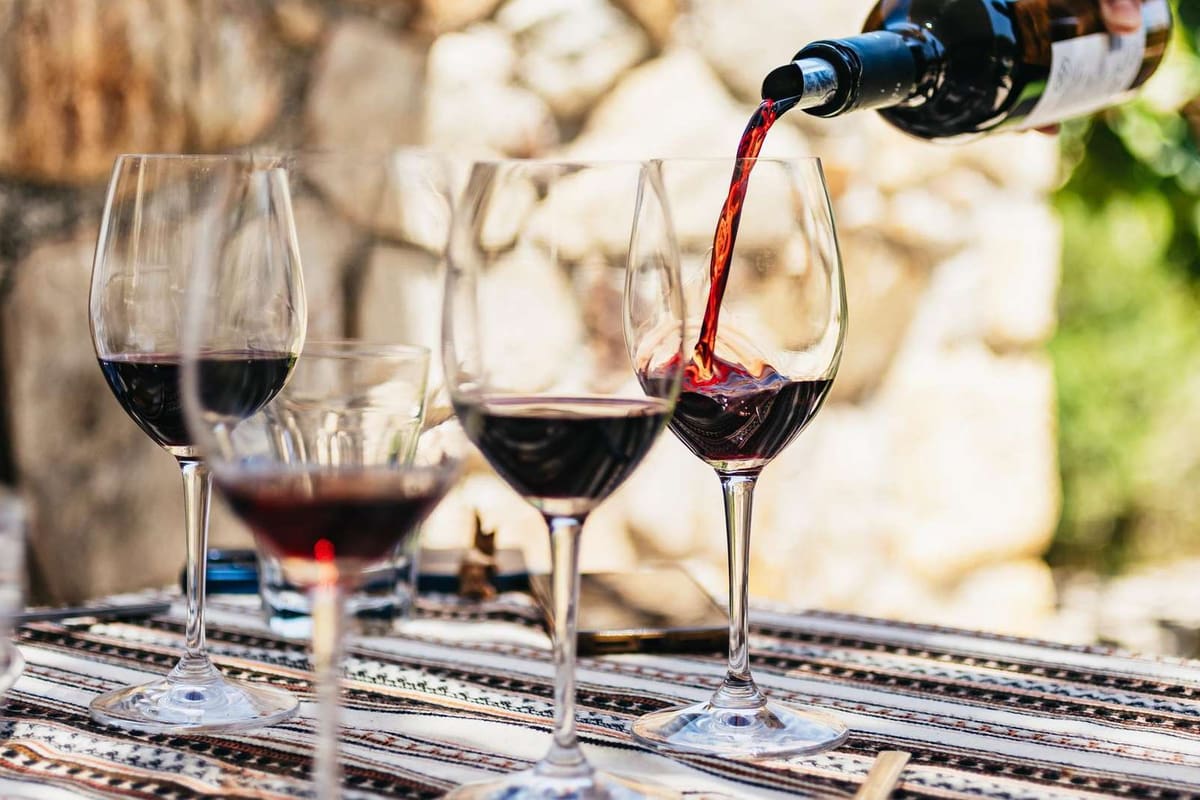
A Chania wine tour visits the vineyards and wineries of western Crete, from the coast to the foothills of the White Mountains. It is one of the wine tours in Greece on Greece VIP.
This post covers what a Chania wine tour includes, the grape varieties and the rules behind the labels. It also covers the wine villages, the land and the wine history of the area. How wine is made, the best season and common questions come last.
Each section ends with a Chania wine tour or a nearby tasting that can be booked online.
What does a Chania wine tour include?
A Chania wine tour includes tastings of wines from the Chania regional unit. ELSTAT counted 8,689 stremmata of wine vines there in 2023. They gave 8,758 tonnes of grapes for wine. PGI Chania covers dry, sweet, liqueur and sun-dried wines.
One stremma is 0.1 hectare, so the vines around a Chania wine tour cover 868.9 hectares.
A Chania wine tour crosses a PGI zone of 2,376 square kilometres. Its vineyards climb to above 700 metres, sitting mainly on north-facing slopes and plateaus.
PGI Chania whites and reds come dry, semi-dry, semi-sweet or sweet. A Chania wine tour can taste all four styles under the same regional name.
The ISO 3591 tasting glass has a rim 46 mm wide and a cup 100 mm tall. It is made of lead crystal with 9% lead.
One wine-education body advises 13 °C for light reds and 10–13 °C for fuller oaked whites. Soils in the PGI zone lean moderately alkaline, at pH 7.5.
Greek rules let only wineries in the prefecture or a neighbouring one make PGI Chania wine. The same prefecture also hosts the food tours in Chania.
- Table grapes: The unit held 90 stremmata of table-grape vines.
- Crete: The region held 46,481 stremmata of wine vines.
- 2011: The unit then held 15,732 stremmata of wine vines.
Liqueur and sun-dried wines once came with the meals of major Christian feasts. A Chania wine tour can taste them under the PGI Chania name.



Which grape varieties does a Chania wine tour taste?
A Chania wine tour tastes grapes such as Romeiko, Kotsifali, Mandilaria and Vilana. All four sit on the PGI Chania list of 15 varieties. Vidiano, Liatiko and Malvasia di Candia Aromatica appear on the PGI Crete list instead.
VIVC lists Romeiko as variety number 10182, with ten synonyms such as Mavro Kritis and Tsardana. DNA markers confirm its parents as Ladikino and Lagorthi.
A Chania wine tour also meets Kotsifali, VIVC number 6446, with eleven synonyms such as Korfiatis. Greece grew 1,264 hectares of it in 2008, says VIVC.
A peer-reviewed DNA study tested 51 vine samples of seven Cretan varieties kept at Messara. It named Kotsifali the leading native red wine grape of Crete.
A Chania wine tour can include Mandilaria, VIVC number 7300, with 41 synonyms. The DNA study places it in central Greece and the central Aegean.
Liatiko holds VIVC number 6829 and 26 synonyms. Leaf and berry traits grouped its samples with Kotsifali or Mandilaria, but DNA markers placed all six together.
Vilana, VIVC number 13078, also features on a Chania wine tour. DNA markers name Albanello as one parent. Vidiano holds number 13063 and five synonyms.
- Malvasia di Candia Aromatica: VIVC lists Italy as its origin.
- Moschato Spinas: VIVC files it under Muscat à Petits Grains Blancs.
- Romeiko: VIVC records 2,203 hectares in Greece in 1989.
The DNA study proposes that Moschato Spinas reached the Chania village of Spina from Samos. A Chania wine tour finds it in liqueur and sun-dried wines.
Which wine labels and rules cover a Chania wine tour?
A Chania wine tour meets two regional labels: PGI Chania and PGI Crete. The EU register protects PGI Chania from 20 December 2011 and PGI Crete from 16 April 2004. EU rules also set the sulphite warning on labels.
Under EU law, a PDO wine uses grapes only from its named area. A PGI wine needs at least 85% of its grapes from that area.
PGI Chania covers land above 30 metres across the prefecture, under EU file PGI-GR-A1059. A Greek ministerial decision of 24 December 2010 drew the zone.
PGI Chania caps red varieties at 12,000 kilograms of grapes per hectare and whites at 13,000. Wine output stops at 96 hectolitres per hectare for reds.
On a Chania wine tour, PGI Chania dry whites need at least 11.0% alcohol. Dry reds need 11.5%. Total sulphur dioxide in dry whites stops at 200 mg per litre.
A Chania wine tour also meets PGI Crete, file PGI-GR-A1605, with 27 varieties. A Greek decision bars its labels from naming Malvasia di Candia Aromatica.
Bottles on a Chania wine tour must state “contains sulphites” above 10 mg per litre. The EU rule dates from November 2005. Greek labels can use θειώδη.
- Alcohol: Strength shows in whole or half units with “% vol”.
- Ingredients: Wines made from 8 December 2023 must list ingredients and nutrition.
- E-label: Labels can show only energy as “E”, with details online.
Allergens such as sulphites must still appear on the bottle itself, after the word “contains”. Compulsory label details need letters at least 1.2 mm tall.
Which villages does a Chania wine tour visit?
A Chania wine tour visits villages in Platanias, Kissamos, Apokoronas, Kantanos-Selino and the Keramia hills. Vatolakkos, Voukolies and Kolymbari form the main wine tourism belt in the northwest. Malaxa, Alikambos, Lousakies and Spina sit between 260 and 740 metres.
A Chania wine tour reaches Vatolakkos, home to 640 people in 2021 at about 100 metres. An estate there grows Syrah and Grenache at 320–600 metres.
Voukolies, in Platanias, had 700 residents in 2021 and a significant Saturday market. Its unit runs from Tavronitis on the coast to the mountain foothills.
The Kissamos wine zone, set up in 1990, covers Voukolies, Kolymbari, Innachori, Kissamos and Mythimni. A Chania wine tour tastes its dry white, rosé and red wines.
Kolymbari, about 20 km from Chania, had 1,072 residents in 2021. Nearby Nochia and Afrata keep vineyards, and Vouves counts wine among its two strongest products.
Malaxa, in the Keramia hills of Chania municipality, sits at 470 metres with 150 residents in 2021. A Chania wine tour finds organic, low-yield vines in Keramia.
Spina, in Kantanos-Selino, lies at 740 metres and had just 9 residents in 2021. It gives its name to Moschato Spinas, a white grape grown in Chania.
- Alikambos: This Apokoronas village at 310 metres had 223 residents in 2021.
- Lousakies: This Kissamos village at 260 metres had 134 residents in 2021.
- 1583: A Venetian census found 261 people in Vatolakkos and 438 in Lousakies.
Malaxa had 497 residents in 1900, over triple the figure a Chania wine tour finds today.
How does the land shape a Chania wine tour?
A Chania wine tour crosses vineyards set mainly at 200 to 500 metres west of the city. Limestone and phyllite-quartzite rocks shape the ground. The White Mountains trap moist air and shield northern vineyard slopes from hot southern winds.
On a Chania wine tour, the highest plantings climb to about 900 metres. The main vineyards sit on the northern side of the prefecture.
The phyllite-quartzite rock group reaches its widest extent in western Crete. A Chania wine tour also crosses limestone soils, which give the prefecture its abundant springs.
Around Vatolakkos, limestone-heavy hill soils hold heat differently from sandy coastal plains. At Alikambos, vines grow on sloping, stony ground between the Cretan Sea and the mountains.
Souda airport logged 614.7 mm of rain a year over 96.6 rainy days in 1971–2000. A Chania wine tour in September faces just 15.2 mm of average rain.
The White Mountains capture moist currents from the Ionian Sea, raising rainfall. Temperature swings widen near the range. North and northwest winds prevail in autumn and winter.
A 2022 study used records of the Sultana table grape across Crete. It projects budbreak 7 to 8 days earlier by 2060, and 11 to 18 days by 2100.
- Sunshine: Souda logs 2,813.7 sun hours and an 18.1 °C yearly mean.
- Study sites: The budbreak study drew on records from 20 Cretan locations.
- Warming: South-east Mediterranean projections add 1.7 to 5.0 °C by 2100.
A Chania wine tour runs through the coolest and greenest prefecture on Crete.
What wine history does a Chania wine tour recall?
A Chania wine tour recalls Bronze Age Kydonia, where a tablet names Dionysus. Roman and Byzantine demand, a Venetian turn to olive oil, Ottoman wine taxes and phylloxera follow. Household cellars and bulk cooperatives preceded today’s protected wine zones.
Excavators on Kastelli hill found five Linear B tablets in 1989 and 1990. On Crete, such tablets had otherwise turned up only at the Knossos palace.
One tablet, KH Gq 5, records honey offered to Zeus and Dionysus. For a Chania wine tour, it shows Dionysus was a god by 1250 BC.
After the battle of Actium in 31 BC, Augustus set Kydonia free for its help. Romans coveted wines from the Chania area, and so did Byzantium.
Crete’s vineyards peaked in the 15th and 16th centuries under Venice. Then Spain made similar sweet wines, and glass bottles with cork let dry wines travel.
A Chania wine tour crosses land the Ottomans first surveyed in 1650, after Chania fell. Their code charged Muslims 20 akçe per dönüm for new vineyards.
Phylloxera reached Crete only in 1977 and wiped out vineyards now seen on wine tours across Crete. Nearly 20,000 acres of vines were replanted in 1988–1992.
- Olive oil: In the 17th century, Venice backed oil trade and presses.
- Customs law: A 1669 code let Christian traders ship wine at 4% duty.
- Cooperatives: A handful of large cooperatives once made Crete’s commercial wine in bulk.
On a Chania wine tour, old vineyards saved by household winemaking give concentrated wines.
How is wine made on a Chania wine tour?
A Chania wine tour follows grapes from gentle pressing to tanks and oak barrels. Cool tanks protect white aromas, while warm tanks pull color from red skins. Sulphur dioxide guards the wine, and long aging earns Reserve labels.
The OIV recommends gentle destemming, crushing and pressing. Rough handling releases oxidation enzymes and extra potassium, and the potassium lowers the acidity of the juice.
Cool fermentation at 6 to 10°C helps white wines keep delicate aromas. Red wines ferment warmer, between 20 and 32°C, which raises color and tannin.
Sulphur dioxide is an antiseptic and antioxidant. EU law caps it at 150 mg per liter in reds, 200 in whites. Sweeter wines get higher caps.
Lactic acid bacteria carry out malolactic fermentation once the yeasts finish. Adding these bacteria with the yeast can shorten the wait between the two stages.
Oak aging adds more than vanilla flavor to wine. Wines kept for years in barrel develop nutty notes, and slow oxygen contact can soften tannin.
Greek rules keep Reserve and Grande Reserve for PDO wines. A Reserve red needs three years, including six months in wood and six in bottle.
- Grande Reserve: Whites need three years, one in wood, one in bottle.
- SO2 timing: Winemakers add it at the end of fermentation.
- Bottles: The OIV favors green or brown glass.
Near Prinias in Crete, medieval presses called patitiri are cut into limestone.
When is the best season for a Chania wine tour?
September suits a Chania wine tour best, since mid-September brings Crete’s busiest harvest work. HCAA data for 2023 counted 268,821 passenger arrivals at Chania airport that month. July, the peak month, drew 342,399. That gap tops 73,000 travelers.
In 2023, August followed July with 303,036 arrivals. October dropped to 154,970, less than half the July total. February was the quietest month, with 27,386.
At the Chania airport weather station, September brings only 2.6 wet days on average. Rain then rises sharply in October, after the main harvest.
A Chania wine tour in the west pairs well with day trips to Elafonisi. One tasting tour from Chania stops at that beach and at Elos village.
In hot climates, growers can pick part of the crop before full ripeness. This double harvest yields sharper wine that lifts the main pick’s acidity.
The Nea Chora sardine festival in Chania runs from 1 to 10 September. It offers free sardines and wine, with dancing and music.
Orthodox Greeks honor Saint Tryphon, patron of winegrowers and gardeners, on 1 February. His feast gave February the folk name Aï-Tryphonas. Cretans also say Flegaris.
- Harvest mood: In Greek villages, the vintage took on the feel of a festival.
- Stavriatis: September’s other folk name honors the 14 September feast of the Cross.
- Treaders: Folk tradition called grape treaders patitades.
Vouves, near Kolymbari, holds a wine festival in late July or early August.
What do travelers ask about a Chania wine tour?
Travelers on a Chania wine tour ask about sweetness terms, organic rules, orange wine and label details. Others ask how grape must differs from wine. EU law defines each still-wine sweetness term by grams of sugar per liter.
What do sweetness terms mean on a Chania wine tour label?
EU law calls a still wine dry up to 4 g of sugar per liter. Dry stretches to 9 g if acidity sits within 2 g of the sugar. Medium dry reaches 12 g. Medium sweet ends at 45 g, where sweet begins.
What does organic mean for a Chania wine tour bottle?
EU organic winemaking rules apply from 1 August 2012. All raw material must be organic. Organic reds under 2 g of sugar hold up to 100 mg of sulphur dioxide per liter. Matching whites and rosés hold up to 150 mg per liter.
What is orange wine on a Chania wine tour?
Orange wine is white wine made with grape skins left in the juice for days or months. Its color comes from skin pigments. It is also called skin-contact white or amber wine. Georgian qvevri skin-contact winemaking revived after independence in 1991.
How does grape must differ from wine on a Chania wine tour?
EU law defines grape must as the liquid obtained naturally or by physical means from fresh grapes. Its actual alcohol strength stays at or below 1% vol. Must in fermentation holds more than 1% vol, yet less than three fifths of its total strength.
What does the vintage year on a Chania wine tour label mean?
A vintage year means at least 85% of the grapes were picked that year. Sweetening wine is left out of that count. Non-PDO, non-PGI wines need certification to show one. Grapes picked in January or February carry the previous year.
What do “bottled by” and the alcohol figure mean on a Chania wine tour label?
“Bottled by” names the bottler, its area and its country. The stated alcohol must match the wine closely. It stays within 0.5% vol of lab analysis. PDO or PGI wines kept in bottle over three years get 0.8%.