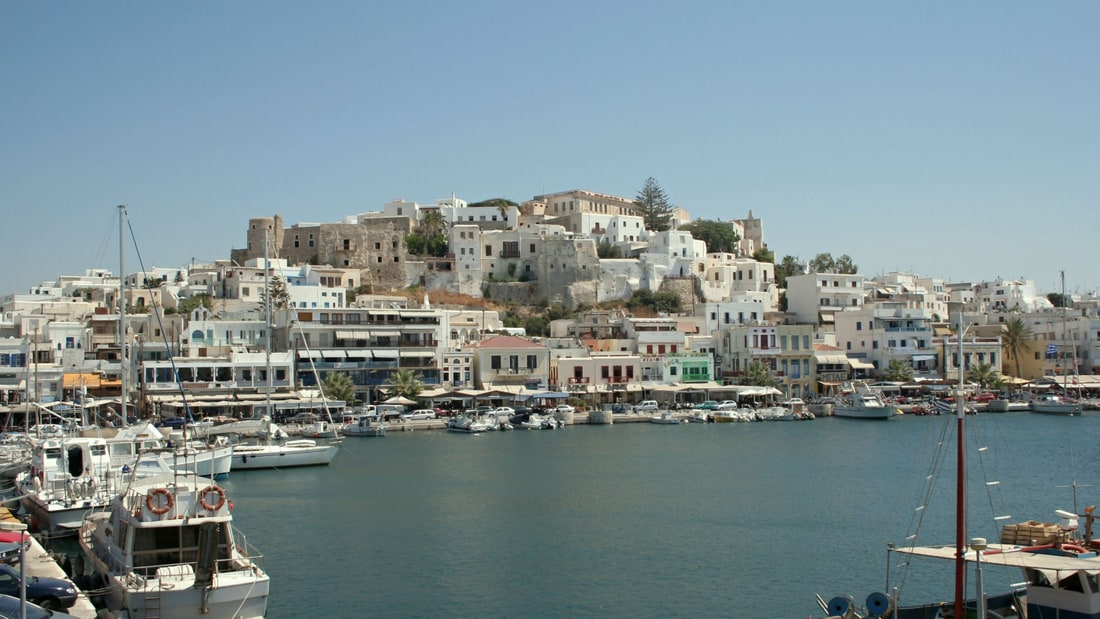
A Naxos cooking class spends a day in the kitchens of the largest island of the Cyclades, from farms in the inland villages to family taverns, cooking with island potatoes, olive oil, wild herbs and the local cheeses, then pouring a glass of kitron. This post covers what a Naxos cooking class includes, where classes are held, the produce, the cheeses, the dishes taught, kitron, the place of Naxos in Cycladic cooking and the best season. It is one of the cooking classes in Greece on Greece VIP.
Each section ends with a Naxos cooking class that can be booked online.
What does a Naxos cooking class include?
A Naxos cooking class combines three parts: the island’s farm produce, the cooking of Naxian dishes, and a shared meal at the end. Naxos suits this format because it is the largest island of the Cyclades and the one whose soil is fertile.
The Cyclades hold about 220 islands, and apart from Naxos their soil is not very fertile. Naxos is also the largest of them. The climate of the group is dry and mild, but the inland areas of Naxos are much wetter and cooler in winter because of their higher elevation. The agricultural produce of the Cyclades includes wine, fruit, wheat, olive oil and tobacco.
A Naxos tour is a sightseeing route across the island, from the harbour town to the mountain villages and the ancient sites. A Naxos cooking class stays in one kitchen and ends at the table. The tour moves between places, while the class works with food, from raw produce to the finished dishes. The class also adds a shared meal, where the cooks eat what they prepared.
- Produce: The class starts with the island’s farm produce.
- Cooking: A Naxos cooking class turns that produce into local dishes.
- Shared meal: The cooks eat together what they made.
The Neolithic culture of the Cyclades arose in the western Aegean before 4000 BCE and rested on emmer, wild-type barley, sheep, goats, pigs and tuna. Archaeology also reveals a farming and seafaring culture that had emigrated from Anatolia around 5000 BCE. A Naxos cooking class continues that farm tradition in a kitchen, from the produce to the shared meal.


Where is a Naxos cooking class held?
A Naxos cooking class is held on farms and in village kitchens across the fertile interior of the island, in the Tragea valley, Chalki, Filoti and Apeiranthos, and also in Naxos Town, the island’s capital on the west coast.
The municipal unit of Drymalia covers about 70 percent of Naxos, across the eastern, northern and southern parts of the island, and its seat, Chalkeio, lies at the centre. The unit had 4,889 inhabitants at the 2021 census. Filoti is its largest town, and the other large towns are Aperathos, Koronos, Damarionas and Koronis. A Naxos cooking class in the interior falls inside Drymalia.
Filoti has been classified as a traditional settlement since 1988. Its two old settlements keep paved labyrinthine streets, arches and covered walkways, and a hundred-year-old plane tree dominates the village square. The municipal community of Filoti extends over 92.79 square kilometres and has the largest acreage on Naxos. The village lives from farming and livestock, so a Naxos cooking class there sits in a farming village.
- Tragea valley and Chalki: Chalki, also written Halki, lies in Tragaia, and cultivation of the Greek citron concentrated there.
- Apeiranthos: The mountainous village had 722 inhabitants at the 2011 census, second only to Filoti.
- Naxos Town: Under the Dukes of Naxos, Bourgos housed mainly merchants, landowners and artisans, and Nio Chorio mainly poor peasants.
A Naxos cooking class therefore has a clear map. The Tragea valley, Chalki, Filoti and Apeiranthos make up the farming interior, where crops and livestock shape village life. Naxos Town marks the coast, where the capital stands. Either setting draws on the same island produce.
Which produce does a Naxos cooking class use?
A Naxos cooking class uses the farm produce of the island: Naxos potatoes, vegetables and fruit, olives and olive oil, and the dairy and meat of livestock. Naxos ranks as the island of the Cyclades with the highest self-sufficiency.
The fertile plains of Plaka, near the village of Tripodes in the south-west, support the cultivation of Naxos potatoes, vegetables, barley and vines. Olive oil is the defining and ancient element of Greek cuisine, and olives are also widely eaten. Filoti grows figs, grapes and, above all, olives, which give very good quality olive oil.
In Filoti, the leading production is free-range sheep and goats and their dairy products, because the terrain is mountainous. Greek terrain and climate favour goats and sheep over cattle. An ancient rock carving near the cave on Mount Zas reads Zeus Melosios, which names Zeus as the protector of the sheep. A Naxos cooking class draws on this livestock for its meat and dairy.
- Potatoes: Naxos is well known within Greece for its potatoes.
- Cattle: Cattle breeding forms part of the farming of Naxos.
- Olive oil: The agricultural produce of the Cyclades includes olive oil.
The livestock tradition of the mountain villages includes the pig. Every family bred one through the year and slaughtered it almost ritually on Tsiknopempti, a custom recorded in Filoti and observed mainly in the mountain villages of Naxos. The meat was processed in different ways so that it lasted for months. A Naxos cooking class therefore draws on crops, olives, flocks, cattle and household pork.
Which cheeses does a Naxos cooking class use?
A Naxos cooking class uses graviera of Naxos and Arseniko Naxou. Graviera of Naxos carries protected designation of origin in both the EU and the UK, and Arseniko Naxou is a cheese for which Naxos is well known within Greece.
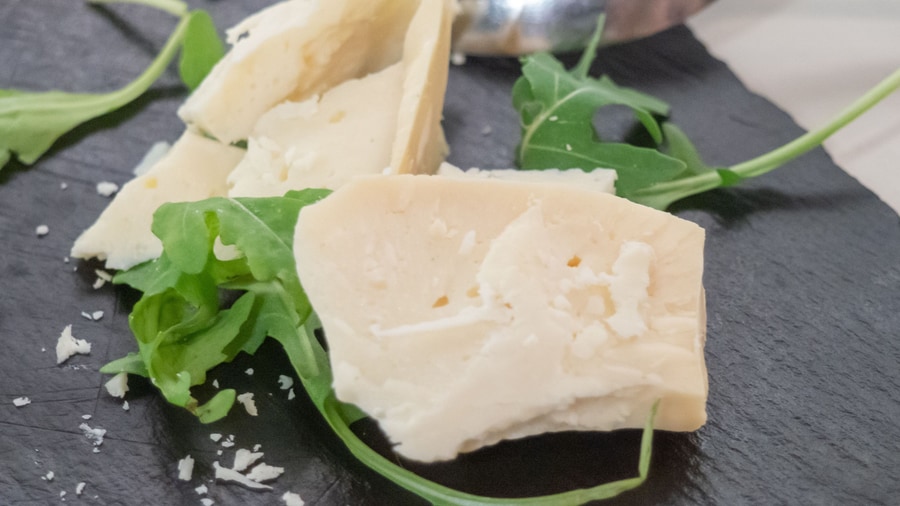
The name graviera comes from gruyère, the hard Swiss cheese that graviera resembles. Gruyère takes its name from the town of Gruyères in Fribourg. A Naxos cooking class that cooks with graviera works with the cheese that ranks second in popularity in Greece after feta. Gruyère can stand in for graviera, although graviera is homier.
Graviera Naxou is one of three graviera names registered as protected designation of origin, beside Graviera Kritis and Graviera Agrafon, in both the EU and the UK. A cheese can carry a protected name only when it comes from the designated region, and the European Commission maintains the register of protected names. In a Naxos cooking class, the name Graviera Naxou marks a cheese made on the island.
- Saganaki: the dish is named for the saganáki, a small frying pan.
- Cheeses: graviera, kefalograviera, halloumi, kasseri, kefalotyri and sheep’s milk feta all go in the pan.
- Serving: the melted cheese comes with lemon juice, pepper and bread.
Kefalograviera shares the saganaki pan with graviera. It is a hard table cheese of sheep’s milk or of sheep’s and goat’s milk mixed, with a salty flavour and a rich aroma. Cooks cut it into triangles, roll them in seasoned flour and fry them lightly. A Naxos cooking class that makes saganaki can use it, and it carries protected designation of origin in both the EU and the UK.
Which dishes does a Naxos cooking class teach?
A Naxos cooking class teaches dishes built on the produce of the island: potatoes, cheese and citron. Greek cuisine records potato fritters, baked potato with oregano, potato stew and tiropita, a cheese pie, and citron rind becomes a spoon sweet.
Naxos is well known within Greece for its potatoes, and Greek cuisine counts the potato among its important vegetables. Patatokeftedes are potato fritters. Ofti potato is a baked potato with coarse salt, dried oregano and olive oil, served with olives, chopped dried onion and lemon. Potatoes yachni simmers potatoes in a tomato sauce with onions, garlic, herbs and spices.
A second group of dishes in a Naxos cooking class holds the cheese pies. Tiropita means cheese pie in Greek, and bakers serve it in an individual-size free-form shape or as a larger pie that is portioned. Tiropitakia are mini cheese pies made with phyllo triangles stuffed with feta. Kolokithopita is a savory pie of pumpkin and feta between two layers of phyllo.
- Stifado: a wine or vinegar casserole of baby onions and tomatoes with pork among its meats.
- Skordalia: a garlic dip of mashed potatoes, olive oil, vinegar and raw garlic.
- Briam: a dish of eggplants, zucchini, onions, potatoes, tomatoes, garlic and parsley.
Citron rind has its own place among the sweets of a Naxos cooking class. Cooks halve the citron, remove the pulp and cut the thick rind into pieces. The pieces cook in sugar syrup into a spoon sweet called kítro glykó. Cooks dice the rind and candy it with sugar for cakes.
Why does a Naxos cooking class pour kitron?
A Naxos cooking class pours kitron because the citron liqueur of Naxos is traditionally drunk as a digestif, a drink served after a meal. Makers distil kitron from citron leaves and fruit, and the liqueur has a citrusy aroma and flavour.
Kitron comes in three varieties. The green variety is sweeter and holds less alcohol, at 30% ABV. The yellow variety is the strongest, at 36% ABV, and has the least sugar. The colourless variety sits between the two, at 33% ABV. A Naxos cooking class that pours kitron therefore meets a liqueur that ranges from 30% to 36% ABV.
The citron tree is similar to the lemon tree but stronger, and its fruit differs slightly in taste. The citron is a large fragrant citrus fruit with a thick, coarse rind. Its pulp is dry and holds a small quantity of juice, so the thick white rind forms the main content of the fruit. Kitron is a liqueur like limoncello, produced from citrons rather than lemons.
- Flavedo: the outer peel of the citron gives fragrance and zest.
- Cedrata: in Italy, a soft drink of that name is made from the fruit.
- Cedro: Italy also makes a dense and powerful citron liqueur called cedro or cedrello.
Kitron became fashionable in the early 1980s, yet a shortage of citron trees keeps it hard to find outside Naxos. Cultivation of the Greek citron concentrated in Halki, where a small production serves distillation, and citron trees stand on Corfu. Crete growers sell citrons as candied peel called succade. A Naxos cooking class therefore pours a liqueur that depends on a small crop.
How does a Naxos cooking class fit into Cycladic cooking?
A Naxos cooking class fits into Cycladic cooking as the farm branch of the island chain. Naxos has water, fertile ground and cattle, and the drier islands rely on wine and wheat while a Venetian duchy once ruled from Naxos.
Water separates Naxos from the other Cyclades. The group is dry and mild, and Naxos is the one island with fertile soil. Mount Zeus rises to 1,001 metres, the highest peak in the group, and traps clouds, so more rain falls. Vegetable and fruit crops and cattle breeding grow from that supply, which left Naxos self-sufficient. A Naxos cooking class cooks from that farm base.
The other islands work with less. The archipelago holds about 220 islands, and apart from volcanic Milos and Santorini, the islands are peaks of a submerged mountain range. A Mykonos food tour covers a neighbour outside the fertile exception. There the Ghisi brothers held Mykonos and Tinos and never accepted Sanudo’s rule, while Naxos was the seat of his duchy.
- Duchy: Sanudo conquered Naxos in 1205 to 1207.
- Law: Greek residents kept Byzantine civil law under Western feudal law.
- Trade: Venetians shipped Naxian corundum and marble to Venice.
Twenty-one dukes of two dynasties ruled the archipelago until 1566, and under Venetian rule the island carried the Italian name Nasso. Italian influence runs through Greek cuisine, whose borrowed dishes include pastitsio and stifado. A Naxos cooking class stands on a farm island with a Venetian past and a Greek kitchen.
When is the best season for a Naxos cooking class?
A Naxos cooking class has no single best season, because the island mixes a Mediterranean climate with a hot semi-arid one. Greek home cooking is built on seasonal vegetables, so the greens and herbs in the pot change as the year turns.
Naxos has a Mediterranean climate, coded Csa, in one set of places and a hot semi-arid climate, coded BSh, in another. Stations of the National Observatory of Athens report the semi-arid type for locations on the island. A Mediterranean climate means a dry summer and a wet winter, since the subtropical ridge moves poleward in summer and equatorward in winter.
Lathera are seasonal vegetables stewed with olive oil, herbs and tomato sauce, and the vegetables include green beans, peas, okra, cauliflower, spinach and leeks. Horta are boiled edible greens, such as endives, amaranth greens, chicory and chard, dressed with olive oil and fresh lemon juice. Spanakopita is a spinach and cheese pie, and kolokythopita is a zucchini pie.
- Dry summer: Thyme tolerates drought and feeds Naxian honey.
- Wet winter: Inland Naxos is much wetter and cooler in winter.
- Church calendar: Easter Sunday brings magiritsa, and Christopsomo is Christmas bread.
Olive oil shows the calendar too. Its composition varies with the cultivar, the altitude, the time of harvest and the extraction process, and Greek cooks use it in vegetable stews and horta dressings. A Naxos cooking class in any season therefore works with seasonal vegetables, honey and olive oil.
What do travelers ask about a Naxos cooking class?
A Naxos cooking class takes place on the largest island of the Cyclades, home to 20,578 people at the 2021 census, of whom 8,897 live in the capital, Chora. Its six main villages are Filoti, Apiranthos, Vivlos, Agios Arsenios, Koronos and Glynado.
Does a Naxos cooking class cater for vegetarians?
Greek cooking holds a wide list of meatless dishes. Appetizers include patatokeftedes, potato fritters, kolokithokeftedes, pumpkin fritters, and melitzanes tiganites, fried eggplants. Gigantes plaki are beans baked with tomato sauce and herbs, and hortopita is a filo pie filled with greens.
Can a Naxos cooking class include a farm visit?
In Byzantine times, as in antiquity, Naxos was celebrated for its agriculture and animal husbandry, and the 12th-century geographer al-Idrisi records extensive cattle raising on the island. Barley, vines, vegetables and Naxos potatoes are cultivated on the fertile plains of Plaka.
Where are the inland villages for a Naxos cooking class?
Filoti is a semi-mountainous village of central Naxos, at the foot of Mount Zas, at an altitude of 400 metres. Apeiranthos is a mountain village 28 kilometres north-east of the capital, on the foothill of Mount Fanari, between 650 and 700 metres.
Do travelers eat what they cook at a Naxos cooking class?
The cooked dishes make a complete Greek meal. Horiatiki salad combines tomatoes, cucumbers, onion, feta and olives, dressed with oregano and olive oil. Fasolada is a soup of dry white beans, olive oil and vegetables. Common dessert ingredients include nuts, honey and sesame.
Does a Naxos cooking class use olive oil and herbs?
Olive oil is the ancient, characteristic element of Greek cuisine, and olives are widely eaten. Greek cuisine leans on oregano, mint, garlic, onion, dill, cumin and bay laurel leaves more than other Mediterranean cuisines do. Basil, thyme and fennel seed are other common herbs.
Can a Naxos cooking class teach stuffed vegetables?
Stuffed dishes suit a home kitchen. Gemista, whose name means “filled with” in Greek, are bell peppers and tomatoes baked with a filling of rice, ground beef or both, with onions, mint, parsley and olive oil. Dolmades, also called dolmadakia or sarmadakia, are stuffed grape leaves.
Does a Naxos cooking class make moussaka or a dessert?
The modern Greek moussaka comes from the French-trained chef Nikolaos Tselementes, who joined an older eggplant dish to a French-style gratin topping. For dessert, loukoumades are fried balls of dough spiced with cinnamon and drizzled with honey.
Featured photo: Zde, CC BY-SA 4.0, via Wikimedia Commons.